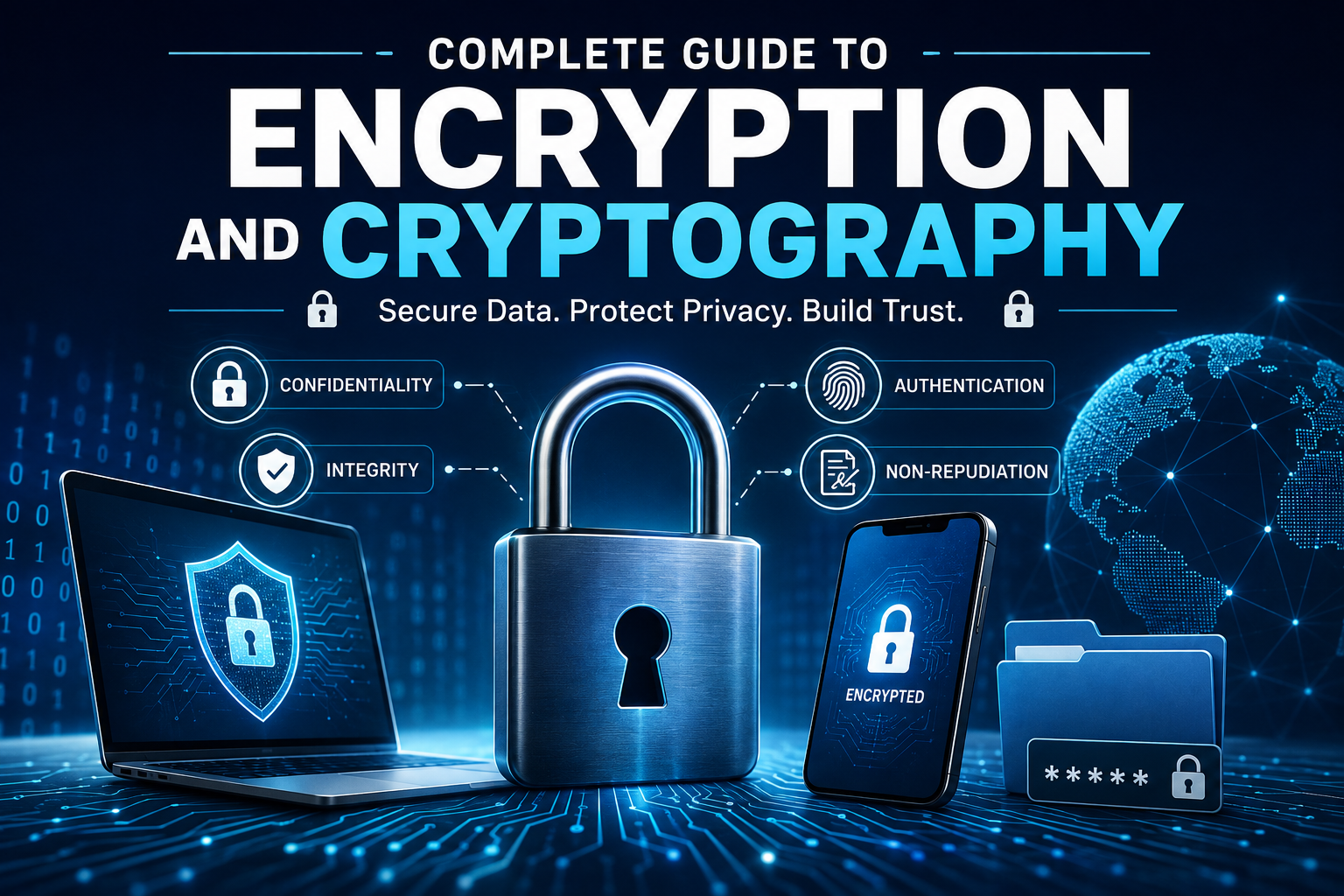
Complete Guide to Encryption and Cryptography
Encryption is one of the technologies quietly protecting modern digital life.
Every time someone visits a secure website, sends a private message, signs into online banking, stores a file in the cloud, connects to a business application, or makes a digital payment, cryptographic systems may be working in the background.
For businesses, encryption is especially important because sensitive information constantly moves between employees, devices, applications, servers, cloud platforms, customers, suppliers, and other organizations.
A strong cryptographic strategy can help protect that information if communications are intercepted, devices are lost, storage systems are compromised, or unauthorized parties gain access to protected data.
However, terms such as encryption, cryptography, hashing, digital signatures, public keys, private keys, certificates, TLS, and cryptographic keys can be confusing when encountered for the first time.
The underlying concepts are easier to understand once they are separated.
This guide explains what encryption and cryptography are, how different cryptographic techniques work, where businesses and individuals use them, how keys and certificates are managed, what common mistakes to avoid, and why cryptography is becoming increasingly important as digital threats and computing capabilities evolve.
For the broader cybersecurity picture, see the Ultimate Guide to Business Cybersecurity.
What Is Cryptography?
Cryptography is the use of mathematical techniques to protect information and communications.
Modern cryptography can provide several important security properties, including:
- Confidentiality — helping prevent unauthorized people from reading information.
- Integrity — helping detect whether information has been modified.
- Authentication — helping establish the identity of a communicating party or verify the origin of information.
- Non-repudiation — providing cryptographic evidence associated with certain digital actions or signatures.
- Privacy — helping limit unauthorized access to sensitive information.
Encryption is therefore one part of cryptography, rather than another word for the entire field.
Cryptography also encompasses hashing, digital signatures, key exchange, certificates, authentication mechanisms, and cryptographic protocols.
What Is Encryption?
Encryption is the process of transforming readable information, known as plaintext, into an encoded form called ciphertext.
The transformation uses an encryption algorithm and cryptographic key.
Conceptually:
Plaintext + Key + Encryption Algorithm → Ciphertext
The intended recipient or authorized system can then use the appropriate cryptographic information to recover the original data:
Ciphertext + Key + Decryption Process → Plaintext
For example, a message such as:
Meet me at the office at 10.
can be transformed into ciphertext that should be unintelligible to someone who does not possess the necessary cryptographic information.
Modern encryption is considerably more sophisticated than simply replacing one letter with another. It relies on carefully designed mathematical algorithms intended to make unauthorized recovery of the original information computationally impractical.
Why Encryption Matters for Cybersecurity
Businesses create, store, process, and transmit enormous quantities of sensitive information.
This can include:
- Customer records
- Employee information
- Financial information
- Password-related data
- Business documents
- Intellectual property
- Authentication credentials
- Source code
- Internal communications
- Contracts
- Backup data
- Personal information
If this information is exposed, attackers may attempt to use it for fraud, extortion, identity theft, espionage, or further compromise.
Encryption provides an additional layer of protection by making protected information significantly harder to understand without the appropriate cryptographic keys.
It is particularly valuable because no cybersecurity control is perfect.
A firewall may be bypassed.
A laptop may be stolen.
A cloud account may be compromised.
A backup may be copied.
A network connection may be monitored.
Encryption can help reduce the consequences when information falls outside its intended security boundary.
Encryption and Cryptography Are Not the Same
These terms are closely related but describe different concepts.
| Term | Meaning |
|---|---|
| Cryptography | The broader discipline of protecting information using mathematical techniques |
| Encryption | Transforming readable information into protected ciphertext |
| Decryption | Recovering readable information from ciphertext |
| Hashing | Producing a fixed-length representation of data |
| Digital signature | A cryptographic mechanism used to establish integrity and authenticity |
| Cryptographic key | Information used by a cryptographic algorithm to perform an operation |
| Certificate | A digitally signed structure that associates identity information with a public key |
Understanding these distinctions makes the rest of cryptography much easier to understand.
The Two Main Types of Encryption
Modern encryption is generally divided into two broad categories:
- Symmetric encryption
- Asymmetric encryption
Both protect information, but they solve different problems.
What Is Symmetric Encryption?
Symmetric encryption uses the same secret key, or related secret-key material, for encryption and decryption.
A simplified model looks like this:
Plaintext → Symmetric Encryption + Secret Key → Ciphertext
The recipient then uses the appropriate secret key to decrypt the ciphertext.
The major advantage of symmetric encryption is speed.
Symmetric algorithms are generally efficient enough to encrypt large quantities of information, which makes them useful for:
- File encryption
- Full-disk encryption
- Database encryption
- Cloud storage
- Network traffic
- Secure communications
- Backup systems
The major challenge is key distribution.
If two parties need to communicate securely using a shared secret, they need a secure way to establish that secret.
Common Symmetric Encryption Algorithms
AES
Advanced Encryption Standard (AES) is one of the most widely used symmetric encryption standards.
AES supports key sizes including:
- AES-128
- AES-192
- AES-256
It is widely used in storage encryption, applications, communications, enterprise systems, and other security technologies.
AES is often combined with an authenticated encryption mode such as GCM so that systems can protect confidentiality while also detecting unauthorized modification.
ChaCha20
ChaCha20 is another modern symmetric encryption algorithm.
It is designed to provide strong security and efficient software performance and is commonly encountered in modern secure communication systems.
ChaCha20 is often paired with Poly1305 to provide authenticated encryption.
What Is Asymmetric Encryption?
Asymmetric encryption, also known as public-key cryptography, uses a mathematically related pair of keys:
- A public key
- A private key
The public key can generally be distributed.
The private key must remain protected.
Public-key cryptography can be used for several purposes, including:
- Encryption
- Digital signatures
- Authentication
- Key exchange
- Certificates
- Identity verification
The ability to distribute a public key without revealing the corresponding private key is one of the most important ideas in modern cryptography.
How Public and Private Keys Work
Imagine that Alice wants to communicate securely with Bob.
Bob can make his public key available.
Alice can use Bob’s public key as part of a cryptographic process designed to protect information intended for Bob.
Bob keeps the corresponding private key secret.
Under the intended security assumptions, an attacker who knows the public key should not be able to feasibly derive the private key.
Public and private keys can also be used in the opposite conceptual direction for digital signatures.
In that case, the private key is used to create a signature and the public key is used to verify it.
Common Public-Key Cryptographic Systems
Several important public-key cryptographic families have been used in modern computing.
RSA
RSA is one of the best-known public-key cryptosystems.
It has historically been used for:
- Digital signatures
- Authentication
- Encryption
- Key exchange
RSA relies on mathematical properties related to integer factorization.
Because public-key cryptography is generally more computationally expensive than symmetric encryption, RSA is not normally used to encrypt large volumes of data directly.
Instead, modern systems often use public-key cryptography to establish or protect a symmetric session key and then use symmetric encryption for the actual data.
Elliptic Curve Cryptography
Elliptic Curve Cryptography (ECC) uses mathematical structures involving elliptic curves.
ECC can provide strong security with comparatively smaller keys than traditional RSA systems at similar security levels.
Elliptic-curve cryptography is used in areas such as:
- Digital signatures
- Key exchange
- Secure communications
- Mobile computing
- Embedded systems
Examples include ECDSA and ECDH.
Post-Quantum Cryptography
Post-quantum cryptography (PQC) is the development of cryptographic algorithms designed to remain secure against attacks from sufficiently capable quantum computers.
The concern is primarily associated with certain public-key cryptographic systems whose mathematical assumptions could eventually be threatened by quantum algorithms.
This does not mean that today’s encryption has already been broken by quantum computers.
Instead, organizations are preparing for a potential future in which existing public-key systems may no longer provide an adequate security margin.
What Is Hybrid Encryption?
Modern secure systems commonly combine symmetric and asymmetric cryptography.
This is often described as hybrid cryptography.
A simplified process looks like this:
- A temporary symmetric session key is generated.
- Symmetric encryption protects the actual data.
- Public-key cryptography helps establish or protect the session key.
- Both parties use the session key for efficient communication.
This approach combines the strengths of both cryptographic models.
Symmetric encryption provides efficiency.
Asymmetric cryptography helps with key exchange and authentication.
This general architecture is fundamental to many secure communication systems.
What Is a Cryptographic Key?
A cryptographic key is information used by a cryptographic algorithm to perform a security operation.
Depending on the system, keys can be used to:
- Encrypt information
- Decrypt information
- Generate digital signatures
- Verify digital signatures
- Establish shared secrets
- Authenticate systems
- Protect other cryptographic keys
The security of a cryptographic system therefore depends on much more than selecting a strong algorithm.
Keys must also be:
- Generated securely
- Stored securely
- Distributed appropriately
- Accessed only by authorized systems
- Rotated when necessary
- Revoked when compromised
- Backed up when appropriate
- Destroyed securely when no longer needed
This is known as cryptographic key management.
Why Key Management Matters
Consider a company that encrypts its customer database using a strong encryption algorithm.
If the encryption key is stored insecurely next to the database, an attacker who obtains both may be able to access the protected information.
This demonstrates an important principle:
Strong encryption cannot compensate for weak key management.
Effective key management can include:
- Secure key generation
- Key storage
- Access restrictions
- Key rotation
- Key backup
- Key recovery
- Key revocation
- Key destruction
- Monitoring
- Separation of duties
Larger organizations may use dedicated systems such as Hardware Security Modules (HSMs) and key-management services to protect cryptographic keys.
What Is Hashing?
Hashing is related to cryptography but is different from encryption.
A cryptographic hash function takes input data and produces a fixed-length output called a hash or digest.
Conceptually:
Input Data → Hash Function → Fixed-Length Digest
A properly designed cryptographic hash function is intended to make it computationally impractical to reconstruct the original input directly from the digest.
Hashing can be useful for:
- Data integrity
- File verification
- Digital signatures
- Password storage
- Content identification
- Detecting changes to information
Hashing is therefore primarily about representing information and detecting changes, rather than keeping information confidential.
Encryption vs. Hashing
| Feature | Encryption | Hashing |
|---|---|---|
| Primary purpose | Confidentiality | Integrity and data representation |
| Reversible | Yes, using appropriate cryptographic information | Designed to be one-way |
| Uses a key | Generally yes | Conventional cryptographic hashes do not |
| Output | Ciphertext | Fixed-length digest |
| Common use | Files and communications | Password systems and integrity verification |
| Original data recovered? | Yes, through decryption | Not normally |
One of the most common cryptography misconceptions is that hashing is simply another form of encryption.
It is not.
How Passwords Should Be Protected
Passwords generally should not be stored in plaintext.
They should instead be processed using dedicated password-hashing or password-based key-derivation techniques designed to make password guessing expensive.
Common approaches include:
- Argon2
- bcrypt
- scrypt
- PBKDF2
These systems generally use a salt and deliberately configured computational work.
The objective is to make stolen password databases substantially more difficult to attack efficiently.
This is different from simply running a password through a fast general-purpose hash function.
For broader account protection, businesses should also consider multifactor authentication, access controls, and identity security. See the Complete Guide to Identity and Access Security for a broader look at protecting identities and access.
What Is a Salt?
A salt is additional unique data incorporated into a password-hashing process.
Conceptually:
Password + Unique Salt → Password-Hashing Function → Stored Hash
A unique salt helps prevent attackers from efficiently using precomputed tables against large collections of password hashes.
It also means that two users who happen to choose the same password can still have different stored hash values.
The salt itself does not need to be kept secret in the same way as a password or cryptographic key.
What Is a Digital Signature?
A digital signature is a cryptographic mechanism that helps establish the integrity and authenticity of digitally signed information.
A simplified signing process can look like:
Message → Hash → Digital Signature Using Private Key
The recipient can then use the corresponding public key to verify the signature.
Digital signatures are commonly used for:
- Software signing
- Code distribution
- Digital documents
- Authentication
- Certificates
- Secure communications
- Financial systems
A valid digital signature can provide evidence that the signed data corresponds to the information that was signed and that the signature was created using the associated private key.
Encryption vs. Digital Signatures
These technologies solve different security problems.
Encryption primarily protects confidentiality.
Digital signatures primarily help establish authenticity and integrity.
For example, encrypting a document can prevent unauthorized people from reading it.
Signing a document can help recipients determine whether it was modified and whether the signature corresponds to a particular private key.
A secure system can use both technologies simultaneously.
What Is Authenticated Encryption?
Encryption by itself does not necessarily provide protection against unauthorized modification.
Modern systems therefore frequently use authenticated encryption.
Authenticated encryption is designed to provide:
- Confidentiality
- Integrity
- Authentication of the encrypted data
Common examples include:
- AES-GCM
- ChaCha20-Poly1305
These approaches produce encrypted information together with authentication information that allows the receiving system to detect unauthorized modification.
This makes authenticated encryption particularly useful for secure communications and applications.
What Is End-to-End Encryption?
End-to-end encryption (E2EE) is a communication model in which information is encrypted at the sender’s endpoint and remains protected until it reaches the intended recipient’s endpoint.
A simplified model is:
Sender → Encryption → Encrypted Communication → Decryption → Recipient
The intended security property is that intermediaries transporting the communication should not be able to read its plaintext contents.
However, end-to-end encryption does not necessarily hide all information associated with a communication.
Depending on the system, metadata such as:
- Account information
- Device information
- Timestamps
- Connection information
- Communication patterns
may still be visible.
The precise privacy properties therefore depend on how the particular system is designed and implemented.
Encryption in HTTPS
When you visit a website using HTTPS, your browser typically establishes a secure connection using Transport Layer Security (TLS).
TLS can provide:
- Confidentiality
- Integrity
- Server authentication
- Protection against certain network interception attacks
A simplified process looks like:
Browser → TLS Handshake → Server Authentication → Session Establishment → Encrypted Communication
Modern TLS connections use a combination of asymmetric cryptography and symmetric cryptography.
Public-key cryptography helps establish trust and negotiate secure session parameters, while symmetric cryptography efficiently protects the data exchanged during the session.
For a broader understanding of the systems that protect network communications, see the Complete Guide to Network Security.
What Are Digital Certificates?
A digital certificate is a digitally signed structure that associates identity-related information with a public key.
Websites commonly use certificates as part of HTTPS.
When a browser connects to a secure website, the certificate helps the browser determine whether the website’s cryptographic identity has been issued through a trusted certificate authority.
Certificates can contain information such as:
- Domain names
- Public keys
- Validity periods
- Certificate issuer
- Digital signatures
- Other identity-related information
Certificates are an important component of the trust infrastructure behind secure web communication.
What Is a Certificate Authority?
A Certificate Authority (CA) is an organization or system that issues and manages digital certificates within a public-key infrastructure.
Browsers and operating systems maintain collections of trusted certificate authorities.
When a certificate chain validates successfully, a browser can establish greater confidence that the public key presented by a website has been issued within a trusted certificate system for the expected domain.
This helps prevent attackers from simply presenting their own public key while impersonating a legitimate website.
What Is Public-Key Infrastructure?
Public-Key Infrastructure (PKI) is the collection of technologies, policies, procedures, and systems used to manage public-key cryptography and digital certificates.
PKI can involve:
- Certificate authorities
- Registration authorities
- Digital certificates
- Public and private keys
- Certificate policies
- Certificate validation
- Certificate revocation
- Identity verification
Organizations can use PKI for:
- Secure websites
- Device authentication
- Enterprise authentication
- Digital signatures
- Secure email
- Application security
- Internal services
What Is a Cryptographic Protocol?
A cryptographic algorithm is not the same thing as a complete security protocol.
A cryptographic protocol defines how cryptographic algorithms and other security mechanisms interact to achieve a particular security objective.
A secure communications protocol may define:
- How parties identify one another.
- How cryptographic parameters are negotiated.
- How keys are established.
- How messages are encrypted.
- How message integrity is verified.
- How sessions are maintained and terminated.
This distinction matters because a strong cryptographic algorithm can still be used incorrectly inside a poorly designed system.
Cryptographic security therefore depends on the algorithm, protocol, implementation, configuration, and key management process.
Encryption at Rest vs. Encryption in Transit
Organizations commonly protect information in two important states.
Encryption at Rest
Encryption at rest protects information while it is stored.
Examples include:
- Hard drives
- Databases
- Cloud storage
- Backup systems
- USB drives
- Smartphones
- Server storage
Encryption in Transit
Encryption in transit protects information while it moves between systems.
Examples include:
- HTTPS traffic
- API communications
- Secure messaging
- Internal network communications
- Remote connections
- Secure email connections
A mature data-protection strategy often needs both.
Encryption Protection Compared
| Protection | Main Purpose | Example |
|---|---|---|
| Encryption at rest | Protect stored information | Encrypted laptop drive |
| Encryption in transit | Protect moving information | HTTPS connection |
| End-to-end encryption | Protect communication contents between endpoints | Private messaging |
| Database encryption | Protect stored records | Encrypted customer database |
| File encryption | Protect individual files | Encrypted business document |
Protecting only one state can leave important security gaps.
How Encryption Supports Business Cybersecurity
Encryption should not be treated as an isolated technology.
It works alongside other cybersecurity controls.
A business may combine encryption with:
- Identity and access management
- Multifactor authentication
- Network segmentation
- Endpoint protection
- Application security
- Vulnerability management
- Security monitoring
- Backup and recovery
- Security awareness
- Incident response
This layered approach is important because encryption protects information, but it does not automatically stop every way an attacker can compromise a business.
For example, an attacker who steals valid credentials may be able to access data through legitimate systems.
Similarly, malware running on an already authenticated device may access information that the user is authorized to see.
For that reason, encryption should be part of the wider security architecture described in the Ultimate Guide to Business Cybersecurity.
Encryption and Application Security
Encryption is also closely connected to software and application security.
Applications frequently process:
- Authentication credentials
- Customer information
- Payment information
- API keys
- Business records
- Session information
- Confidential files
Developers therefore need to consider how information is protected while it is stored and transmitted.
Poor implementation can undermine otherwise strong cryptographic algorithms.
Common application-level mistakes include:
- Hard-coding secret keys
- Improper certificate validation
- Using outdated cryptographic algorithms
- Misconfiguring TLS
- Storing passwords incorrectly
- Exposing secrets in source code
- Reusing cryptographic material improperly
Businesses developing or operating software should therefore treat cryptography as one component of a broader application-security strategy.
The Guide to Software Security provides additional context on protecting software systems from security threats.
How Businesses Should Approach Encryption
A mature business encryption strategy should answer several practical questions.
What Information Needs Protection?
Organizations should identify sensitive information and classify it according to its importance and risk.
Where Is the Information Stored?
Businesses should identify:
- Databases
- Cloud storage
- Employee devices
- Servers
- Backup systems
- Removable media
Where Does the Information Travel?
Organizations should understand how information moves between:
- Users
- Applications
- Servers
- Cloud services
- Customers
- Partners
Who Can Access the Information?
Encryption does not replace authorization.
Organizations still need appropriate identity and access controls.
Where Are Encryption Keys Stored?
Keys should receive appropriate protection and should not simply be stored alongside the data they protect.
Who Can Manage the Keys?
Access to key-management systems should be restricted and monitored.
What Happens If a Key Is Compromised?
Organizations should have procedures for revoking, replacing, and rotating affected keys.
What Happens If a Key Is Lost?
Critical encryption systems need appropriate recovery procedures so that legitimate users do not permanently lose access to important information.
Common Encryption Mistakes
Strong cryptography can still fail because of poor implementation.
Using Outdated Algorithms
Legacy algorithms may no longer provide an appropriate security margin.
Organizations should periodically review their cryptographic technologies and replace obsolete systems where practical.
Hard-Coding Encryption Keys
Embedding secret keys directly into application source code can expose them through:
- Source repositories
- Developer systems
- Application packages
- Automated scanning
- Logs
- Compromised development environments
Secrets and keys should instead be managed using appropriate security mechanisms.
Reusing Keys Indefinitely
Long-lived cryptographic keys can increase the consequences of compromise.
Appropriate key-rotation policies can reduce exposure.
Encrypting Primary Data but Ignoring Backups
A production database may be encrypted while older backup copies remain poorly protected.
Encryption should therefore be considered across the entire information lifecycle.
Storing Passwords with Ordinary Hashes
Passwords need dedicated password-hashing techniques rather than simply applying a fast general-purpose hash function.
Creating Your Own Cryptographic Algorithm
Designing secure cryptographic algorithms is extraordinarily difficult.
Organizations should generally rely on well-studied cryptographic standards and established libraries rather than inventing their own encryption systems.
Assuming Encryption Solves Everything
Encryption does not automatically prevent:
- Phishing
- Malware
- Social engineering
- Credential theft
- Weak passwords
- Vulnerable applications
- Insider threats
- Excessive permissions
- Compromised endpoints
Encryption is one layer within a broader cybersecurity strategy.
Cryptographic Key Rotation
Cryptographic keys may eventually need to be replaced.
Key rotation can be necessary because:
- A key has reached the end of its intended lifetime.
- A key may have been exposed.
- Security requirements have changed.
- An organization is migrating systems.
- An algorithm or configuration is being retired.
A key-rotation process should account for how existing encrypted data will continue to be accessed.
Simply generating a new key is not enough.
Organizations need to understand:
- Which systems use the old key
- Which data was encrypted with it
- How new data will be encrypted
- How old data will be migrated
- How compromised keys will be revoked
- How old keys will eventually be retired
What Is Cryptographic Agility?
Cryptographic agility is the ability of a system or organization to replace cryptographic algorithms, keys, protocols, and configurations without having to completely rebuild the environment.
This matters because cryptographic standards evolve.
A system that permanently depends on one algorithm can become difficult to update when that algorithm becomes outdated or a new security requirement emerges.
Cryptographic agility can make it easier to:
- Replace outdated algorithms
- Introduce stronger technologies
- Rotate keys
- Respond to newly discovered vulnerabilities
- Adopt post-quantum cryptography
- Meet changing requirements
Long-lived applications should consider cryptographic agility during architecture and development.
The Threat of Quantum Computing
Quantum computing represents an important long-term consideration for cryptography.
Some public-key cryptographic systems rely on mathematical problems that sufficiently capable quantum computers could potentially solve much more efficiently than classical computers.
This creates a migration challenge for organizations that need to protect sensitive information for many years.
One related concern is sometimes described as “harvest now, decrypt later.”
In this scenario, an attacker collects encrypted information today and attempts to decrypt it in the future when more powerful technology becomes available.
This may be particularly relevant to information with a long confidentiality lifespan, including:
- Government information
- Financial records
- Intellectual property
- Research data
- Sensitive business information
- Long-term strategic information
Post-quantum cryptography is therefore becoming an increasingly important area of long-term cybersecurity planning.
How Individuals Can Use Encryption
People do not need to be cryptography experts to benefit from encryption.
Several practical measures can improve everyday protection.
Use Devices With Built-In Encryption
Modern smartphones and computers commonly provide storage-encryption capabilities.
Users should keep operating systems updated and enable appropriate device-security features.
Use HTTPS
When entering sensitive information online, make sure the connection is protected by HTTPS and pay attention to browser security warnings.
However, remember that HTTPS does not automatically mean a website is trustworthy.
A fraudulent website can also use HTTPS.
Use Secure Messaging
For highly private conversations, consider services that provide strong end-to-end encryption.
Understand the provider’s security and privacy model rather than assuming that all messaging services offer identical protection.
Protect Accounts
Encryption cannot compensate for an account that an attacker can access using stolen credentials.
Use:
- Strong, unique passwords
- A reputable password manager
- Multifactor authentication
- Security keys where appropriate
- Secure account-recovery methods
Protect Backups
Important documents should not exist only on one device.
Backups should be protected against both hardware failure and unauthorized access.
Encryption and Mobile Devices
Smartphones contain enormous amounts of potentially sensitive information.
They may store:
- Messages
- Photographs
- Documents
- Password-related information
- Authentication tokens
- Contacts
- Business applications
- Location information
Device encryption can help protect stored information if the device is lost or stolen.
However, encryption should be combined with:
- Strong device authentication
- Automatic updates
- Secure applications
- Screen-lock protection
- Account security
- Remote-management capabilities where appropriate
Encryption protects stored information, but it does not eliminate every threat to a compromised mobile device.
Encryption and Cloud Computing
Cloud environments introduce additional considerations because information may be distributed across multiple systems and services.
Businesses may need to consider encryption for:
- Cloud storage
- Databases
- Backups
- Virtual machines
- APIs
- Application traffic
- Cloud-to-cloud communication
Organizations also need to understand who controls the encryption keys.
Depending on the service, keys may be managed by the provider, the customer, or a combination of both.
The correct approach depends on the organization’s security requirements, threat model, architecture, and contractual obligations.
Encryption and Data Security
Encryption is one component of a broader data-security strategy.
A business needs to understand:
What data does it have?
Where is that data located?
Who can access it?
How does it move?
How long should it be retained?
How is it backed up?
How is it eventually deleted?
Encryption can protect information during storage and transmission, but effective data security also requires access control, data classification, monitoring, retention policies, backups, and secure disposal.
How Encryption Fits Into a Layered Security Strategy
A useful way to understand encryption is to view it as one layer in a larger defense system.
For example:
Identity Controls → Access Controls → Network Security → Encryption → Monitoring → Backup and Recovery
Each layer addresses different risks.
Identity controls determine who a user is.
Access controls determine what that user can access.
Network controls regulate communications.
Encryption protects information from unauthorized disclosure and modification in appropriate contexts.
Monitoring helps detect suspicious activity.
Backups help organizations recover when systems or information are damaged.
This is why encryption should not be evaluated in isolation.
Common Questions About Encryption and Cryptography
Is Encryption the Same as Cybersecurity?
No.
Encryption is one cybersecurity technology.
Cybersecurity encompasses a much broader range of practices, including network security, application security, endpoint security, identity management, vulnerability management, security monitoring, incident response, risk management, and data protection.
Can Encrypted Data Be Hacked?
Attackers can attempt to compromise encrypted systems in many ways.
They may attempt to:
- Steal encryption keys
- Guess passwords
- Exploit vulnerable implementations
- Compromise endpoints
- Exploit outdated algorithms
- Attack authentication systems
- Use social engineering
Strong modern encryption makes directly defeating the underlying mathematics extremely difficult when properly implemented, but encryption does not make an entire system invulnerable.
Can Encryption Be Broken?
Some cryptographic algorithms have been broken, weakened, or deprecated over time.
Others remain considered secure when used correctly with appropriate parameters.
Security therefore depends on:
- The algorithm
- Key size
- Implementation
- Configuration
- Key management
- Protocol
- Threat model
- Current cryptographic knowledge
Is AES-256 Always Better Than AES-128?
Not necessarily.
Both can provide strong security when appropriately implemented.
The correct choice depends on factors such as the application’s requirements, performance considerations, security standards, and expected lifespan of the protected information.
Is Hashing Reversible?
A properly designed cryptographic hash function is intended to make direct recovery of the original input computationally infeasible.
However, attackers can guess likely inputs and compare their resulting hashes.
This is why password storage requires specialized password-hashing techniques.
Does Encryption Completely Protect Privacy?
No.
Encryption can strongly protect the confidentiality of information, but privacy involves much more than encryption.
Metadata, account information, device identifiers, collection practices, and other information may remain visible depending on the system.
What Happens If an Encryption Key Is Lost?
The answer depends on the encryption system.
If no appropriate recovery mechanism exists and the key is genuinely lost, encrypted information may become permanently inaccessible.
This is why responsible key management needs carefully designed backup and recovery procedures.
A Simple Mental Model for Modern Cryptography
The easiest way to understand cryptography is to think of it as a toolbox rather than one technology.
Encryption protects confidentiality.
Hashing helps establish integrity and supports secure password storage.
Digital signatures help establish authenticity and integrity.
Public-key cryptography helps solve identity and key-exchange problems.
Symmetric encryption efficiently protects large amounts of information.
Certificates and PKI help establish trust between systems.
Authenticated encryption combines confidentiality with protection against unauthorized modification.
Together, these technologies form a major part of the cryptographic foundation of modern digital infrastructure.
Building a Stronger Business Encryption Strategy
Businesses can approach encryption systematically.
Step 1: Identify Sensitive Information
Determine which information requires protection and classify it according to business importance and risk.
Step 2: Map the Data Lifecycle
Understand where information is:
- Created
- Stored
- Processed
- Transmitted
- Backed up
- Archived
- Deleted
Step 3: Identify Cryptographic Requirements
Determine where encryption, hashing, digital signatures, certificates, or other cryptographic mechanisms are appropriate.
Step 4: Protect Cryptographic Keys
Establish appropriate controls for key generation, storage, access, rotation, recovery, revocation, and destruction.
Step 5: Review Cryptographic Algorithms
Identify outdated or unnecessary cryptographic technologies and establish a process for replacing them.
Step 6: Protect Applications and Endpoints
Make sure cryptographic controls are implemented correctly in software, servers, computers, and mobile devices.
Step 7: Monitor and Test
Review configurations, investigate unusual activity, test security controls, and verify that cryptographic protections work as intended.
Step 8: Prepare for Future Changes
Consider cryptographic agility and future migration requirements, including the eventual adoption of post-quantum cryptography where appropriate.
Why Cryptography Is Becoming More Important
Digital infrastructure continues to expand.
Businesses increasingly depend on:
- Cloud services
- Remote work
- Mobile devices
- APIs
- Online payments
- SaaS applications
- Connected devices
- Digital identities
- Automated systems
- Artificial intelligence
Each new connection creates additional information that may need protection.
At the same time, attackers continue to search for weaknesses in applications, credentials, networks, endpoints, and organizational processes.
Cryptography therefore remains an essential foundation for protecting digital information.
The challenge is not simply to “use encryption.”
Organizations need to understand where encryption is required, which cryptographic mechanisms are appropriate, how keys are managed, how implementations are secured, and how cryptographic systems will evolve over time.
Encryption Is Powerful, but It Is Not the Whole Security Strategy
Encryption has become so deeply integrated into modern computing that much of it operates without users consciously noticing.
HTTPS protects web communications.
Device encryption protects stored information.
Password-hashing systems protect authentication databases.
Digital signatures help establish software and document integrity.
Public-key infrastructure helps establish trust between systems.
Secure communication protocols combine multiple cryptographic technologies to protect information as it moves between endpoints.
Yet cryptography works best as part of a broader security architecture.
A business still needs appropriate identity controls, network defenses, secure software, endpoint protection, vulnerability management, monitoring, incident response, backups, and security policies.
For that reason, encryption should be viewed as a critical security layer rather than a complete cybersecurity solution.
The broader framework is covered in the Ultimate Guide to Business Cybersecurity, while the Complete Guide to Network Security explores how networks and communications can be protected, and the Guide to Software Security examines the protection of software systems.
As computing technology evolves, the principles remain consistent: protect sensitive information, manage cryptographic keys carefully, use appropriate and well-established algorithms, verify identities, protect endpoints, and maintain the ability to replace outdated cryptographic technology.
The goal is not merely to make information unreadable.
It is to build digital systems in which confidentiality, integrity, authentication, and trust are deliberately designed into the way information is created, transmitted, stored, accessed, and protected.