Complete Guide to Evaluating Product Reliability Before Buying
Buying a product is often presented as a simple choice: compare prices, check features, read a few reviews, and place an order. But the cheapest option or the product with the longest feature list is not necessarily the best purchase.
Product reliability is one of the most important factors to consider before spending money, particularly when buying electronics, appliances, tools, vehicles, furniture, or other products expected to last for years.
A reliable product should perform its intended job consistently, withstand normal use, require reasonable maintenance, and remain supported when something goes wrong. Evaluating those qualities before purchasing can help reduce repair costs, replacements, frustration, and buyer’s remorse.
This complete guide explains how to evaluate product reliability, how to interpret reviews and ratings, which specifications matter, how to identify warning signs, and how to make better buying decisions without relying on marketing claims alone.
What Is Product Reliability?
Product reliability refers to how consistently a product performs its intended function over time and under expected conditions.
Reliability is different from simply having good performance.
A device might be extremely fast when new but develop frequent problems after a year. Another product might have fewer impressive specifications but continue working reliably for many years.
Reliability can involve several factors:
- Durability
- Build quality
- Failure rates
- Component quality
- Manufacturing consistency
- Software stability
- Maintenance requirements
- Repairability
- Warranty support
- Availability of replacement parts
- Long-term manufacturer support
The exact definition depends on the type of product being evaluated.
For example, reliability in a washing machine may involve motor durability and resistance to repeated cycles, while reliability in a smartphone can involve battery longevity, software stability, display durability, and long-term update support.
Why Product Reliability Matters
A product’s purchase price tells you how much it costs today. It does not necessarily tell you how much it will cost to own.
A cheaper product that fails frequently can ultimately become more expensive than a higher-quality alternative.
Consider two products:
| Factor | Product A | Product B |
|---|---|---|
| Purchase price | $300 | $450 |
| Expected useful life | 2 years | 5 years |
| Repairs | Frequent | Minimal |
| Replacement parts | Difficult to find | Widely available |
| Software support | Short | Long |
| Resale value | Low | Moderate |
Product A appears cheaper initially, but Product B may provide substantially better value over its useful life.
This is why total cost of ownership is often more useful than purchase price alone. For a detailed breakdown of the expenses that contribute to true product cost, see Product Ownership Costs: Complete Guide to True Cost.
Reliability Versus Durability
Reliability and durability are closely related, but they are not identical.
Reliability
Reliability asks:
How consistently does the product work as intended?
Durability
Durability asks:
How well does the product withstand physical wear, environmental conditions, and repeated use?
A product can be durable without being highly reliable.
For example, a device may have a strong metal body but experience frequent software crashes.
Likewise, a product may operate reliably but contain components that are easily damaged by physical impact.
The strongest products combine both characteristics.
The Most Important Factors That Determine Reliability
Before purchasing, evaluate the product from several angles rather than focusing on a single specification or review score.
1. Manufacturer Reputation
The manufacturer can provide useful clues about expected reliability.
Look for companies with a consistent history of:
- Product quality
- Warranty fulfillment
- Customer support
- Replacement parts
- Software updates
- Transparent product information
- Long-term product availability
A famous brand is not automatically reliable, and a lesser-known manufacturer is not automatically poor.
Instead of asking whether a brand is “good,” investigate how it has performed with similar products over time.
A company may make excellent laptops but mediocre appliances, for example.
For a more focused evaluation of a manufacturer’s track record and credibility, see How to Evaluate Brand Reputation Before Buying a Product.
2. Product-Specific Reliability History
Brand reputation should never replace research into the specific product.
Look for information about:
- Previous generations
- Common defects
- Recurring failures
- Manufacturing revisions
- Recall history
- Warranty complaints
- Long-term owner experiences
A manufacturer may have an excellent reputation while a particular model has a known weakness.
This is especially important when buying products that contain many mechanical or electronic components.
3. Build Quality
Physical construction can provide important clues about durability.
Depending on the product, inspect:
- Materials
- Joints
- Hinges
- Buttons
- Connectors
- Fasteners
- Seams
- Moving parts
- Protective covers
- Internal components
For example, on a laptop, you might evaluate the hinge, keyboard deck, chassis rigidity, ports, and cooling system.
For furniture, examine joints, fasteners, frame construction, and material thickness.
For appliances, inspect doors, controls, seals, handles, and moving components.
Build quality should be evaluated according to the product’s intended use rather than simply choosing the heaviest or most expensive option.
4. Materials and Components
The materials used in a product can influence its service life.
However, expensive materials do not automatically guarantee reliability.
Instead, ask:
- Is the material appropriate for the intended use?
- Are high-stress components reinforced?
- Are critical parts adequately protected?
- Are moving parts designed for repeated operation?
- Are heat-sensitive components properly managed?
- Are components replaceable?
A well-designed product using ordinary materials can outperform a poorly engineered product made with premium-looking materials.
5. Engineering and Design
Reliability is often influenced by design decisions that are not obvious from the outside.
A product may fail because components:
- Generate excessive heat
- Experience excessive vibration
- Have inadequate cooling
- Are difficult to access
- Are exposed to moisture
- Experience unnecessary mechanical stress
- Cannot be repaired economically
This is one reason technical reviews can be more valuable than simple star ratings.
Look for reviewers who explain why a product is likely to perform well or poorly.
How to Read Product Reviews Properly
Reviews are among the most useful resources when evaluating reliability, but they must be interpreted carefully.
A five-star rating does not automatically mean a product is reliable.
Look Beyond the Average Rating
Suppose a product has:
4.6 out of 5 stars
That sounds excellent.
But investigate the distribution.
If many reviews mention:
- Failure after six months
- Battery degradation
- Broken hinges
- Overheating
- Difficult warranty service
- Replacement parts being unavailable
the average rating may hide an important reliability issue.
Pay Attention to One-Star and Two-Star Reviews
Negative reviews can be particularly useful when researching reliability.
Do not simply count them.
Instead, look for patterns.
One person reporting a defective unit may simply have received an unlucky sample.
Hundreds of customers reporting the same failure can indicate a recurring problem.
Look for phrases such as:
- “Stopped working after…”
- “Failed after…”
- “Battery died…”
- “Overheated…”
- “Replacement part unavailable…”
- “Warranty refused…”
- “Developed a crack…”
- “Started making noise…”
- “Software stopped working…”
Repeated complaints deserve closer investigation.
Distinguish Defects From User Error
Not every negative review indicates poor product reliability.
A product can receive a one-star review because the buyer:
- Used it incorrectly
- Expected a feature it never advertised
- Installed it improperly
- Used incompatible accessories
- Ignored maintenance requirements
- Purchased the wrong size or configuration
Before treating a complaint as evidence of unreliability, determine whether the issue was actually caused by the product.
Look for Long-Term Reviews
Reviews written immediately after purchase primarily tell you about the first impression.
Reliability requires time.
A product reviewed after:
- One day
- One week
- One month
has not necessarily been tested long enough to reveal reliability problems.
Long-term reviews can reveal:
- Component failures
- Battery degradation
- Material wear
- Software problems
- Maintenance costs
- Parts availability
- Changes in performance
For expensive products, prioritize reviews from owners who have used the product for months or years.
Why Professional Reviews Are Useful
Professional reviewers can provide controlled comparisons that ordinary customer reviews cannot.
They may evaluate:
- Performance
- Construction
- Thermal behavior
- Battery life
- Noise
- Materials
- Repairability
- Features
- Usability
However, professional reviews also have limitations.
A reviewer may have access to a product for only a short period.
Therefore, the strongest reliability assessment combines professional testing with long-term owner experiences.
Look for Independent Testing
Independent testing can reveal information that manufacturer specifications do not.
Depending on the product, useful tests might include:
- Stress testing
- Battery testing
- Drop testing
- Water resistance testing
- Endurance testing
- Thermal testing
- Load testing
- Material testing
- Performance consistency testing
Independent testing is particularly valuable when the manufacturer makes broad claims such as “built to last” or “professional-grade.”
Understanding Product Specifications
Specifications can help evaluate reliability, but they should not be treated as a complete reliability score.
For example, a larger battery does not necessarily mean better battery longevity.
A more powerful processor does not necessarily mean better long-term performance.
A thicker material does not automatically mean better construction.
Specifications should be interpreted in context.
Ask:
What does this specification mean for long-term ownership?
That question is usually more useful than asking which product has the largest number.
For more guidance on interpreting specifications before purchasing, see How to Understand Product Specifications Before Buying.
Evaluate the Warranty
A warranty can provide useful information about how a manufacturer stands behind its product.
Check:
- Warranty length
- What components are covered
- What types of damage are excluded
- Labor coverage
- Replacement policies
- Repair policies
- Shipping responsibilities
- Authorized service locations
- Warranty claim requirements
A long warranty does not guarantee reliability.
However, a weak warranty can increase the financial consequences if something fails.
Read the Warranty Terms
Do not stop at:
“Three-year limited warranty.”
The word limited matters.
The actual warranty may exclude:
- Accidental damage
- Wear items
- Batteries
- Accessories
- Water damage
- Certain components
- Commercial use
- Improper installation
Always examine the actual warranty conditions before making an expensive purchase.
Check Replacement Parts Availability
A product can be beautifully designed and still become impractical to own if replacement parts are impossible to obtain.
Before buying, determine whether common replacement components are available.
These might include:
- Batteries
- Filters
- Belts
- Cables
- Chargers
- Screens
- Motors
- Seals
- Buttons
- Wheels
- Blades
Parts availability becomes increasingly important as a product ages.
Evaluate Repairability
Repairability can significantly influence long-term value.
Ask:
- Can the product be opened?
- Can major components be replaced?
- Are parts sold separately?
- Are repair manuals available?
- Are specialized tools required?
- Are components permanently glued together?
- Are replacement parts reasonably priced?
A product that can be repaired instead of replaced may provide better long-term value.
Software Support Is Part of Reliability
For connected products, reliability is no longer purely physical.
Smartphones, computers, smart home devices, vehicles, cameras, watches, and other connected products may depend heavily on software.
Evaluate:
- Operating system updates
- Security updates
- Bug fixes
- App compatibility
- Cloud service requirements
- Manufacturer support lifespan
- Offline functionality
A physically functional product can effectively become obsolete if essential software services disappear.
Cloud Dependence Can Create Risks
Some modern products depend heavily on cloud infrastructure.
Before buying a connected product, ask:
What happens if the manufacturer stops supporting the cloud service?
A product that requires an online account for basic functionality may have a shorter practical lifespan than a comparable product that can operate independently.
This does not mean cloud-connected products are inherently unreliable.
It means service dependency should be included in the reliability assessment.
Evaluate Battery Longevity
For battery-powered products, reliability should include the battery itself.
Lithium-ion batteries naturally lose capacity over time.
Look for information about:
- Battery replacement options
- Expected cycle life
- Charging behavior
- Replacement cost
- Battery warranty
- Availability of replacement batteries
A product with a replaceable battery may remain useful longer than an otherwise similar product with a permanently sealed battery.
Consider Maintenance Requirements
Maintenance is not necessarily a sign of poor reliability.
Some products are designed to last for decades with regular maintenance.
Before buying, find out:
- How often maintenance is required
- What maintenance involves
- Which parts require replacement
- How much maintenance costs
- Whether you can perform basic maintenance yourself
- Whether professional servicing is necessary
A product that requires inexpensive routine maintenance may be a better long-term purchase than one that appears maintenance-free but is difficult to repair when something fails.
Calculate Total Cost of Ownership
The real cost of a product can be expressed more realistically as:
Purchase price + maintenance + repairs + consumables + accessories + energy costs − resale value
For example, two appliances may have similar purchase prices but very different operating costs.
Consider:
- Electricity consumption
- Replacement filters
- Batteries
- Cleaning supplies
- Maintenance
- Repairs
- Accessories
- Subscription fees
A product with a higher initial price may have a lower total cost of ownership.
Beware of Products With Excessive Subscriptions
Some products increasingly rely on subscriptions for features that buyers might expect to be included.
Before purchasing, identify:
- Monthly fees
- Annual fees
- Premium features
- Cloud storage charges
- Required memberships
- Consumable subscriptions
Then ask whether the product remains useful without the subscription.
This is especially important for connected devices and software-dependent products.
Check for Recalls and Safety Notices
For certain product categories, recall information can be critical.
Search for the product’s:
- Model number
- Manufacturer
- Product family
- Revision number
Look for official recall databases and safety notices relevant to your country.
A recall does not necessarily mean a manufacturer produces unreliable products overall. In some cases, an effective recall demonstrates that a company has identified and addressed a safety issue.
Understand Failure Rates Carefully
Failure-rate data can be extremely useful, but it is not always publicly available.
If reliable failure statistics exist, determine:
- Sample size
- Time period
- Failure definition
- Product version
- Usage conditions
- Data source
A claim such as “only 2% failure rate” is meaningless without knowing how and where the number was measured.
Product Reliability by Category
Different product categories require different evaluation criteria.
Electronics
Focus on:
- Component quality
- Heat management
- Battery longevity
- Software updates
- Repairability
- Port durability
- Warranty
- Replacement parts
Appliances
Evaluate:
- Motor quality
- Mechanical components
- Energy consumption
- Serviceability
- Replacement parts
- Warranty coverage
- Maintenance requirements
Furniture
Look at:
- Frame construction
- Joinery
- Material quality
- Hardware
- Weight capacity
- Finish durability
- Repairability
Tools
Consider:
- Motor or mechanism quality
- Materials
- Ergonomics
- Replacement parts
- Battery ecosystem
- Service support
- Warranty
Vehicles
Evaluate:
- Engine or drivetrain history
- Maintenance requirements
- Common mechanical problems
- Parts availability
- Service network
- Warranty
- Long-term ownership costs
How to Compare Two Products for Reliability
When comparing products, avoid relying solely on a single rating.
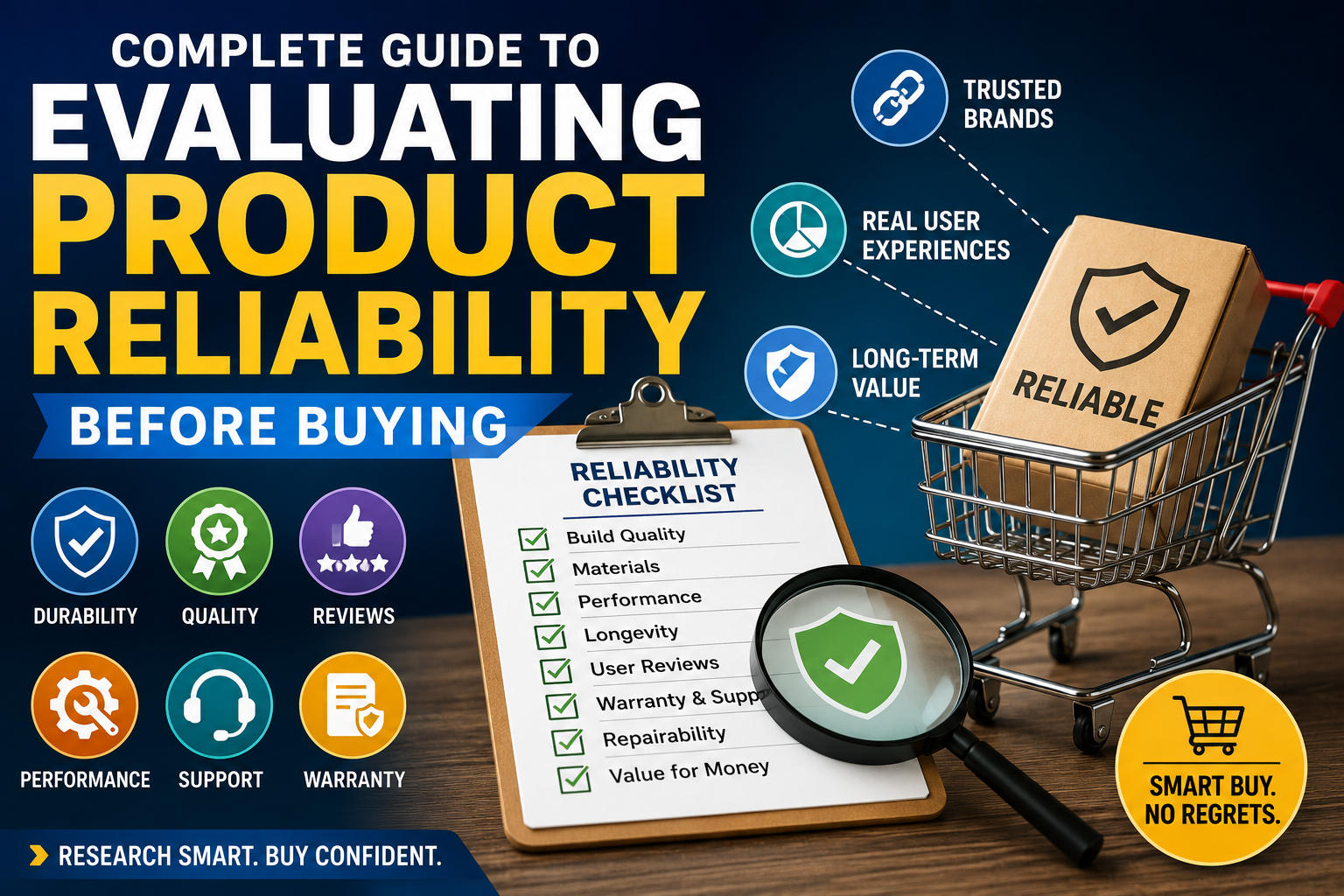
Create a reliability checklist.
| Reliability Factor | Product A | Product B |
|---|---|---|
| Build quality | Excellent | Good |
| Long-term reviews | Strong | Mixed |
| Warranty | 3 years | 1 year |
| Parts availability | Excellent | Limited |
| Repairability | Good | Poor |
| Software support | Strong | Unclear |
| Maintenance cost | Low | Moderate |
| Known recurring issues | Few | Several |
| Total ownership cost | Moderate | High |
| Overall reliability outlook | Strong | Moderate |
This makes the decision more objective.
Create a Reliability Scorecard
For expensive purchases, consider assigning weighted scores.
For example:
| Category | Weight |
|---|---|
| Long-term reliability evidence | 25% |
| Build quality | 20% |
| Warranty and support | 15% |
| Repairability | 15% |
| Parts availability | 10% |
| Maintenance requirements | 10% |
| Software support | 5% |
You can then rate each product from 1 to 10.
The weights should change according to the product.
For a smartphone, software support might receive more weight.
For a refrigerator, mechanical reliability and serviceability might matter more.
Red Flags That May Indicate Poor Reliability
Certain warning signs deserve additional research.
Repeated Failure Complaints
Multiple independent customers reporting the same failure is significant.
Very Short Warranty
A short warranty is not proof of poor quality, but it increases your financial exposure.
No Replacement Parts
Products that cannot be repaired may have shorter practical lifespans.
Poor Customer Support
A reliable product can still become a frustrating purchase if warranty claims are difficult.
Excessive Marketing Claims
Statements such as “built to last forever” should be supported by evidence.
Lack of Technical Information
Manufacturers unwilling to provide basic specifications, manuals, or warranty information deserve additional scrutiny.
Suspiciously Uniform Reviews
If reviews appear repetitive, vague, or unusually similar, investigate further.
Product Discontinued Quickly
A short product lifecycle can make accessories, software, and replacement parts harder to obtain.
How to Spot Fake or Low-Quality Reviews
Online reviews can be manipulated, so critical thinking is important.
Warning signs include:
- Generic praise without details
- Repeated wording
- Reviews posted in unusual bursts
- Excessively enthusiastic language
- No discussion of actual usage
- Reviews that focus entirely on delivery
- Ratings that do not match the written review
More useful reviews usually explain:
- How long the product was used
- How it was used
- What worked well
- What failed
- What could be improved
- Whether the reviewer would buy it again
Specificity is generally more valuable than enthusiasm.
Don’t Confuse Popularity With Reliability
A product can be extremely popular and still have reliability problems.
Popularity can result from:
- Aggressive marketing
- Low price
- Brand recognition
- Influencer promotion
- Attractive design
- Strong distribution
- Viral exposure
Reliability requires different evidence.
Look for long-term ownership data, independent testing, service information, warranty experiences, and recurring failure patterns.
Don’t Automatically Choose the Most Expensive Product
Higher prices can sometimes reflect better materials, engineering, support, and quality control.
But price alone is not evidence of reliability.
Premium products can also suffer from:
- Complex designs
- Expensive repairs
- Proprietary components
- Fragile finishes
- Difficult servicing
The objective should be to identify the product with the best reliability relative to its total ownership cost, not simply the highest-priced model.
How Long Should a Product Last?
There is no universal reliability lifespan.
Expected life depends on:
- Product category
- Build quality
- Usage frequency
- Environment
- Maintenance
- Technology changes
- Repairability
A product used occasionally may last far longer than one subjected to heavy daily use.
Therefore, when researching lifespan, compare your expected usage with the conditions under which the available reliability evidence was collected.
Reliability and Intended Use
A product can be reliable for one user and unsuitable for another.
For example, a lightweight consumer tool may work perfectly for occasional household projects but struggle under daily professional use.
Before buying, identify:
- How often you will use it
- How intensely you will use it
- Where you will use it
- Environmental conditions
- Required workload
- Expected lifespan
Then choose a product designed for those conditions.
How to Research a Product Before Buying
A structured research process can save considerable time.
Step 1: Define Your Requirements
Write down what you actually need.
Avoid starting with brands or models.
Step 2: Identify Suitable Products
Create a shortlist based on essential features.
Step 3: Research Long-Term Ownership
Look for reviews from people who have used the products for extended periods.
Step 4: Investigate Common Failures
Search for recurring problems involving the exact model.
Step 5: Examine Warranty Coverage
Read the actual warranty terms.
Step 6: Check Repairability
Find out whether replacement parts and repair documentation exist.
Step 7: Calculate Ownership Costs
Include maintenance, accessories, subscriptions, energy, repairs, and replacement costs.
Step 8: Compare Alternatives
Do not evaluate one product in isolation.
Step 9: Make the Purchase Based on Evidence
Choose the product that best fits your needs and risk tolerance.
For a broader framework that brings product requirements, pricing, specifications, reliability and other considerations together, see The Complete Guide to Choosing the Right Products.
Questions to Ask Before Buying Any Product
A useful reliability checklist includes:
- How long has this product been available?
- Does it have a history of recurring failures?
- What do long-term owners report?
- What does the warranty actually cover?
- Are replacement parts available?
- Can important components be repaired?
- How expensive are common repairs?
- Does the product require subscriptions?
- How long will software support last?
- Are there known recalls or safety issues?
- How difficult is routine maintenance?
- What is the expected useful life?
- How much will it cost to operate?
- What happens if the manufacturer stops supporting it?
- Is there a better-established alternative?
These questions can reveal problems that a product specification sheet will never show.
The Role of E-E-A-T in Product Research
When evaluating online buying advice, the quality of the source matters.
Look for content that demonstrates:
- Experience: Evidence that the product was actually tested or used.
- Expertise: Knowledge of the product category and relevant technical details.
- Authoritativeness: A strong reputation or credible evidence base.
- Trustworthiness: Transparent methodology, accurate claims, disclosures, and clear sourcing.
Be especially cautious with reviews that appear designed primarily to generate affiliate sales.
A trustworthy buying guide should explain both strengths and weaknesses, rather than presenting every product as an ideal choice.
How Manufacturers Can Demonstrate Reliability
Manufacturers can make reliability easier to evaluate by providing:
- Detailed specifications
- Warranty documentation
- Repair manuals
- Replacement parts
- Service information
- Software support policies
- Testing methodology
- Product revision information
- Safety certifications
- Clear maintenance instructions
Transparency gives consumers more information with which to make informed decisions.
The Best Reliability Strategy Is Evidence, Not Hype
Evaluating product reliability requires more than checking a star rating or choosing the most expensive model.
The strongest buying decisions combine long-term user experiences, independent testing, build-quality assessment, warranty research, repairability, parts availability, manufacturer support, and total cost of ownership.
Most importantly, evaluate the product according to how you actually intend to use it.
A product that perfectly matches your needs, has a strong service ecosystem, can be repaired when necessary, and has a history of dependable performance is often a smarter investment than a product with more features but a questionable ownership record.
The goal isn’t to find a product that can never fail—no product can guarantee that. The goal is to reduce the probability and financial impact of failure while maximizing useful life and value.
That approach turns product research from a quick comparison of specifications into a much more informed long-term buying decision.