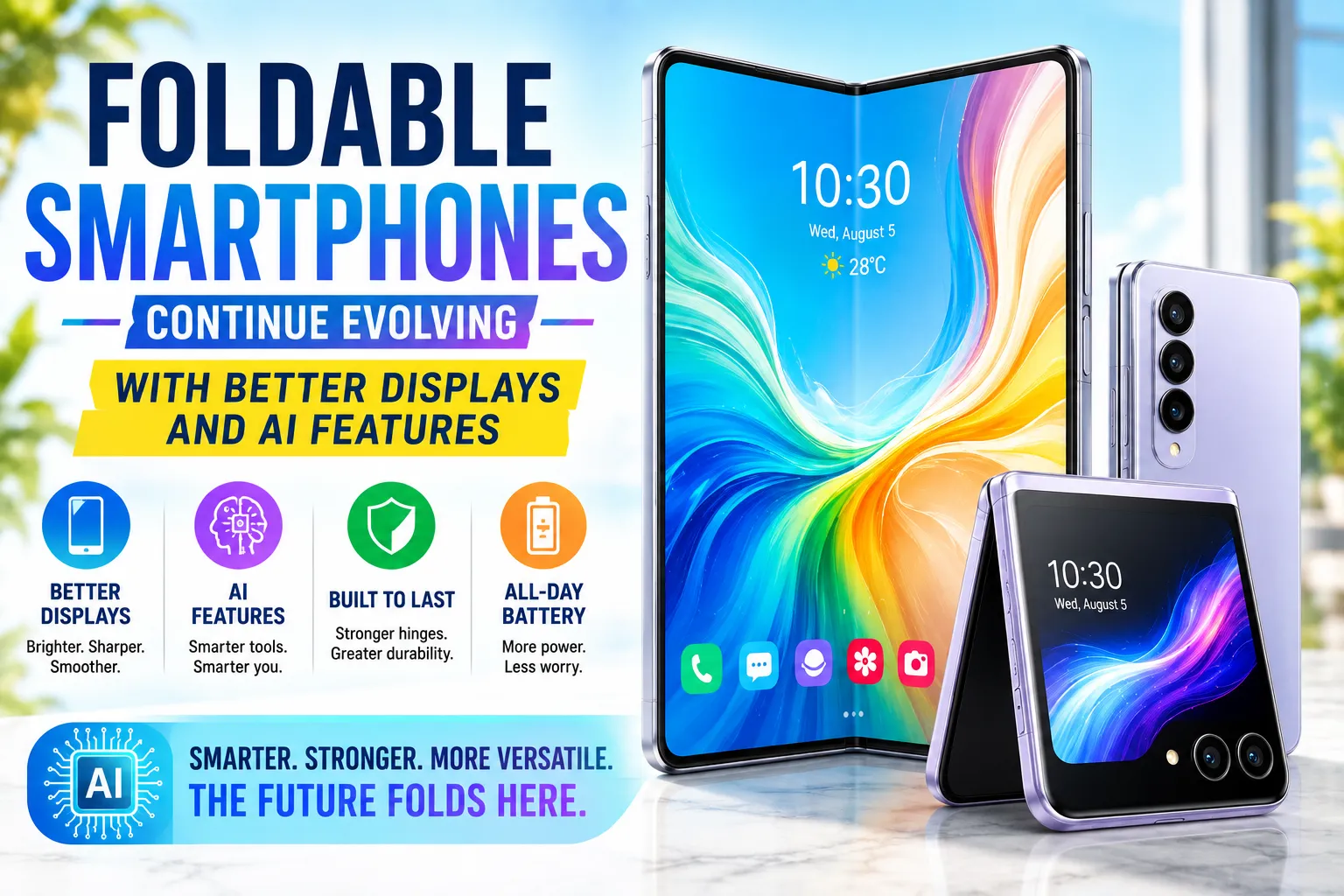
Foldable Smartphones Continue Evolving With Better Displays and AI Features
Foldable smartphones are steadily moving from niche premium devices toward the mainstream as manufacturers continue improving display technology, durability, battery efficiency, and artificial intelligence capabilities.
After years of rapid hardware development, the latest generation of foldable phones is focusing less on simply folding and more on delivering smarter software experiences powered by AI. These improvements are making foldables increasingly attractive to professionals, content creators, and everyday consumers looking for devices that combine portability with productivity.
Industry analysts say the category is becoming one of the most competitive segments of the smartphone market as manufacturers race to differentiate their flagship devices.
Foldables Reach a New Level of Maturity
Early foldable smartphones impressed consumers with innovative designs but also faced criticism over durability, visible display creases, and battery performance.
Recent generations have introduced significant improvements, including:
- Stronger hinge mechanisms
- More durable ultra-thin glass
- Better water and dust resistance
- Brighter OLED displays
- Reduced screen creasing
- Improved battery optimization
- Lighter overall designs
These refinements have made foldable devices more practical for everyday use.
AI Becomes the Biggest Selling Point
While flexible displays remain the defining feature, artificial intelligence is becoming the technology that truly differentiates modern foldable smartphones.
Manufacturers are integrating AI across numerous features, including:
- Real-time language translation
- Intelligent photo editing
- AI-powered writing assistance
- Voice transcription
- Smart note organization
- Personalized recommendations
- Live summaries
- Productivity automation
Instead of functioning as standalone tools, these AI capabilities are increasingly integrated throughout the operating system.
Larger Screens Unlock New AI Experiences
Foldable smartphones provide significantly more screen space than conventional smartphones, creating opportunities for more advanced AI-assisted workflows.
Users can simultaneously:
- Edit documents
- Summarize meetings
- Compare research
- Chat with AI assistants
- Translate conversations
- Generate presentations
- Organize notes
The larger internal displays make multitasking more efficient, particularly for professionals working on the move.
Display Technology Continues Improving
Display quality remains one of the most important areas of innovation.
Recent improvements include:
- Higher peak brightness
- Better outdoor visibility
- Adaptive refresh rates
- Improved color accuracy
- Enhanced HDR support
- Lower power consumption
- Reduced display crease visibility
These upgrades contribute to a viewing experience that increasingly rivals traditional flagship smartphones.
Better Battery Efficiency
Battery life has traditionally been one of the biggest concerns for foldable devices.
Manufacturers are addressing this challenge through:
- More efficient processors
- AI-assisted power management
- Improved battery chemistry
- Adaptive charging
- Dynamic refresh rates
- Smarter background app management
These optimizations help users enjoy longer usage despite powering larger displays.
Cameras Continue Closing the Gap
Premium foldables now feature camera systems approaching those found in flagship smartphones.
Recent improvements include:
- Larger image sensors
- Better low-light photography
- AI scene recognition
- Advanced image stabilization
- Improved computational photography
- Higher-quality zoom capabilities
Artificial intelligence also enhances photo editing by automatically removing unwanted objects, improving lighting, and sharpening details.
Durability Remains a Key Focus
Consumers continue to expect foldables to withstand everyday use.
Manufacturers have introduced stronger materials including:
- Reinforced aluminum frames
- Toughened ultra-thin glass
- Improved hinge engineering
- Scratch-resistant coatings
- Enhanced water resistance
Although foldables remain more mechanically complex than conventional smartphones, reliability has improved considerably over recent product generations.
Productivity Drives Consumer Interest
Many buyers are choosing foldables because they function as both smartphones and compact tablets.
Productivity-focused features include:
- Split-screen multitasking
- Drag-and-drop content
- Floating application windows
- Stylus compatibility (on selected models)
- Desktop-style interfaces
- Multi-app workflows
These capabilities appeal particularly to business users and content creators.
Competition Continues Expanding
The foldable smartphone market has become increasingly competitive as additional manufacturers introduce new designs.
Companies are exploring:
- Book-style foldables
- Flip-style foldables
- Tri-fold concepts
- Rollable display prototypes
- Slimmer form factors
Greater competition is encouraging faster innovation while gradually making foldable technology more accessible.
Challenges Still Remain
Despite significant progress, foldable smartphones continue facing several challenges.
These include:
- Premium pricing
- Higher repair costs
- App optimization
- Battery limitations
- Long-term durability perceptions
- Limited availability in some markets
Manufacturers continue investing heavily to overcome these barriers.
The Future of Foldable Smartphones
Industry observers expect artificial intelligence to play an even larger role in future foldable devices.
Potential developments include:
- Fully context-aware AI assistants
- More advanced real-time translation
- AI-generated productivity workflows
- Smarter multitasking
- Personalized operating systems
- Improved battery prediction
- Adaptive user interfaces
Advances in flexible display technology may also lead to thinner, lighter, and more affordable foldable smartphones over the coming years.
Looking Ahead
Foldable smartphones have evolved well beyond their experimental beginnings. What was once viewed primarily as a hardware innovation is becoming a sophisticated blend of premium engineering and intelligent software.
As AI capabilities continue expanding and display technology matures, foldable devices are increasingly positioned as productivity-focused smartphones capable of replacing multiple devices for many users.
While premium pricing remains a consideration, ongoing improvements suggest foldables will continue playing a growing role in the future of consumer technology.
Frequently Asked Questions
What is a foldable smartphone?
A foldable smartphone features a flexible display that allows the device to fold into a smaller form while expanding into a larger screen for productivity and entertainment.
Why are AI features important on foldable phones?
AI enhances multitasking, productivity, photography, translation, writing assistance, and device optimization, making better use of the larger foldable display.
Are foldable smartphones more durable now?
Yes. Recent generations have introduced stronger hinges, improved ultra-thin glass, better water resistance, and enhanced structural materials compared with earlier models.
Do foldable phones replace tablets?
For many users, foldables offer enough screen space to perform many tablet-like tasks, including document editing, media consumption, multitasking, and note-taking.
Are foldable smartphones becoming more common?
Yes. More manufacturers are entering the market, introducing new designs and improving hardware while gradually expanding consumer adoption.
Key Takeaways
- Foldable smartphones continue improving through stronger displays, better durability, and longer battery life.
- Artificial intelligence is becoming the primary driver of new user experiences.
- Larger foldable displays enable more productive multitasking and AI-powered workflows.
- Camera systems, display quality, and software optimization continue advancing rapidly.
- Increased competition is accelerating innovation across the foldable smartphone market.
- Foldables are evolving into premium productivity devices that combine smartphone convenience with tablet versatility.