How Businesses Evaluate and Purchase Technology Solutions for Organizational Needs
Technology has become deeply connected to how modern businesses operate. From accounting platforms and customer relationship management systems to cybersecurity tools, cloud infrastructure and communication software, organizations rely on technology to solve problems and support growth.
But purchasing technology is rarely as simple as choosing the product with the longest list of features.
A solution that works well for one company may be unsuitable for another because organizations differ in size, budgets, workflows, technical capabilities, security requirements and long-term goals. Effective technology purchasing therefore requires a structured process that connects business needs with practical technology decisions. For a broader look at the software categories and systems businesses use, see the complete guide to business software.
Why Technology Purchasing Requires Careful Evaluation
Businesses can spend significant amounts of money on software, hardware and technology services. The initial purchase price, however, represents only part of the total cost.
Organizations may also need to consider:
- Implementation costs
- Employee training
- Integration with existing systems
- Data migration
- Maintenance
- Technical support
- Security requirements
- Subscription fees
- Upgrades
- Customization
- Vendor management
- Potential switching costs
A technology solution can appear inexpensive during the purchasing process but become expensive to operate over several years.
For this reason, businesses increasingly evaluate technology based on overall business value rather than price alone.
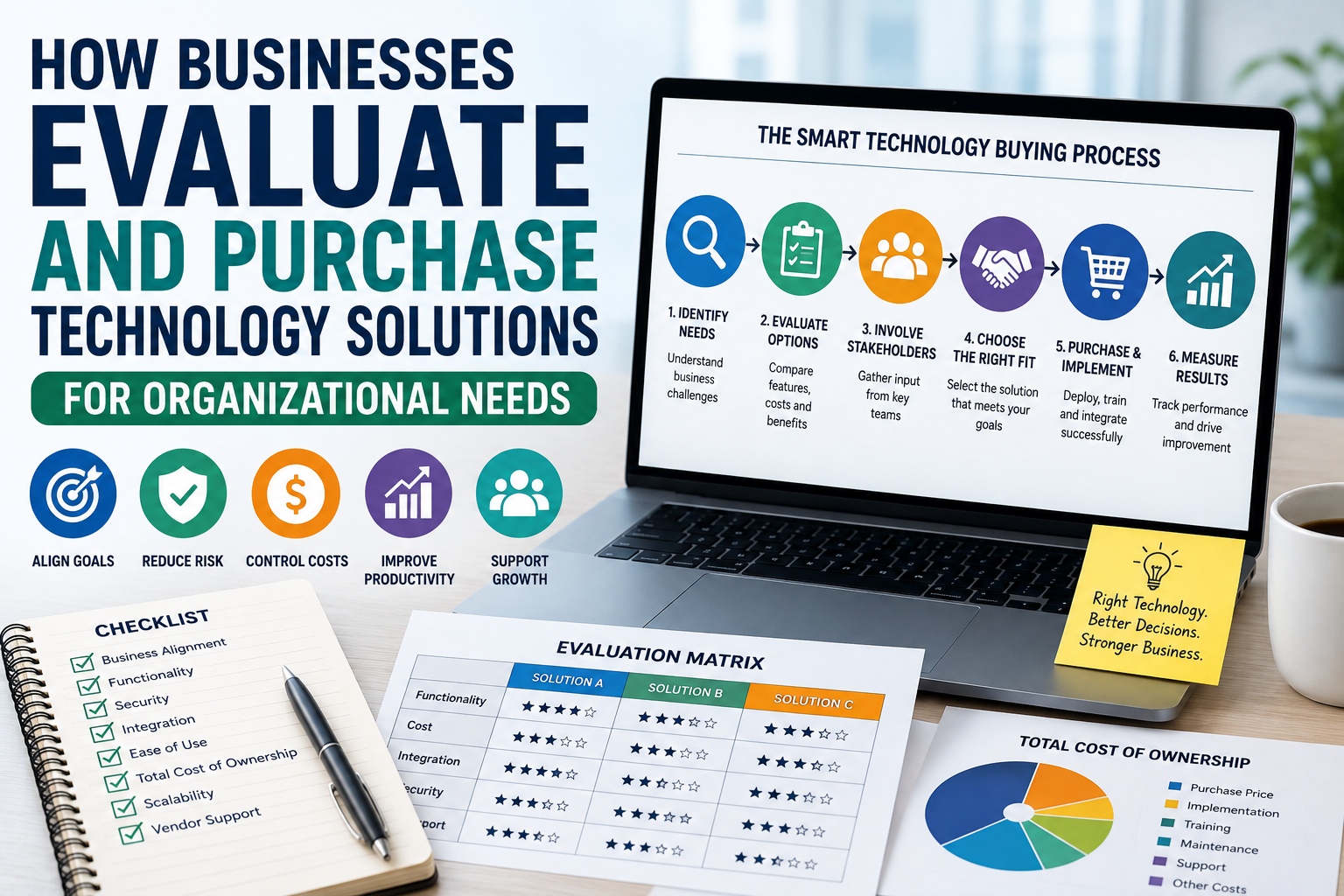
The Technology Buying Process Starts With a Business Problem
One of the most important steps is identifying what the organization actually needs to solve.
Instead of beginning with:
“Which software should we buy?”
A business should first ask:
“What problem are we trying to solve?”
For example, a company might discover that its sales team spends too much time manually entering customer information.
The actual requirement may therefore be:
Reduce manual customer-data entry and improve visibility into sales activity.
That problem could potentially be addressed through CRM software, workflow automation, better integrations or improvements to existing systems.
Starting with the problem prevents organizations from becoming overly focused on specific products before understanding their requirements.
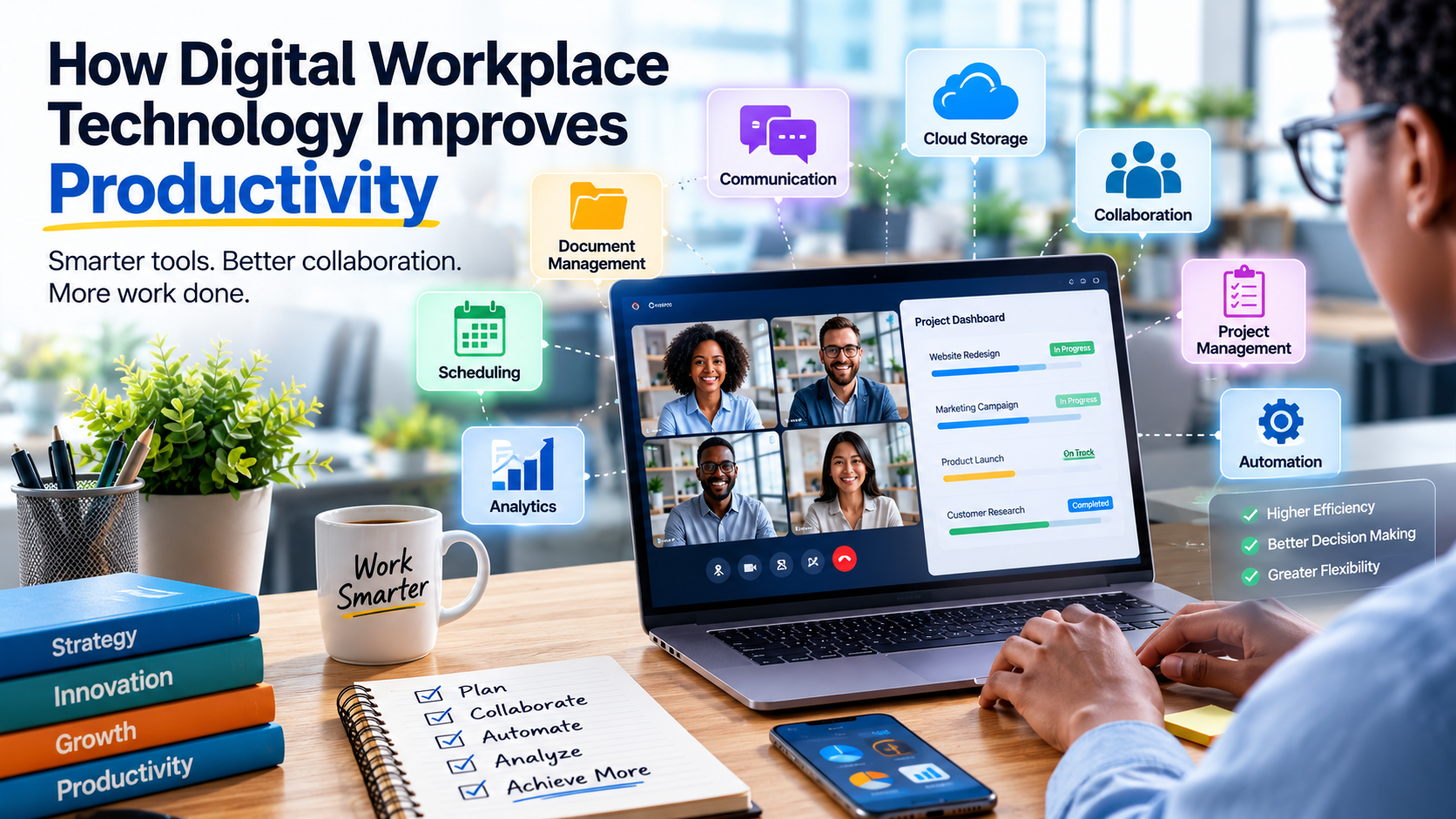
This is also why understanding how workplace technology improves employee productivity and collaboration can help businesses identify where technology investments may provide genuine operational value.
Identifying Organizational Requirements
Once the business problem is understood, teams can translate it into specific requirements.
Requirements typically fall into several categories.
Functional Requirements
These describe what the technology must be able to do.
Examples include:
- Manage customer records
- Generate reports
- Process payments
- Track inventory
- Automate approvals
- Support remote collaboration
- Manage employee information
Technical Requirements
These describe how the solution needs to operate.
They might include:
- Operating system compatibility
- Cloud or on-premises deployment
- API availability
- Storage requirements
- Integration capabilities
- Performance requirements
- Network compatibility
Security Requirements
Security requirements can include:
- User authentication
- Access controls
- Encryption
- Audit logs
- Data backup
- Security monitoring
- Regulatory requirements
Operational Requirements
Businesses also need to consider how the technology will fit into everyday operations.
For example:
- Who will administer it?
- Who will use it?
- How much training will employees need?
- What happens when something goes wrong?
- How will support requests be handled?
This broader assessment helps organizations avoid purchasing technology that looks impressive but does not fit their working environment.
Involving the Right People in the Decision
Technology purchases are rarely successful when only one department makes the decision.
Different stakeholders may see the same solution differently.
A finance team may focus on cost.
IT may focus on security and integration.
Employees may care about usability.
Managers may focus on productivity.
Executives may be concerned with strategic value and return on investment.
Customers may ultimately be affected by changes to service quality.
A cross-functional evaluation team can therefore provide a more complete assessment.
Typical participants may include:
- Business leaders
- IT professionals
- Finance representatives
- Department managers
- End users
- Security specialists
- Procurement teams
- Legal or compliance staff
The exact group depends on the size and nature of the organization.
Defining Must-Have and Nice-to-Have Features
Technology vendors often present products with extensive feature lists.
More features do not automatically mean better value.
A useful evaluation separates requirements into categories such as:
| Requirement | Importance |
|---|---|
| Core business function | Must have |
| Security capability | Must have |
| Required integration | Must have |
| Regulatory compliance | Must have |
| Advanced customization | Nice to have |
| Additional analytics | Nice to have |
| Optional interface features | Nice to have |
This distinction helps prevent organizations from paying for capabilities they are unlikely to use.
It also makes vendor comparisons easier because each product can be evaluated against the same core requirements.
Researching Potential Technology Vendors
After defining requirements, businesses can identify potential solutions.
Research may involve:
- Vendor websites
- Product documentation
- Independent reviews
- Industry publications
- Professional recommendations
- Customer references
- Product demonstrations
- Trial accounts
- Analyst research
Businesses should avoid relying exclusively on vendor marketing.
Marketing materials naturally emphasize the strengths of a product. A proper evaluation should also investigate limitations, implementation requirements, customer support, contract terms and potential risks.
Comparing Technology Solutions
A structured scoring system can make technology comparisons more objective.
For example:
| Evaluation Area | Weight |
|---|---|
| Business functionality | 25% |
| Security | 20% |
| Integration | 15% |
| Ease of use | 15% |
| Total cost | 15% |
| Vendor support | 10% |
Each vendor can then be scored against these categories.
The exact weighting should reflect the organization’s priorities.
A healthcare organization, for example, may place greater emphasis on security and compliance, while a small creative agency may prioritize usability and collaboration.
The purpose is not to create a mathematically perfect score. It is to establish a consistent framework for comparing alternatives.
Evaluating Total Cost of Ownership
Price is one of the most visible factors in technology purchasing, but it is not necessarily the most useful one.
Businesses should consider total cost of ownership, which includes the expenses associated with acquiring, operating and eventually replacing a technology solution.
Costs may include:
- Purchase price
- Subscription fees
- Implementation
- Custom development
- Hardware
- Training
- Integration
- Support
- Maintenance
- Data migration
- Upgrades
- Additional users
- Storage
- Security services
For subscription-based software, companies should also examine how pricing changes as the organization grows.
A platform that is affordable for 20 employees may become significantly more expensive for 500 employees.
Calculating Potential Return on Investment
Businesses also need to consider what they expect to gain from a technology investment.
Potential benefits may include:
- Reduced labor costs
- Faster processes
- Increased sales
- Lower error rates
- Improved customer retention
- Reduced downtime
- Better decision-making
- Stronger security
- Improved employee productivity
For example, suppose a business spends $20,000 implementing an automation system and expects to save $10,000 per year in administrative costs.
The organization could estimate the payback period and compare the investment with alternative uses of the same budget.
Not every technology benefit is easily expressed in financial terms, but identifying measurable outcomes makes the business case stronger.
Testing Technology Before Buying
Whenever possible, businesses should test a technology solution before making a major commitment.
A demonstration can reveal how a product works, but a trial or pilot provides more realistic evidence.
A pilot might involve:
- Selecting a small group of employees.
- Configuring the technology for a specific use case.
- Connecting necessary systems.
- Testing real workflows.
- Recording problems and user feedback.
- Measuring performance.
- Deciding whether the solution should be expanded.
Testing can reveal issues that are difficult to identify during a sales presentation.
For example, a system might technically support an integration but require significant development work to make it practical.
Assessing Ease of Use
A technically powerful system can still fail if employees struggle to use it.
Businesses should consider:
- Interface design
- Learning curve
- Training requirements
- Accessibility
- Mobile support
- Workflow complexity
- User adoption
User experience matters because technology produces little value when employees avoid using it.
During testing, businesses should ask employees questions such as:
- Is the system easy to understand?
- Which tasks are difficult?
- What information is hard to find?
- How long does it take to complete common tasks?
- What would make the system easier to use?
Actual users can provide valuable information that purchasing teams may overlook.
Checking Integration Capabilities
Modern organizations rarely operate with one technology platform.
A business might use separate systems for:
- Accounting
- Customer management
- Human resources
- Marketing
- Inventory
- Payments
- Communication
- Data analytics
New technology therefore needs to work within an existing ecosystem.
Businesses should investigate whether a potential solution offers:
- APIs
- Native integrations
- Data import and export
- Webhooks
- Standard connectors
- Single sign-on
- Integration documentation
Poor integration can result in duplicated data, manual work and inconsistent information across systems.
This is particularly important when evaluating business technology and digital systems because the value of individual tools often depends on how effectively they work together.
Evaluating Security and Privacy
Security should be part of technology evaluation from the beginning rather than an afterthought.
Businesses should determine:
- What data the system stores
- Where data is hosted
- Who can access it
- How users are authenticated
- How permissions are managed
- Whether data is encrypted
- How backups are handled
- What happens after an account is terminated
- How security incidents are handled
Organizations operating in regulated industries may have additional requirements.
The technology vendor’s security practices should therefore be evaluated alongside the product’s functionality.
Understanding Vendor Reliability
Purchasing technology often creates a long-term relationship with a vendor.
Businesses should investigate the company’s:
- Financial stability
- Customer support
- Product development
- Reputation
- Service availability
- Security practices
- Contract terms
- Support response times
Vendor reliability becomes particularly important for mission-critical technology.
If a business depends heavily on a platform, it should understand what would happen if the vendor experienced prolonged downtime, changed its pricing model or discontinued the product.
Reviewing Contracts and Pricing Carefully
Technology contracts can contain important details that are easy to overlook.
Businesses should examine:
- Contract duration
- Renewal terms
- Cancellation conditions
- Price increases
- User limits
- Data storage limits
- Support levels
- Service-level agreements
- Implementation fees
- Early termination charges
- Data export rights
A low introductory price may not represent the long-term cost.
Procurement, finance and legal teams can help identify contractual issues before an agreement is signed.
Considering Scalability
Technology should support the organization’s future needs without requiring constant replacement.
Businesses should ask:
Will this solution still work if the company doubles in size?
Scalability may involve:
- More users
- More transactions
- More data
- Additional locations
- New products
- International expansion
- More complex workflows
A solution that works perfectly for a small organization may not be suitable for a rapidly growing company.
At the same time, businesses should avoid paying for excessive capacity they have no realistic need for.
The goal is an appropriate balance between current requirements and reasonable future growth.
Avoiding Vendor Lock-In
Vendor lock-in occurs when switching away from a technology provider becomes difficult or expensive.
Businesses can reduce this risk by examining:
- Data portability
- Export formats
- API access
- Integration options
- Contract restrictions
- Migration support
Data portability is particularly important.
Before adopting a major platform, organizations should understand how they would retrieve their information if they eventually decided to move to another provider.
Building a Business Case
For significant purchases, decision-makers often need a formal business case.
A strong business case can explain:
The Problem
What business challenge exists today?
The Proposed Solution
How would the technology address it?
Expected Benefits
What improvements are expected?
Investment Required
What will implementation and ongoing operation cost?
Risks
What could go wrong?
Alternatives
What other options were considered?
Expected Outcomes
How will success be measured?
This gives decision-makers a clearer basis for approving or rejecting the investment.
Making the Final Technology Selection
Once potential solutions have been evaluated, the organization can compare the findings.
The final decision should consider the complete picture rather than focusing on one attractive feature.
A useful decision framework might ask:
- Does the technology solve the identified problem?
- Does it meet essential requirements?
- Can employees use it effectively?
- Can it integrate with existing systems?
- Is it secure enough for the organization’s needs?
- Is the total cost reasonable?
- Is the vendor dependable?
- Can the solution scale?
- Can the business exit the relationship if necessary?
- Can success be measured?
If a product performs well across these areas, it is more likely to deliver sustainable value.
Successful Implementation Matters as Much as the Purchase
Buying the right technology is only the beginning.
Implementation determines whether the organization actually receives the expected benefits.
A strong implementation process may include:
- Project planning
- Data migration
- System configuration
- Integration
- Employee training
- Testing
- Documentation
- User support
- Performance monitoring
Organizations should also establish clear responsibilities.
Someone should know who owns the technology, who manages it and who is responsible for measuring its performance.
Measuring Technology Performance After Deployment
Businesses should not assume that a technology investment is successful simply because the system has been installed.
Performance should be measured against the original objectives.
Useful metrics might include:
- Time saved
- Adoption rate
- Processing time
- Error reduction
- Revenue generated
- Customer satisfaction
- System availability
- Support requests
- Cost savings
For example, if the original objective was to reduce a manual process from two hours to 30 minutes, the organization should measure whether that improvement actually occurred.
This creates accountability and helps guide future technology investments.
Common Technology Purchasing Mistakes
Several mistakes can undermine otherwise promising technology investments.
Choosing Based on Features Alone
A long feature list does not guarantee that the product solves the organization’s actual problem.
Focusing Only on Purchase Price
Low upfront cost can hide significant implementation or operating expenses.
Ignoring Employees
Users who dislike or cannot understand a system may resist adoption.
Skipping Security Evaluation
Security problems can create financial, operational and reputational consequences.
Overlooking Integration
A new platform that cannot communicate effectively with existing systems can increase manual work.
Failing to Test
A product demonstration is not always representative of real-world use.
Ignoring Exit Strategies
Organizations should understand how they would migrate their data and processes if they eventually changed providers.
Technology Purchasing Should Be a Business Decision
The most effective organizations treat technology purchasing as more than an IT responsibility.
Technology affects operations, finances, employees, customers and long-term strategy. That means purchasing decisions should connect directly to organizational objectives.
The best solution is rarely the one with the most features or the lowest advertised price. It is the one that solves an important problem, fits existing processes, meets security requirements, provides acceptable value and can continue supporting the organization as its needs evolve.
Building a More Disciplined Technology Strategy
Technology purchasing becomes considerably more effective when businesses move through a deliberate process: identify the problem, define requirements, research alternatives, evaluate vendors, calculate total costs, test solutions, assess risks and measure results after implementation.
This approach helps organizations avoid technology purchases driven by hype or isolated features. More importantly, it turns technology from an expense that simply needs approval into a strategic investment that can be evaluated according to measurable business outcomes.
As organizations continue adopting cloud platforms, automation, artificial intelligence and increasingly connected business systems, the ability to evaluate technology intelligently will become just as important as the technology itself.