How Smartphone Computational Photography Works
Modern smartphone cameras can produce remarkably detailed photos despite using camera sensors and lenses that are much smaller than those found in many dedicated cameras.
The secret is computational photography.
Instead of relying entirely on the physical camera hardware to capture a single image, smartphones combine sensors, software, image-processing algorithms, and increasingly artificial intelligence to create the final photograph.
This approach allows a phone to improve exposure, reduce noise, expand dynamic range, recover details, and produce effects that would be difficult to achieve with a tiny camera system alone.
What Is Computational Photography?
Computational photography is the use of software algorithms and computational processing to improve or transform images captured by a camera.
Traditional photography depends heavily on the physical characteristics of a camera, including its:
- Lens
- Sensor
- Aperture
- Shutter
- ISO settings
A smartphone still uses these components, but software plays a much larger role in determining the final image.
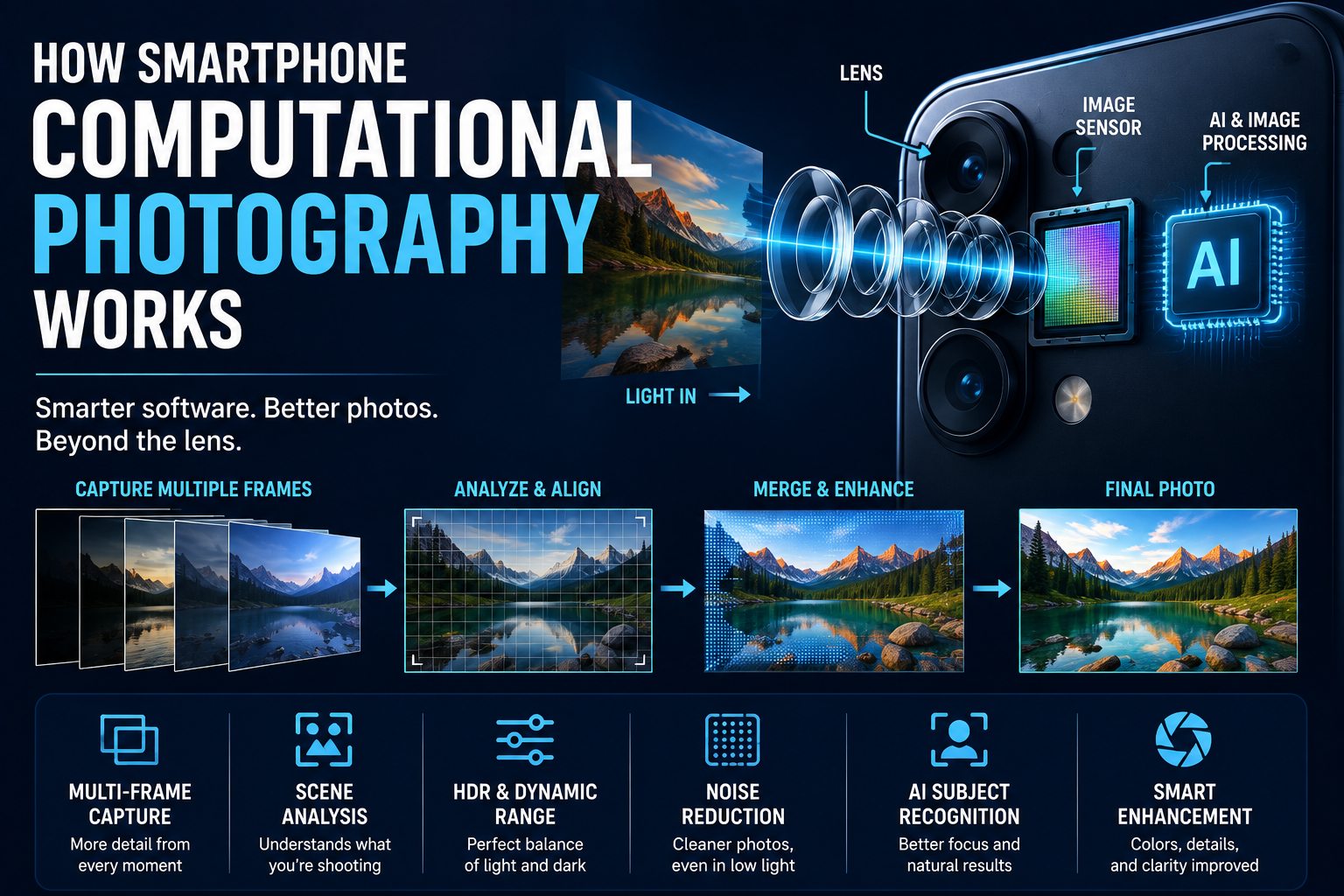
When you press the shutter button, the phone may capture multiple frames, analyze the scene, align the images, combine useful information, reduce noise, adjust colors, and apply other processing before displaying the final photograph.
In other words, the image you see is often the result of both photography and computation.
Why Smartphones Need Computational Photography
Smartphones face several physical limitations.
Their compact designs leave relatively little space for large sensors, long lenses, and mechanical camera components.
A larger camera sensor can capture more light, while a larger lens can provide greater optical capabilities. Smartphones cannot always accommodate those components without becoming significantly thicker and heavier.
Computational photography helps compensate for some of these limitations.
Software can combine information from multiple frames to create an image that contains more useful detail than a single exposure might provide.
This is particularly important when photographing:
- Dark scenes
- High-contrast environments
- Moving subjects
- Distant objects
- Portraits
- Nighttime scenes
These capabilities are part of what makes modern smartphones such powerful consumer gadgets, combining compact hardware with sophisticated software and processing.
What Happens When You Press the Shutter?
The process varies between smartphones and camera applications, but a modern phone may perform many operations within fractions of a second.
A simplified workflow looks like this:
Scene analysis → Frame capture → Image alignment → Frame combination → Noise reduction → Color processing → Detail enhancement → Final image
The phone’s processor can perform much of this work almost instantly.
Some devices also begin analyzing the scene before the shutter is pressed, allowing the camera system to maintain a rolling buffer of recent frames.
This means the phone may have more information available than a conventional single-frame photograph.
Multi-Frame Photography
One of the most important techniques in computational photography is multi-frame image processing.
Instead of relying on one photograph, the smartphone can capture several frames in rapid succession.
Each frame may contain slightly different information.
For example, one frame may contain useful shadow detail while another contains a cleaner representation of highlights.
The software can align the frames and combine their useful information into a single image.
This technique can improve:
- Dynamic range
- Noise performance
- Fine detail
- Exposure
- Color consistency
The challenge is that multiple frames cannot simply be stacked together without processing.
If the camera or subject moves between exposures, objects may appear in different positions.
Sophisticated algorithms therefore need to detect and compensate for movement.
How HDR Photography Works
High Dynamic Range, commonly called HDR, is one of the most familiar examples of computational photography.
A scene may contain extremely bright and extremely dark areas at the same time.
For example, imagine photographing a person standing near a bright window.
If the camera exposes the image for the person, the window may become completely white.
If it exposes for the window, the person’s face may become too dark.
HDR processing attempts to preserve useful information across both extremes.
A smartphone can capture frames with different exposure characteristics and combine them into a single image.
The resulting photograph can contain more detail in both highlights and shadows.
Modern HDR systems can become considerably more sophisticated than simply combining a few differently exposed photographs.
They may analyze individual regions of the scene and determine how different areas should be processed.
Computational Photography and Noise Reduction
Digital camera sensors produce noise, particularly when there is not enough light.
Increasing the camera’s sensitivity can make a photograph brighter, but it can also introduce visible grain and color artifacts.
Smartphones can address this problem using multiple frames.
If several frames are captured under similar conditions, algorithms can compare them and distinguish relatively consistent image information from random variations.
The consistent information is more likely to represent the actual scene, while unpredictable variations can often be reduced.
This is one reason modern smartphones can produce surprisingly clean photographs in challenging lighting conditions.
How Night Mode Works
Night mode is one of the clearest demonstrations of computational photography.
Instead of taking one very long exposure, a smartphone can capture a series of shorter exposures.
The software then attempts to align and combine them.
This approach can produce a brighter and cleaner photograph while reducing some of the problems associated with extremely long exposures.
A typical computational night photography system may perform several tasks:
- Analyze the scene.
- Determine appropriate exposure times.
- Capture multiple frames.
- Detect camera movement.
- Align the frames.
- Combine useful image information.
- Reduce noise.
- Adjust brightness and colors.
- Produce the final photograph.
The process can happen automatically without requiring the photographer to understand any of these individual steps.
The Importance of Image Alignment
Combining multiple photographs becomes difficult when the camera moves.
Even small movements can shift objects between frames.
Smartphones therefore use image-registration algorithms to determine how the captured frames correspond to one another.
The software may identify recognizable features in the images and calculate how their positions have changed.
It can then transform the frames so that important details line up.
This is particularly important for handheld photography because asking users to keep a phone perfectly still is unrealistic.
What Is Scene Detection?
Modern smartphone cameras can analyze the scene before processing the final photograph.
Software may attempt to identify characteristics such as:
- Faces
- Skies
- Plants
- Food
- Buildings
- Text
- Landscapes
- Snow
- Low-light conditions
- Backlit subjects
The camera can then adjust processing based on what it believes it is seeing.
For example, a portrait photograph may receive different processing from a landscape photograph.
This is sometimes called scene recognition or scene optimization.
How Smartphones Process Skin Tones
Human skin can be particularly challenging for image-processing systems.
A camera needs to balance exposure, color, contrast, and detail without producing unnatural-looking results.
Modern computational photography systems may identify faces and skin regions and process them differently from other parts of an image.
The objective is generally to preserve realistic skin tones while maintaining overall exposure and color balance.
Good processing should improve the photograph without making the subject appear artificial.
Computational Portrait Photography
Portrait mode is another major application of computational photography.
The goal is to create a shallow-depth-of-field effect similar to what photographers can achieve with larger cameras and lenses.
A smartphone may use multiple cameras, depth information, machine-learning models, or a combination of these technologies to estimate which parts of an image represent the foreground and background.
The software can then apply stronger blur to areas identified as being farther behind the subject.
This creates the familiar portrait effect.
However, the quality of the result depends heavily on how accurately the phone can separate the subject from the background.
Hair, glasses, transparent objects, and complicated backgrounds can be particularly difficult for segmentation algorithms.
Computational Zoom
Zoom is another area where software can compensate for physical limitations.
Optical zoom uses the physical movement or arrangement of lenses to magnify a subject without relying entirely on digital enlargement.
Digital zoom, by contrast, can involve cropping and computational processing.
Modern smartphones increasingly combine different approaches.
A device might use:
- A main camera
- An ultrawide camera
- A telephoto camera
- Sensor cropping
- Image fusion
- Digital processing
The software can determine which camera or combination of cameras is most useful for a particular zoom level.
At intermediate zoom ranges, the phone may combine information from multiple sensors rather than simply cropping one image.
What Is Image Fusion?
Image fusion involves combining information from different image sources.
A smartphone may have several cameras with different focal lengths and sensor characteristics.
Rather than treating those cameras as completely independent systems, computational photography can combine their information.
For example, a phone might use the main sensor for color information while drawing additional detail from a telephoto camera.
The resulting image is intended to appear as one coherent photograph.
This requires careful calibration because the cameras may have different perspectives, exposures, colors, and levels of detail.
The Role of Artificial Intelligence
Artificial intelligence and machine learning have become increasingly important in smartphone photography.
Machine-learning models can help identify objects, faces, scene characteristics, image quality problems, and other patterns.
AI-based systems can assist with:
- Image segmentation
- Noise reduction
- Super-resolution
- Scene recognition
- Portrait effects
- Autofocus
- Exposure decisions
- White balance
- Image enhancement
Some systems can even attempt to reconstruct or enhance details that are difficult to capture directly.
This is where computational photography begins to blur the boundary between traditional image processing and AI-assisted image generation.
Computational Photography Versus AI Image Generation
These technologies are related but not identical.
Computational photography generally attempts to improve or combine information captured by the camera.
Generative AI can potentially create visual information that was not directly captured in the same way.
For example, a conventional computational photography system might combine several frames to reduce noise.
A generative system might use a trained model to reconstruct missing or low-resolution details.
The distinction matters because increasingly sophisticated camera systems may use both techniques within the same workflow.
How Smartphones Handle Motion
Motion presents one of the biggest challenges for multi-frame photography.
If a person moves between frames, combining those images directly can produce ghosting or other artifacts.
Modern camera systems therefore attempt to detect movement.
The software can then decide which parts of different frames should be used.
For example, the background may be combined from several exposures while a moving person’s face may be taken primarily from a single frame.
This selective processing helps preserve sharpness.
Autofocus Is Also Computational
Computational photography is not limited to the image captured after the shutter is pressed.
Modern autofocus systems use sophisticated algorithms to determine where the camera should focus.
Depending on the device, autofocus may use:
- Phase detection
- Contrast detection
- Subject recognition
- Face detection
- Eye detection
- Motion tracking
Machine-learning systems can also help predict how subjects are likely to move.
The camera can continuously adjust focus to keep a subject sharp.
Computational White Balance
White balance determines how colors are represented under different lighting conditions.
A white object should ideally appear white whether it is illuminated by sunlight, an indoor bulb, or another light source.
Real-world lighting can be complicated, however.
Smartphones can analyze the scene and estimate the characteristics of the available light.
The software then adjusts the image to produce more natural-looking colors.
Because white balance affects the entire photograph, inaccurate estimation can make an otherwise good image appear unusually warm, cool, green, or otherwise unnatural.
The Camera ISP
A key piece of hardware involved in smartphone photography is the Image Signal Processor, or ISP.
The ISP is designed to process image data efficiently.
Depending on the device, image processing may involve dedicated hardware, the main processor, graphics hardware, neural-processing components, or combinations of these.
The ISP can handle tasks such as:
- Demosaicing
- Noise reduction
- Exposure processing
- Color conversion
- Sharpening
- HDR processing
- Autofocus assistance
Specialized hardware allows many of these operations to happen extremely quickly while consuming less power than performing everything through general-purpose computation.
Why Camera Software Matters So Much
Two smartphones can use sensors with similar specifications and still produce noticeably different photographs.
The reason is that sensor size and megapixel count are only part of the imaging system.
Other factors include:
- Lens quality
- Sensor characteristics
- Image signal processing
- Camera software
- HDR algorithms
- Noise reduction
- Color science
- Machine-learning models
- Exposure algorithms
- Focus systems
This is why comparing smartphone cameras based solely on megapixel numbers can be misleading.
For broader context on the hardware and capabilities of modern phones, the Complete Guide to Wireless Connectivity also explains how smartphones combine multiple communication technologies with increasingly sophisticated hardware.
The Limits of Computational Photography
Computational photography is powerful, but it is not magic.
Software cannot completely eliminate the physical limitations of a small sensor or lens.
Processing can also introduce unwanted effects.
Aggressive noise reduction may remove fine textures.
Excessive sharpening can create unnatural edges.
Strong HDR processing can make photographs look artificial.
AI enhancement can sometimes introduce details that appear plausible but do not accurately represent the original scene.
The best systems therefore need to balance enhancement with realism.
Why Computational Photography Keeps Improving
Smartphone processors are becoming more powerful, while specialized AI hardware is becoming increasingly common.
This gives camera software more computational resources to analyze images in real time.
At the same time, smartphone manufacturers can train increasingly sophisticated models using large collections of image data.
The result is a continuing shift in smartphone photography.
Hardware still matters, but software increasingly determines how much useful information can be extracted from that hardware.
The Future of Smartphone Cameras
Future smartphones are likely to continue combining multiple cameras, specialized sensors, computational algorithms, and AI.
Rather than simply increasing megapixel counts, manufacturers can improve photography by making better use of the information already captured.
Potential areas of development include:
- More accurate subject segmentation
- Better low-light photography
- Improved motion handling
- More natural HDR
- Higher-quality computational zoom
- Faster autofocus
- Better video processing
- More advanced image reconstruction
- Greater personalization
The broader trend is clear: smartphone cameras are becoming increasingly computational.
Why the Best Smartphone Camera Is More Than Hardware
A smartphone camera is no longer simply a lens connected to a sensor.
It is a complete imaging system in which hardware and software work together.
When you take a photograph, the phone may capture multiple frames, analyze the scene, align images, reduce noise, reconstruct detail, balance colors, identify subjects, and combine information before showing you the result.
That is the fundamental idea behind computational photography.
As smartphone processors and AI capabilities continue to advance, the camera’s ability to transform raw sensor data into useful images will become just as important as the physical camera components themselves. The future of smartphone photography will therefore be shaped not only by better lenses and sensors, but by increasingly intelligent ways of turning limited physical information into better photographs.