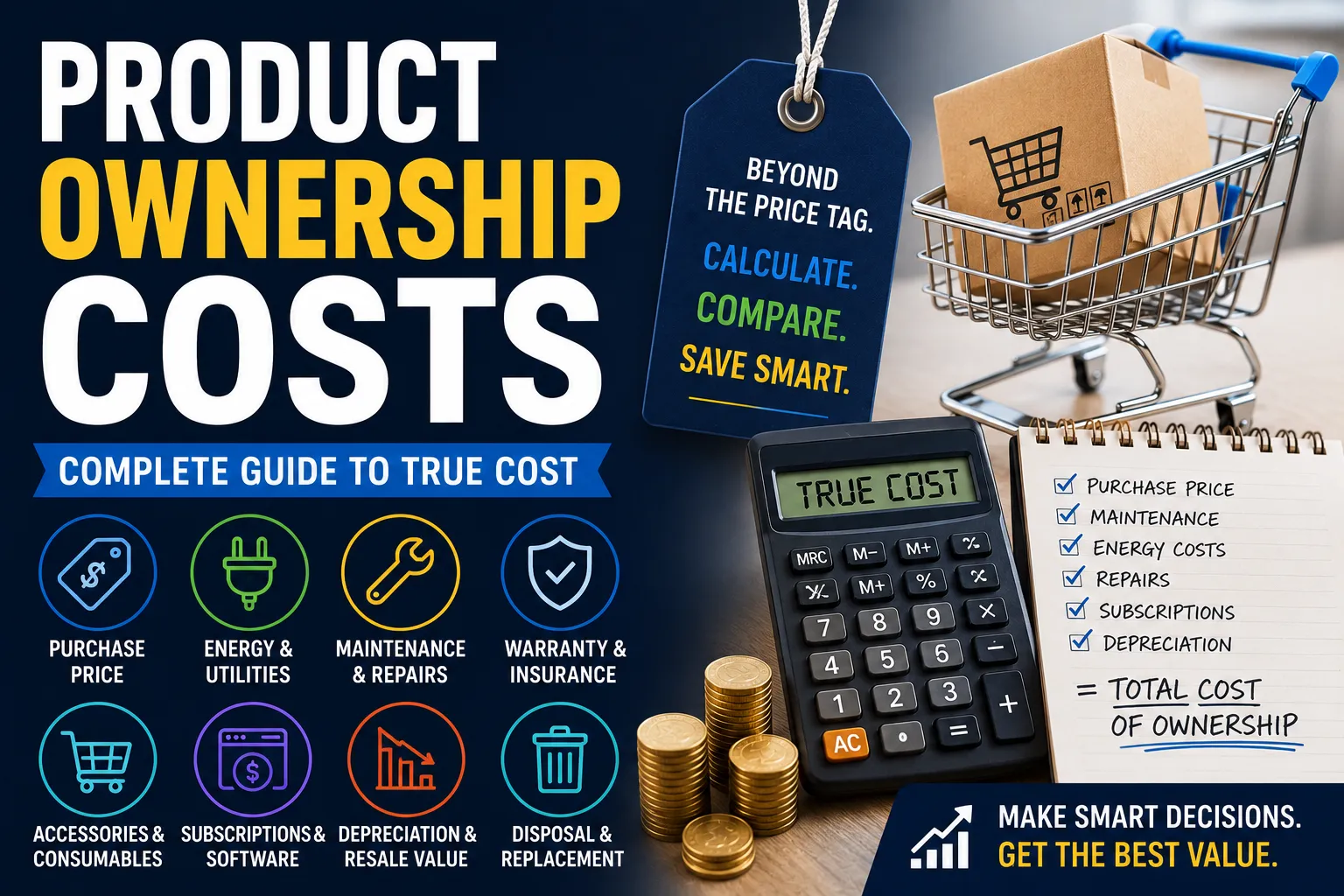
Product Ownership Costs: Complete Guide to True Cost
The price printed on a product is rarely the full cost of owning it.
A car may require fuel, insurance, servicing and repairs. A laptop may eventually need a battery replacement, accessories or paid software. A home appliance can consume electricity for years after the initial purchase. Even a seemingly inexpensive product can become costly if it breaks frequently or needs expensive consumables.
This is why product ownership cost matters.
Instead of asking only, “How much does this product cost?”, smart buyers ask a more useful question:
“How much will this product actually cost me from the day I buy it until the day I stop using it?”
That figure is often called the total cost of ownership, or TCO.
Understanding total ownership costs can help consumers compare products more accurately, avoid misleadingly cheap purchases and identify products that deliver better long-term value.
This complete guide explains what product ownership costs are, which expenses to include, how to calculate total cost of ownership, how to compare competing products and how to determine whether paying more upfront can actually save money.
What Is Product Ownership Cost?
Product ownership cost is the total amount of money a consumer spends to purchase, use, maintain and eventually replace or dispose of a product.
It includes more than the initial purchase price.
Depending on the product, ownership costs can include:
- Purchase price
- Delivery costs
- Installation
- Accessories
- Consumables
- Energy or fuel
- Maintenance
- Repairs
- Software subscriptions
- Insurance
- Replacement parts
- Financing costs
- Taxes and fees
- Disposal
- Replacement costs
The exact categories vary depending on the product.
For some products, ongoing costs are negligible.
For others, they can exceed the original purchase price.
What Is Total Cost of Ownership?
Total cost of ownership (TCO) is a method of calculating the complete cost associated with acquiring and using a product or asset over a defined period.
A simplified formula is:
Total Cost of Ownership = Initial Cost + Ongoing Costs + Maintenance and Repairs + Other Ownership Costs − Residual Value
For example, suppose you buy a device for $800.
Over five years, you spend:
- $100 on accessories
- $150 on software
- $200 on replacement parts
- $250 on electricity
- $100 on repairs
If the product can later be sold for $150, the estimated ownership cost would be:
$800 + $100 + $150 + $200 + $250 + $100 − $150 = $1,450
The purchase price was $800, but the actual five-year ownership cost was approximately $1,450.
Purchase Price vs. Ownership Cost
These two numbers answer different questions.
Purchase Price
How much does the product cost to acquire?
Ownership Cost
How much will the product cost over the period you expect to use it?
The distinction becomes particularly important when comparing products with different price points.
Consider two hypothetical washing machines:
| Cost | Machine A | Machine B |
|---|---|---|
| Purchase price | $500 | $700 |
| Energy costs | $900 | $650 |
| Maintenance | $350 | $200 |
| Repairs | $300 | $150 |
| Accessories | $50 | $50 |
| Five-year total | $2,100 | $1,750 |
Machine B costs $200 more initially but could cost significantly less to own.
The cheaper product isn’t necessarily the cheaper product.
Why True Cost Matters When Buying Products
Looking only at the sticker price can create several problems.
A low-priced product may have:
- Shorter lifespan
- Higher energy consumption
- Expensive replacement parts
- Frequent repair requirements
- Proprietary accessories
- Expensive consumables
- Limited warranty coverage
- Mandatory subscriptions
A more expensive product may have:
- Better durability
- Lower operating costs
- Longer warranty coverage
- Lower maintenance requirements
- Better energy efficiency
- Higher resale value
The important question is not simply whether something is cheap.
It is whether it provides good value relative to its total cost and expected usefulness.
For a broader framework for evaluating price, features, durability and long-term value together, see The Complete Guide to Choosing the Right Products.
The Main Components of Product Ownership Costs
A comprehensive ownership calculation should consider several categories.
1. Initial Purchase Price
This is the most obvious cost.
It includes the price paid to acquire the product.
Depending on the market, the actual amount may also include:
- Sales tax
- Import duties
- Dealer fees
- Delivery charges
- Installation fees
Consumers should use the actual out-the-door cost rather than relying solely on the advertised price.
2. Delivery and Shipping Costs
Some products have significant transportation costs.
This is especially relevant for:
- Furniture
- Large appliances
- Exercise equipment
- Electronics
- Outdoor equipment
Free delivery can also be conditional, so buyers should check the terms before assuming shipping costs are zero.
3. Installation Costs
Installation is easy to overlook.
Examples include:
- Appliance installation
- Furniture assembly
- Network equipment setup
- Security camera installation
- Home electronics installation
- Professional equipment setup
A product with a lower purchase price may require substantially more installation work.
4. Accessories and Required Extras
Some products aren’t particularly useful without additional purchases.
Examples include:
- Chargers
- Cases
- Mounts
- Cables
- Batteries
- Filters
- Stands
- Memory cards
- Specialized tools
When comparing products, determine whether important accessories are included.
5. Consumable Costs
Consumables are items that must be replaced regularly.
Examples include:
- Printer ink
- Water filters
- Vacuum bags
- Air filters
- Cleaning supplies
- Batteries
- Replacement blades
- Coffee capsules
Consumables can have a surprisingly large impact on long-term ownership costs.
6. Energy Costs
Products that consume electricity, fuel or another energy source can accumulate substantial operating expenses.
Examples include:
- Refrigerators
- Air conditioners
- Washing machines
- Dryers
- Water heaters
- Vehicles
- Space heaters
Energy efficiency should therefore be evaluated over the expected ownership period rather than simply at the time of purchase.
7. Maintenance Costs
Maintenance includes routine actions intended to keep a product functioning properly.
Examples include:
- Cleaning
- Lubrication
- Servicing
- Filter replacement
- Software maintenance
- Calibration
- Inspections
Some products require regular professional servicing, while others can be maintained by the owner.
8. Repair Costs
Repairs are different from routine maintenance.
A repair is generally required when something fails, becomes damaged or stops functioning properly.
Potential repair expenses include:
- Labor
- Replacement components
- Diagnostic fees
- Transportation
- Service charges
Products with readily available parts can sometimes be less expensive to repair than products with proprietary components.
9. Subscription Costs
Subscription-based products have become increasingly common.
Examples include products that require subscriptions for:
- Cloud storage
- Premium software
- Security monitoring
- Advanced features
- Content
- Connectivity
- Replacement services
A $10 monthly subscription might not seem significant.
Over five years, however:
$10 × 60 months = $600
That can substantially change the true cost of the product.
10. Financing Costs
If a product is purchased using financing, the ownership cost can exceed the cash price.
Potential costs include:
- Interest
- Origination fees
- Administrative charges
- Late-payment fees
Consumers comparing financing options should distinguish between the cash price and the total amount paid over the financing period.
11. Insurance Costs
Some products may require or benefit from insurance.
This can be relevant for:
- Vehicles
- High-value electronics
- Specialized equipment
- Jewelry
- Business equipment
Insurance costs should be included when they are directly associated with ownership.
12. Storage Costs
Some products require dedicated storage.
For example:
- Boats
- Recreational equipment
- Seasonal machinery
- Large furniture
- Specialized tools
Storage can become a meaningful long-term expense.
13. Replacement Costs
Every product eventually reaches the end of its useful life.
The question is not always whether a product will need replacement, but when.
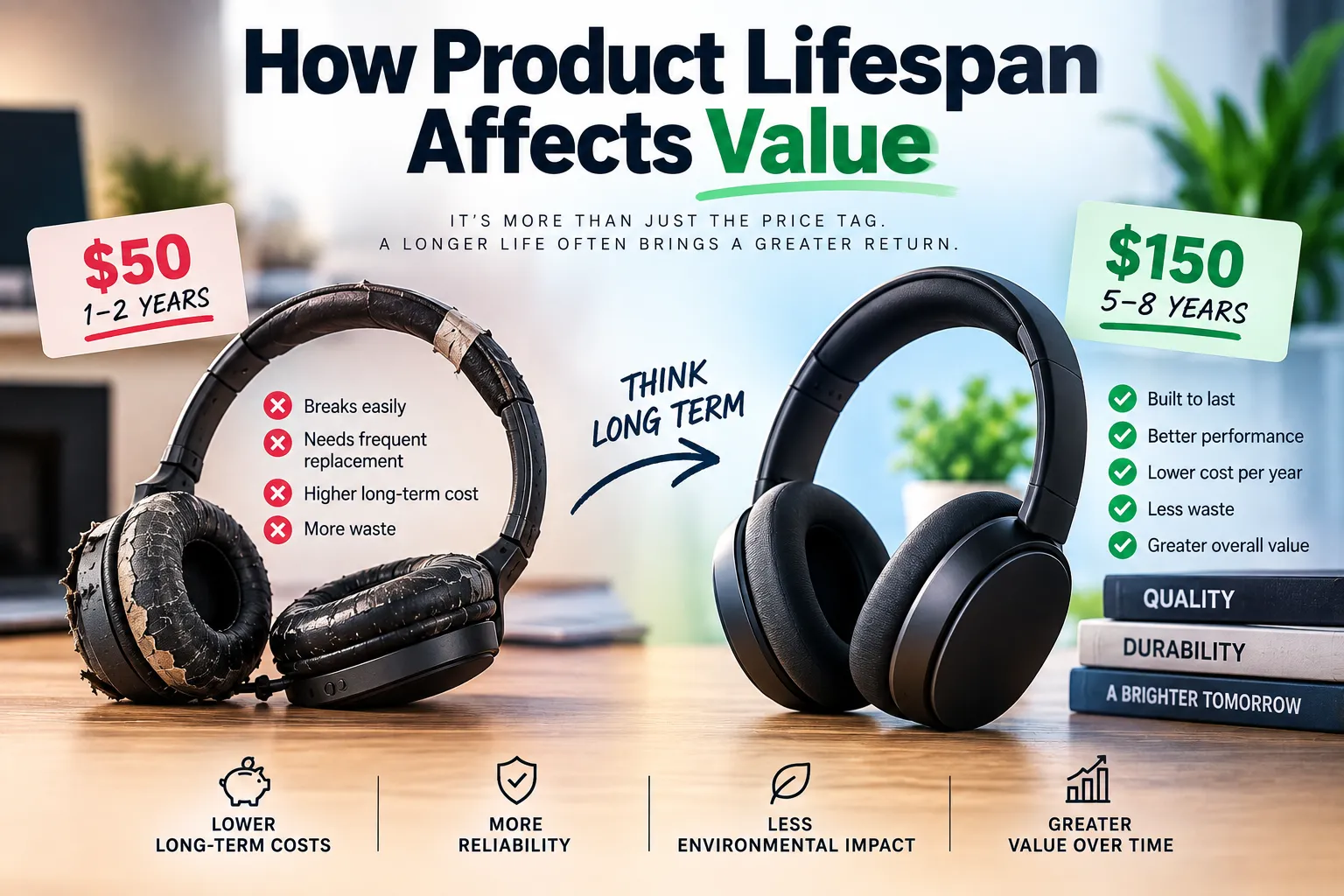
A product that lasts three years may have a much higher annual ownership cost than one that lasts eight years, even if the two products have similar purchase prices.
14. Resale Value
Some products retain significant value after years of use.
Others have little or no resale value.
Examples of products that can sometimes retain substantial value include:
- Vehicles
- Premium electronics
- Professional equipment
- Certain tools
- Collectible items
Residual value can reduce the effective cost of ownership.
How to Calculate Total Cost of Ownership
A basic calculation can follow these steps.
Step 1: Determine the Initial Cost
Include the actual amount required to acquire and set up the product.
Step 2: Estimate the Ownership Period
Decide how long you realistically expect to use it.
Step 3: Estimate Recurring Costs
Calculate annual or monthly operating expenses.
Step 4: Add Maintenance
Estimate routine servicing and replacement parts.
Step 5: Estimate Repairs
Use historical data, warranty information or realistic assumptions.
Step 6: Add Subscriptions
Include recurring digital or service charges.
Step 7: Subtract Expected Residual Value
Estimate what the product might reasonably be worth when you stop using it.
Step 8: Compare Alternatives
Calculate the same categories for competing products.
A Simple Total Cost of Ownership Formula
For many consumer products, this formula provides a useful starting point:
TCO = Purchase Price + Delivery + Installation + Accessories + Consumables + Energy + Maintenance + Repairs + Subscriptions + Financing + Other Costs − Resale Value
The result is an estimate rather than a guarantee.
Actual costs will depend on how the product is used and how long it remains in service.
How to Calculate Annual Ownership Cost
Annualizing ownership costs makes products easier to compare.
Suppose a product has a five-year TCO of $2,500.
The average annual ownership cost would be:
$2,500 ÷ 5 = $500 per year
You can then compare it with another product that costs $2,100 over four years:
$2,100 ÷ 4 = $525 per year
Although the second product has a lower total cost, the first product has the lower average annual cost.
This illustrates why the ownership period matters.
Monthly Ownership Cost
You can also calculate an approximate monthly cost.
If a product costs $2,400 over four years:
$2,400 ÷ 48 months = $50 per month
This can be useful for comparing products with different purchase prices and lifespans.
Example: Comparing Two Laptops
Imagine two hypothetical laptops.
Laptop A
- Purchase price: $900
- Accessories: $100
- Software: $200
- Repairs: $300
- Battery replacement: $150
- Resale value: $100
- Ownership period: 4 years
Estimated TCO:
$900 + $100 + $200 + $300 + $150 − $100 = $1,550
Laptop B
- Purchase price: $1,200
- Accessories: $100
- Software: $200
- Repairs: $150
- Battery replacement: $100
- Resale value: $200
- Ownership period: 5 years
Estimated TCO:
$1,200 + $100 + $200 + $150 + $100 − $200 = $1,550
Both products have the same estimated total ownership cost.
But Laptop B lasts an additional year.
That could make it the better value for someone who prioritizes longevity.
Cost Per Year Is Often More Useful Than Sticker Price
When comparing durable products, cost per year can provide valuable context.
Consider:
- Product A costs $600 and lasts three years.
- Product B costs $900 and lasts six years.
Ignoring other expenses:
Product A = $200 per year
Product B = $150 per year
The more expensive product has the lower annualized purchase cost.
This is why durability can fundamentally change the economics of a purchase.
How Product Lifespan Affects Ownership Cost
Lifespan is one of the most important variables in TCO calculations.
A product that lasts twice as long does not necessarily cost twice as much.
Suppose:
- Product A costs $500 and lasts five years.
- Product B costs $800 and lasts ten years.
The approximate purchase cost per year is:
Product A: $100/year
Product B: $80/year
The more expensive product has the lower annualized acquisition cost.
Reliability and Total Cost
Reliability directly affects ownership expenses.
A product that frequently breaks may generate costs through:
- Repairs
- Replacement parts
- Lost time
- Professional service
- Downtime
- Temporary alternatives
This means reliability should be evaluated alongside specifications.
A technically impressive product that constantly requires repairs may provide worse value than a simpler but more dependable alternative.
For a deeper assessment framework, see How to Determine Whether a Product Is Durable and Reliable.
Warranty and Ownership Cost
Warranty coverage can reduce financial risk.
A warranty may cover certain:
- Manufacturing defects
- Component failures
- Repairs
- Replacement parts
- Labor
However, warranties have limitations.
Buyers should examine:
- Duration
- Covered components
- Exclusions
- Labor coverage
- Shipping responsibilities
- Registration requirements
- Conditions for service
A longer warranty isn’t automatically better if the coverage is narrow.
Extended Warranties: Are They Worth It?
Extended warranties can sometimes make sense for expensive products with high repair costs.
But buyers should compare:
Warranty price + expected benefit
against:
Expected repair cost + risk of failure
For inexpensive products, an extended warranty can sometimes cost a substantial percentage of the purchase price.
For expensive products with costly repairs, additional coverage may be more meaningful.
The right decision depends on the product’s reliability, repair cost and the terms of the warranty.
Repairability and True Cost
Repairability is increasingly relevant when evaluating long-term value.
A repairable product may allow owners to replace individual components instead of replacing the entire product.
Important factors include:
- Availability of replacement parts
- Repair documentation
- Tool requirements
- Component accessibility
- Service network
- Cost of parts
- Expected software support
A product that can be repaired economically may have a longer useful life.
Parts Availability Matters
A product can be technically repairable but practically difficult to maintain if replacement components are unavailable.
Before buying an expensive long-term product, consider whether:
- Replacement parts are sold separately
- Parts are reasonably priced
- Authorized repair services exist
- Independent repair options are available
- Common failure components can be replaced
Parts availability can be especially important for products expected to last many years.
Software Support Is an Ownership Cost
For connected products, software support can be as important as physical durability.
A device might remain physically functional but become less useful if:
- Security updates stop
- Applications stop supporting it
- Cloud services are discontinued
- Important features disappear
- Compatibility declines
Consumers should therefore consider the expected software-support period when evaluating connected devices.
Cloud Dependency Can Change Product Value
Some products depend heavily on cloud services.
Examples include:
- Security cameras
- Smart home devices
- Connected appliances
- Cloud-dependent software
- Certain subscription services
If a company changes its service terms or shuts down a platform, the functionality of the product may be affected.
This creates a form of ownership risk that isn’t visible on the product’s price tag.
Consumables Can Make Cheap Products Expensive
A common example is a product with a low initial price but expensive consumables.
Consider two hypothetical printers:
| Cost | Printer A | Printer B |
|---|---|---|
| Purchase price | $100 | $250 |
| Annual consumables | $180 | $80 |
| Five-year consumables | $900 | $400 |
| Estimated five-year cost | $1,000 | $650 |
The cheaper printer costs significantly more to own.
This principle applies to many categories beyond printers.
For a broader framework for evaluating the relationship between price, quality, usefulness and long-term value, see the Product Value Guide.
Energy Efficiency and Ownership Cost
Energy efficiency can be particularly important for products used frequently.
The potential long-term cost depends on:
- Energy consumption
- Usage frequency
- Energy price
- Product lifespan
A highly efficient product can have a higher upfront price while generating lower operating costs.
The key is to calculate the expected savings over the ownership period.
How to Estimate Energy Costs
A simplified calculation for electricity use is:
Energy Cost = Power Consumption × Usage Time × Electricity Rate
For example, if a device uses 500 watts and operates for two hours:
0.5 kW × 2 hours = 1 kWh
Multiply the energy consumption by the applicable electricity rate to estimate the operating cost.
Real-world consumption can vary, so manufacturer specifications should be treated as estimates rather than guarantees.
Maintenance Frequency Matters
Two products can have similar maintenance costs but very different maintenance schedules.
For example:
- Product A requires inexpensive maintenance every month.
- Product B requires more expensive maintenance once a year.
The financial cost might be similar, but the time commitment is different.
That means total ownership analysis can include time costs, not just monetary costs.
The Hidden Cost of Your Time
Time is often ignored when calculating product ownership costs.
Consider two appliances.
One requires frequent:
- Cleaning
- Troubleshooting
- Maintenance
- Manual adjustments
Another requires very little intervention.
Even if their financial costs are similar, the second product may offer greater practical value.
For busy consumers, convenience can be a legitimate part of the purchasing decision.
Downtime Is Another Ownership Cost
If a product fails, the financial cost isn’t always limited to the repair bill.
There can also be:
- Lost productivity
- Missed opportunities
- Replacement rental costs
- Transportation
- Waiting time
- Business interruption
For professional or business equipment, downtime can become one of the largest ownership expenses.
Product Ownership Costs for Businesses
Businesses often analyze TCO more formally than individual consumers.
For business equipment, TCO can include:
- Purchase
- Installation
- Training
- Licensing
- Maintenance
- IT support
- Energy
- Downtime
- Upgrades
- Security
- Disposal
This is particularly important when purchasing technology and equipment at scale.
Total Cost of Ownership for Software
Software can also have a TCO.
A software product may involve:
- Subscription fees
- Setup costs
- Implementation
- Training
- Data migration
- Integration
- Support
- Upgrades
- Additional users
- Storage
A software plan advertised at a low monthly price can become significantly more expensive once implementation and additional services are included.
Total Cost of Ownership for Cars
Vehicles are among the clearest examples of products where the purchase price tells only part of the story.
Ownership costs can include:
- Purchase price
- Financing
- Fuel
- Insurance
- Registration
- Maintenance
- Repairs
- Tires
- Taxes and fees
- Parking
- Depreciation
Depreciation can be one of the largest ownership expenses.
Depreciation Explained
Depreciation is the decline in an asset’s value over time.
For many products, depreciation represents the difference between what you paid and what you can recover when you sell the product.
A simple calculation is:
Depreciation = Purchase Price − Resale Value
For example:
- Purchase price: $2,000
- Resale value: $800
Estimated depreciation:
$1,200
This is an important component of true ownership cost.
Total Cost of Ownership for Electronics
Consumer electronics can have relatively low maintenance costs but may experience rapid technological depreciation.
Ownership considerations include:
- Purchase price
- Accessories
- Repairs
- Battery replacement
- Software support
- Subscriptions
- Storage
- Resale value
- Upgrade cycle
A cheap device that requires replacement every two years may not necessarily be cheaper than a more durable device used for five years.
Total Cost of Ownership for Home Appliances
Home appliances can have long lifespans, making operating costs especially important.
Consider:
- Electricity consumption
- Water consumption
- Filters
- Detergents
- Maintenance
- Repairs
- Installation
- Replacement parts
For frequently used appliances, operating costs can accumulate substantially over time.
Total Cost of Ownership for Furniture
Furniture ownership costs can involve more than the purchase price.
Consider:
- Delivery
- Assembly
- Maintenance
- Cleaning
- Replacement parts
- Upholstery
- Durability
- Moving costs
- Resale value
A well-built piece of furniture may have a higher initial price but remain usable for many more years.
Total Cost of Ownership for Tools
Tools can vary dramatically in lifetime value.
Consider:
- Purchase price
- Batteries
- Blades
- Bits
- Replacement components
- Maintenance
- Warranty
- Repairability
- Compatibility with other tools
For battery-powered tool ecosystems, battery and charger costs can be particularly important.
Total Cost of Ownership for Smart Home Products
Smart home devices introduce several additional considerations.
Potential costs include:
- Hardware
- Hubs
- Batteries
- Installation
- Subscription fees
- Cloud storage
- Replacement devices
- Internet requirements
Compatibility also matters.
A device that works with an existing smart-home ecosystem may be less expensive to operate than one that requires an entirely separate platform.
Product Ecosystems Can Increase Switching Costs
Some manufacturers build ecosystems in which multiple products work together.
This can be convenient.
However, it can also make switching brands more expensive.
For example, a buyer may accumulate:
- Accessories
- Chargers
- Software
- Subscriptions
- Specialized components
that are compatible with one manufacturer’s ecosystem but not another.
When evaluating long-term value, consider the cost of becoming locked into an ecosystem.
How to Compare Products Using TCO
A useful comparison process is to create a standardized table.
| Cost Category | Product A | Product B | Product C |
|---|---|---|---|
| Purchase | $ | $ | $ |
| Installation | $ | $ | $ |
| Accessories | $ | $ | $ |
| Consumables | $ | $ | $ |
| Energy | $ | $ | $ |
| Maintenance | $ | $ | $ |
| Repairs | $ | $ | $ |
| Subscriptions | $ | $ | $ |
| Financing | $ | $ | $ |
| Resale value | −$ | −$ | −$ |
| Total Cost | $ | $ | $ |
Using the same categories for every product makes comparisons much more meaningful.
Don’t Compare Products Using Different Ownership Periods
One common mistake is comparing:
- Product A over three years
with:
- Product B over eight years
without accounting for the difference.
Choose a consistent ownership period where practical.
For example:
Five-year TCO
Then calculate the expected costs of both products over those five years.
How to Handle Uncertain Costs
Not every future expense can be predicted precisely.
Instead of pretending that estimates are exact, use scenarios.
Optimistic Scenario
Low repair costs and long lifespan.
Expected Scenario
Reasonable assumptions based on available evidence.
Pessimistic Scenario
Higher repairs, faster replacement or unexpected expenses.
For example:
| Scenario | Five-Year TCO |
|---|---|
| Optimistic | $1,300 |
| Expected | $1,600 |
| Pessimistic | $2,100 |
This provides a more realistic picture of financial risk.
Use Ranges Instead of False Precision
If you don’t know whether a product will require $100 or $300 in repairs, don’t present $183.47 as though it were certain.
Use a reasonable range.
For example:
Estimated repair cost: $100–$300 over five years
This makes the analysis more transparent.
Where to Find Ownership Cost Information
Reliable TCO research can draw from several sources.
Useful information can come from:
- Manufacturer documentation
- Warranty terms
- Product manuals
- Official energy specifications
- Replacement-part prices
- Service providers
- Repair databases
- Long-term user reports
- Independent testing
- Consumer reviews
- Resale marketplaces
No single source is necessarily complete.
Combining multiple sources can produce a more realistic estimate.
How Reviews Can Help Determine True Cost
Product reviews can reveal ownership problems that specifications don’t show.
Look for recurring comments about:
- Breakdowns
- Battery degradation
- Expensive parts
- Difficult repairs
- Software problems
- Consumable costs
- Warranty experiences
One negative review shouldn’t automatically determine your decision.
Look for patterns across many credible experiences.
For guidance on separating useful evidence from superficial opinions, see How to Read Product Reviews Like an Expert.
What to Look for in Long-Term Reviews
Short-term reviews often focus on:
- First impressions
- Design
- Performance
- Features
Long-term reviews can reveal:
- Durability
- Reliability
- Battery life after extended use
- Maintenance requirements
- Software support
- Wear
- Repair experiences
For products expected to last several years, long-term ownership evidence can be particularly valuable.
Don’t Ignore Opportunity Cost
Money spent on one product cannot be spent somewhere else.
If buying a more expensive product requires giving up another important financial goal, the additional cost may matter even if the product itself offers better performance.
Opportunity cost is therefore part of broader purchasing decisions.
However, it should be evaluated alongside actual product value rather than used to justify every cheaper option.
Cheapest Isn’t Always Best
A low purchase price can be attractive.
But a cheap product can become expensive when it has:
- High operating costs
- Poor reliability
- Short lifespan
- Expensive accessories
- Frequent repairs
- Limited support
The best-value product is often the one that provides the right balance between price, performance, durability and ownership cost.
Most Expensive Isn’t Always Best Either
The opposite mistake is assuming that higher price automatically means better value.
A premium product may have:
- Features you don’t need
- Expensive accessories
- Higher repair costs
- High depreciation
- Unnecessary subscriptions
The goal isn’t to find the most expensive product.
It’s to find the product whose total ownership cost makes sense for your actual needs.
Value Per Use
Another useful measurement is cost per use.
For example, suppose you spend $300 on a product and use it 600 times.
$300 ÷ 600 = $0.50 per use
A $600 product used 2,000 times would cost:
$600 ÷ 2,000 = $0.30 per use
The second product is more expensive but provides a lower cost per use.
This approach works particularly well for products used frequently.
Cost Per Year vs. Cost Per Use
Both measures are useful, but they answer different questions.
Cost per year works well for products with long ownership periods.
Cost per use works well for products where usage frequency varies significantly.
For example:
- Appliances: cost per year
- Tools: cost per use
- Vehicles: cost per mile
- Software: cost per user per month
- Cameras: cost per shoot
Choose the metric that best reflects how the product creates value.
A Better Product Buying Framework
Before purchasing an expensive product, ask:
1. What Is the Real Upfront Cost?
Include taxes, shipping and setup.
2. What Will I Pay Regularly?
Look at subscriptions, consumables and energy.
3. How Long Will It Last?
Estimate the realistic useful lifespan.
4. What Could Break?
Identify expensive or failure-prone components.
5. Can It Be Repaired?
Check parts availability and repair options.
6. What Does the Warranty Cover?
Don’t assume every failure is covered.
7. Will I Need Additional Products?
Look for proprietary accessories and ecosystem requirements.
8. What Will It Be Worth Later?
Estimate resale value where relevant.
9. How Often Will I Use It?
Calculate cost per use when appropriate.
10. Does It Actually Meet My Needs?
The cheapest TCO is not useful if the product doesn’t perform the required job.
Common Product Ownership Cost Mistakes
Looking Only at the Purchase Price
The initial price is only one component.
Ignoring Consumables
Recurring small purchases can become substantial.
Underestimating Repairs
Unexpected failures can significantly alter TCO.
Ignoring Subscriptions
Monthly fees accumulate quickly.
Assuming a Long Lifespan
A product may become obsolete before it physically fails.
Ignoring Resale Value
Some products retain meaningful value.
Comparing Different Time Periods
TCO calculations should use comparable ownership periods.
Using Unrealistic Estimates
Overly optimistic assumptions can make a product appear cheaper than it really is.
When Paying More Upfront Makes Sense
Paying more can be rational when the additional cost delivers measurable long-term benefits.
For example, a higher-priced product may offer:
- Longer lifespan
- Lower energy consumption
- Better warranty
- Lower maintenance
- Greater repairability
- Higher resale value
- Better performance
- Lower cost per use
The key is to determine whether the additional upfront cost is likely to be recovered through these benefits.
When Buying Cheap Makes Sense
A lower-priced product may be the better choice when:
- You rarely use it
- Its lifespan is sufficient
- Maintenance costs are low
- Replacement is inexpensive
- Advanced features aren’t necessary
- The performance difference isn’t important
Not every purchase requires a premium product.
The right choice depends on how the product fits your actual use case.
A Simple Product Ownership Scorecard
You can evaluate competing products using a scorecard.
| Factor | Weight | Product A | Product B |
|---|---|---|---|
| Initial price | 15% | 8/10 | 6/10 |
| Reliability | 20% | 7/10 | 9/10 |
| Maintenance | 10% | 8/10 | 9/10 |
| Operating cost | 15% | 6/10 | 9/10 |
| Lifespan | 15% | 7/10 | 9/10 |
| Repairability | 10% | 8/10 | 8/10 |
| Warranty | 5% | 7/10 | 9/10 |
| Resale value | 10% | 6/10 | 8/10 |
This prevents the purchase decision from being dominated by one metric.
The True Cost of Ownership Is About Value
A product’s real price isn’t necessarily the number on the checkout screen.
It’s the financial and practical burden created over the period you use it.
That means smart product research should consider:
- How much it costs to buy
- How much it costs to operate
- How much it costs to maintain
- How likely it is to require repairs
- How long it is likely to remain useful
- How much it may be worth when you are finished with it
Once these factors are combined, product comparisons become much more meaningful.
A $500 product that costs another $1,500 to operate and maintain may be far more expensive than a $900 alternative that costs $700 to own over the same period.
The most informed buying decision is therefore rarely based on “Which product is cheapest?”
It is based on a better question:
“Which product gives me the value I need at the lowest reasonable total cost over the time I expect to own it?”
That shift—from sticker price to true ownership cost—can turn product research from a simple price comparison into a much more accurate assessment of long-term value.