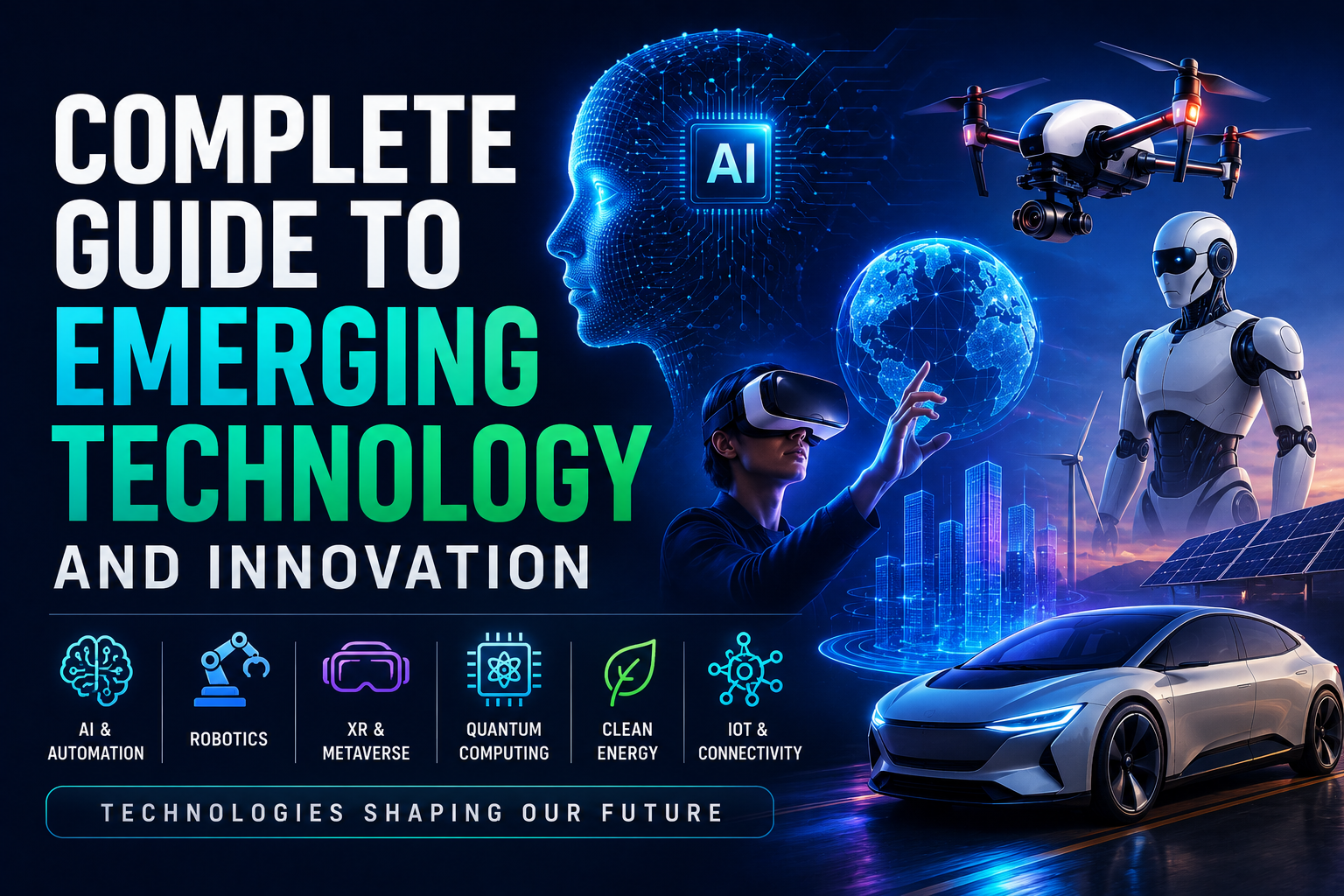
Complete Guide to Emerging Technology and Innovation
Technology is changing faster than at almost any other point in modern history. Artificial intelligence is becoming part of everyday software, robots are moving beyond factories, wearable devices are becoming more intelligent, and new computing technologies are challenging assumptions about what computers can do.
At the same time, innovation is not limited to futuristic gadgets. It is also transforming transportation, healthcare, energy, manufacturing, communication, entertainment and the way businesses operate.
Understanding emerging technology can therefore feel overwhelming. New terms appear constantly, while technologies that once seemed experimental can quickly become commercially available.
This guide explores the major areas shaping the future of technology, how they work, where they are being used and what they could mean for consumers and businesses.
What Is Emerging Technology?
Emerging technology refers to technologies that are relatively new, rapidly developing or moving toward wider adoption.
Some are still experimental. Others already exist commercially but are evolving quickly.
Examples include:
- Artificial intelligence
- Generative AI
- Robotics
- Quantum computing
- Extended reality
- Brain-computer interfaces
- Autonomous vehicles
- Advanced wearable technology
- Biotechnology
- Clean-energy technologies
- Internet of Things devices
- Advanced semiconductor technology
- Spatial computing
Not every emerging technology becomes mainstream.
Some disappear because they are too expensive, unreliable or difficult to scale. Others evolve into completely different products than originally expected.
That uncertainty is one of the defining characteristics of technological innovation.
Artificial Intelligence
Artificial intelligence is arguably the most influential emerging technology category today.
AI systems can analyze information, recognize patterns, generate content, understand language, interpret images and assist with complex tasks.
Traditional AI has been used for years in areas such as:
- Search engines
- Fraud detection
- Recommendation systems
- Spam filtering
- Navigation
- Industrial automation
- Medical analysis
Recent advances in machine learning have dramatically expanded what these systems can accomplish.
Generative AI
Generative AI refers to systems capable of producing new content based on instructions or other inputs.
Depending on the system, that content can include:
- Text
- Images
- Audio
- Video
- Computer code
- Presentations
- 3D assets
Generative AI is increasingly being incorporated into productivity software, search tools, creative applications and developer platforms.
One of its most important effects is that interacting with software can increasingly involve natural language rather than traditional menus and commands.
Instead of manually navigating a complex application, a user may eventually be able to describe the desired outcome and have AI perform much of the work.
AI Agents
A major development beyond basic AI assistants is the rise of AI agents.
An ordinary chatbot might answer a question.
An AI agent is designed to take actions toward a goal.
Depending on its permissions, an agent could potentially:
- Understand a task
- Break it into smaller steps
- Use software tools
- Retrieve information
- Make decisions within defined limits
- Complete actions
- Report the results
This could change how people interact with computers.
Instead of opening several applications and manually completing a workflow, users could increasingly delegate multi-step tasks to software agents.
The challenge will be making these systems reliable enough to operate safely without excessive human supervision.
Robotics
Robotics combines software, sensors, mechanical systems and artificial intelligence to create machines capable of interacting with the physical world.
Industrial robots have been used for decades, particularly in manufacturing.
Emerging robotics is expanding into more complicated environments.
Modern robots are being developed for areas such as:
- Warehouses
- Agriculture
- Healthcare
- Construction
- Logistics
- Domestic assistance
- Disaster response
- Space exploration
The combination of robotics and AI is particularly important.
A traditional robot may perform a carefully programmed sequence of movements. An AI-powered robot could potentially interpret its environment and adapt its behavior to changing circumstances.
For a deeper look at how these systems are developing, see The Future of Robotics.
Humanoid Robots
Humanoid robots are designed with body structures that resemble humans to varying degrees.
The reasoning behind the concept is straightforward: much of the human-built environment is designed around human bodies.
Stairs, doors, shelves, tools and workstations are generally designed for people.
A robot capable of operating in the same environment without extensive modifications could therefore have significant practical value.
Potential applications include:
- Manufacturing
- Warehousing
- Hospitality
- Healthcare assistance
- Dangerous industrial work
- Household tasks
However, humanoid robotics remains challenging.
Walking, grasping objects, understanding environments and safely interacting with humans require sophisticated hardware and software.
Autonomous Vehicles
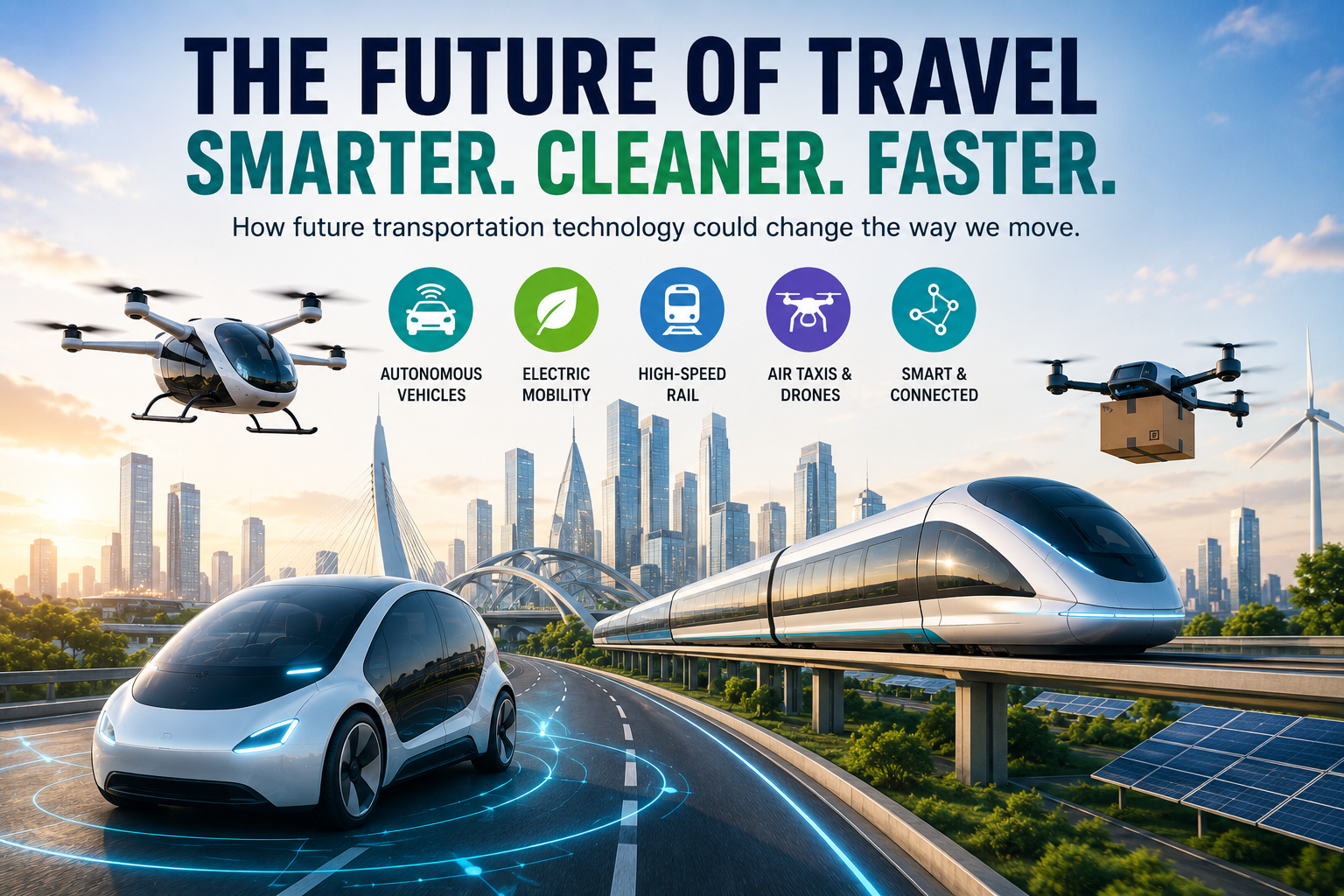
Autonomous vehicles use sensors, software and computing systems to understand their surroundings and make driving decisions.
Technologies involved can include:
- Cameras
- Radar
- LiDAR
- GPS
- Machine learning
- High-performance computing
- Mapping systems
Autonomous driving is often discussed as though vehicles are either fully autonomous or completely manual.
In reality, vehicle automation exists across different levels of capability.
Some systems assist drivers with individual tasks such as braking, steering or maintaining speed. More advanced systems can handle broader driving responsibilities under defined conditions.
Fully autonomous driving remains a significantly harder engineering and regulatory challenge.
Drones and Autonomous Aerial Systems
Drones have evolved from specialist equipment into widely used tools for photography, surveying, agriculture, logistics and industrial inspection.
Modern drones can use sophisticated navigation systems, cameras and automated flight capabilities.
Potential applications include:
- Crop monitoring
- Infrastructure inspection
- Mapping
- Search and rescue
- Environmental monitoring
- Delivery
- Filmmaking
As autonomous systems become more capable, drones may increasingly perform tasks without requiring continuous manual control.
The broader technology behind these systems is explored in The Complete Guide to Drones.
Extended Reality
Extended reality (XR) is an umbrella term covering technologies that combine digital content with physical or simulated environments.
The major categories include:
- Virtual reality
- Augmented reality
- Mixed reality
These technologies are changing the concept of a computer interface.
Instead of interacting with a computer exclusively through a flat screen, users can increasingly interact with digital objects in three-dimensional space.
Virtual Reality
Virtual reality places users inside digitally generated environments.
A VR headset tracks the user’s head movements and displays corresponding visual changes, creating the impression of looking around a virtual world.
VR is being used for:
- Gaming
- Training
- Education
- Design
- Simulation
- Therapy
- Virtual meetings
- Industrial visualization
The technology is particularly useful when experiencing something virtually is safer, cheaper or more practical than experiencing it physically.
For a more detailed explanation of the underlying technology and applications, see Virtual Reality Explained.
Augmented and Mixed Reality
Augmented reality overlays digital information onto the real world.
For example, an AR system might display directions, instructions or product information while the user looks at their physical surroundings.
Mixed reality goes further by allowing digital objects to interact more dynamically with the physical environment.
Potential applications include:
- Industrial maintenance
- Medical visualization
- Architecture
- Education
- Navigation
- Retail
- Remote assistance
The long-term goal for many developers is to make digital information feel like a natural part of the physical environment.
Spatial Computing
Spatial computing refers to computing experiences that understand physical space and allow users to interact with digital content in three dimensions.
It combines technologies such as:
- Cameras
- Depth sensors
- Motion tracking
- Computer vision
- 3D graphics
- Artificial intelligence
Instead of thinking of an application as something confined to a rectangular screen, spatial computing allows software to occupy the user’s environment.
This could eventually change how people design, communicate, work and consume entertainment.
Wearable Technology
Wearables have moved far beyond basic digital watches.
Modern wearable devices can monitor activity, provide notifications, track health-related measurements and interact with other devices.
Examples include:
- Smartwatches
- Fitness trackers
- Smart rings
- Smart glasses
- Connected hearing devices
- Wearable medical sensors
The next generation of wearables is likely to focus increasingly on context.
Rather than simply displaying information, devices may use AI to understand what the user is doing and provide assistance at the appropriate moment.
The broader development of these devices is covered in the Wearable Technology Guide.
Smart Glasses
Smart glasses are one of the most interesting areas of consumer technology.
They can combine cameras, microphones, speakers, connectivity and AI assistance within an ordinary-looking wearable.
Potential uses include:
- Hands-free communication
- Navigation
- Photography
- Translation
- Accessibility
- Real-time information
- AI assistance
However, smart glasses also create significant privacy questions.
A camera embedded in glasses is less obvious than a smartphone camera, creating concerns about recording people without their knowledge.
The success of smart glasses may therefore depend not only on technical capabilities but also on privacy design and public acceptance.
Brain-Computer Interfaces
Brain-computer interfaces, or BCIs, are designed to create communication pathways between brain activity and external devices.
Researchers are investigating BCIs for applications including:
- Restoring communication
- Controlling assistive devices
- Prosthetics
- Rehabilitation
- Neurological research
The technology is still developing and faces significant scientific, medical and ethical challenges.
Long-term possibilities could include more direct interaction between humans and computers.
However, the idea of connecting brains to digital systems also raises difficult questions about privacy, consent, security and ownership of neural data.
Quantum Computing
Traditional computers use bits that represent information using binary states.
Quantum computers use quantum bits, or qubits, which operate according to principles of quantum mechanics.
Quantum computing is not simply a faster version of an ordinary computer.
It uses fundamentally different computational methods that could provide advantages for certain specialized problems.
Potential applications include:
- Drug discovery
- Materials science
- Optimization
- Cryptography
- Scientific simulation
- Financial modeling
Quantum computing remains an emerging field, and building reliable large-scale quantum systems is extremely difficult.
For most everyday applications, conventional computers remain vastly more practical.
Why Quantum Computing Matters
The significance of quantum computing is not that it will replace laptops or smartphones.
Instead, its potential lies in solving certain problems that are extremely difficult for classical computers.
If scalable quantum computers become practical, they could have major implications for scientific research and cybersecurity.
One particularly important issue is cryptography.
Some widely used cryptographic systems could eventually be vulnerable to sufficiently powerful quantum computers, which is why researchers and governments are developing post-quantum cryptography.
The Internet of Things
The Internet of Things (IoT) refers to physical objects equipped with sensors, software and network connectivity.
Examples include:
- Smart thermostats
- Connected appliances
- Industrial sensors
- Smart lighting
- Security cameras
- Connected vehicles
- Agricultural monitoring systems
IoT devices collect information from the physical world and communicate that information through networks.
The result is an increasingly connected environment in which physical objects can be monitored and controlled digitally.
For a broader explanation of connected devices and their role in modern technology, see The Internet of Things Explained.
Edge Computing
Many connected devices generate enormous amounts of data.
Sending everything to a distant cloud server can introduce latency and consume network bandwidth.
Edge computing moves some processing closer to where the data is generated.
For example, a factory sensor could analyze information locally instead of sending every measurement to a remote data center.
This can provide:
- Lower latency
- Reduced bandwidth requirements
- Faster responses
- Greater resilience
- Potentially improved privacy
Edge computing is particularly important for autonomous vehicles, industrial systems, robotics and other applications where immediate decisions matter.
Cloud Computing
Cloud computing has already transformed the technology industry.
Instead of requiring organizations to own all their computing infrastructure, cloud platforms allow them to rent computing resources, storage and software over the internet.
Cloud computing supports:
- Websites
- Mobile applications
- AI systems
- Data analytics
- Online storage
- Streaming services
- Business software
Emerging technologies increasingly depend on cloud infrastructure.
AI models, for example, often require enormous computing resources that are difficult for individual users to provide locally.
The Rise of On-Device AI
At the same time, some AI processing is moving in the opposite direction.
Instead of sending every request to the cloud, smartphones, computers and other devices are increasingly capable of performing AI tasks locally.
This is sometimes called edge AI or on-device AI.
Potential advantages include:
- Faster responses
- Lower cloud costs
- Reduced network dependence
- Greater privacy for certain workloads
- Offline functionality
The future may therefore involve a combination of cloud AI and local AI rather than one completely replacing the other.
Advanced Semiconductors
Almost every modern technology trend depends on semiconductor technology.
AI accelerators, smartphones, electric vehicles, robots and data centers all require increasingly sophisticated chips.
Chip manufacturers are therefore developing smaller and more efficient semiconductor architectures while exploring new packaging technologies and specialized processors.
Rather than relying on one general-purpose processor for everything, modern systems increasingly combine specialized components optimized for different workloads.
Energy-Efficient Computing
As computing demand grows, energy efficiency is becoming increasingly important.
AI data centers, cloud infrastructure and high-performance computing systems can consume substantial amounts of electricity.
This is encouraging research into:
- More efficient processors
- Advanced cooling
- Specialized AI chips
- Improved data-center architecture
- New memory technologies
- Low-power computing
The future of computing is therefore not simply about making machines more powerful.
It is also about making them more efficient.
Biotechnology and Digital Health
Technology is increasingly intersecting with biology.
Advances in computing, genetics, sensors and machine learning are helping researchers study biological systems at unprecedented scales.
Emerging applications include:
- AI-assisted drug discovery
- Personalized medicine
- Digital diagnostics
- Wearable health monitoring
- Gene-editing technologies
- Synthetic biology
- Robotic surgery
The combination of biology and computing could significantly change healthcare.
However, technologies involving human health require especially careful testing, regulation and ethical oversight.
Synthetic Biology
Synthetic biology involves designing or modifying biological systems for useful purposes.
Researchers can engineer microorganisms to produce chemicals, materials, medicines and other products.
Potential applications include:
- Sustainable materials
- Medicine
- Agriculture
- Food production
- Environmental remediation
- Industrial manufacturing
The field combines biology, engineering and computing.
As the technology becomes more accessible, questions around safety, regulation and responsible experimentation will become increasingly important.
Clean Energy Technology
Innovation is also transforming the energy sector.
Solar power, wind energy, batteries, electric vehicles and other technologies are becoming increasingly important components of the global energy system.
Emerging areas include:
- Advanced batteries
- Solid-state batteries
- Grid-scale energy storage
- Green hydrogen
- Advanced solar technologies
- Smart electrical grids
- Carbon-management technologies
Energy innovation matters because electricity demand is closely connected to almost every other technological trend.
More AI, data centers, electric vehicles and connected devices mean greater demand for reliable electricity.
Battery Technology
Batteries are essential to the transition toward electric transportation and renewable energy.
Researchers are exploring battery chemistries and designs that could provide improvements in:
- Energy density
- Charging speed
- Safety
- Lifespan
- Cost
- Availability of raw materials
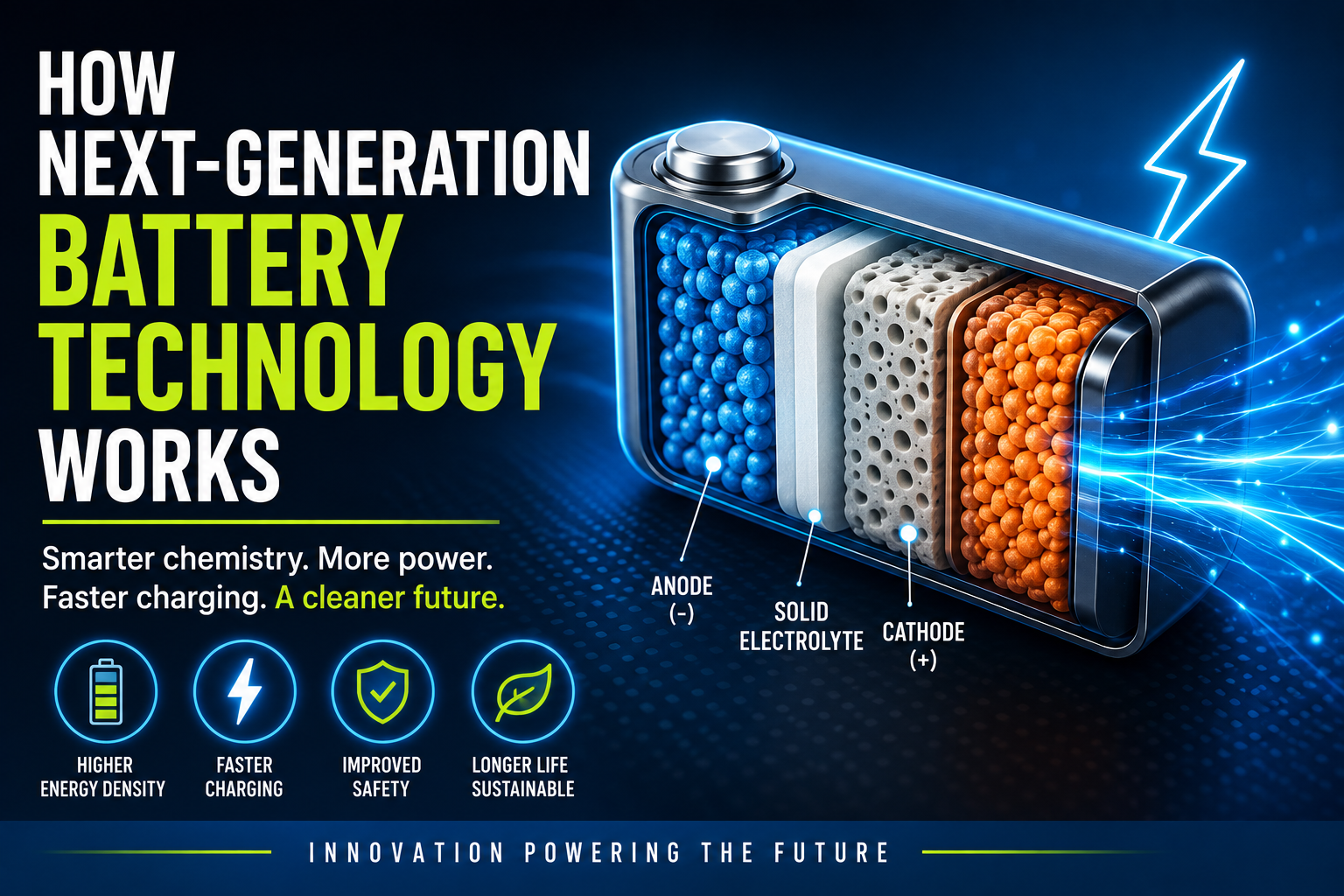
Solid-state batteries are one example of a technology attracting significant attention because they replace or alter the conventional liquid electrolyte architecture used in many existing batteries.
Commercial deployment, however, depends on factors such as manufacturing scale, cost and reliability.
For a deeper look at how newer battery technologies are being developed, see How Next-Generation Battery Technology Works.
Electric Vehicles
Electric vehicles use electric motors powered primarily by rechargeable batteries.
They have become one of the most visible examples of technology changing a major traditional industry.
Modern EV technology increasingly includes:
- Advanced driver assistance
- Software updates
- Connected vehicle services
- Regenerative braking
- Fast charging
- Battery-management systems
The automobile is gradually becoming a software-defined product as much as a mechanical one.
For a broader explanation of the technology behind electric vehicles, see Electric Vehicles Explained.
Smart Homes
Smart-home technology connects household devices to networks and allows them to communicate with users and each other.
Examples include:
- Smart lights
- Smart locks
- Smart thermostats
- Security systems
- Connected appliances
- Voice assistants
- Energy monitors
AI could make smart homes more useful by allowing systems to understand routines rather than simply responding to individual commands.
For example, a future home could automatically optimize heating, lighting and energy consumption based on occupancy and user preferences.
The broader systems behind connected homes are explored in The Complete Guide to Building an Intelligent Home.
3D Printing
3D printing, also known as additive manufacturing, creates physical objects layer by layer from digital designs.
The technology is already used in manufacturing, engineering, healthcare and prototyping.
Applications include:
- Product prototypes
- Automotive components
- Aerospace parts
- Medical implants
- Architectural models
- Customized products
One of its biggest advantages is the ability to produce complex or customized objects without requiring traditional manufacturing molds.
Digital Twins
A digital twin is a digital representation of a physical object, system or environment.
Sensors can provide real-world data that updates the digital model.
Companies can use digital twins to simulate:
- Buildings
- Factories
- Vehicles
- Machines
- Energy systems
- Cities
This can help identify problems before they occur in the physical world.
Blockchain Beyond Cryptocurrency
Blockchain technology is best known for cryptocurrencies, but its underlying architecture has been explored for other applications.
A blockchain is a distributed system for recording transactions or other information in a way designed to make unauthorized changes difficult.
Potential applications have included:
- Digital identity
- Supply-chain tracking
- Asset management
- Smart contracts
- Digital ownership
However, not every proposed blockchain application provides a meaningful advantage over conventional databases.
The technology is most useful when its specific characteristics solve a real problem.
Digital Identity
As more services move online, proving who someone is digitally becomes increasingly important.
Digital identity technologies aim to allow people to authenticate themselves securely without repeatedly sharing unnecessary personal information.
Emerging approaches include:
- Passkeys
- Digital credentials
- Decentralized identity systems
- Biometric authentication
- Cryptographic identity systems
A major goal is to make digital identity both more secure and easier to use.
Cybersecurity in the Age of Emerging Technology
Every new technology creates new security challenges.
AI can help defenders identify threats, but attackers can also use AI to automate phishing, generate malicious content or scale social engineering.
Connected devices create more potential entry points.
Robots can become physical security risks if compromised.
Brain-computer interfaces could eventually introduce entirely new categories of sensitive information.
Security therefore needs to be considered during the design of emerging technology rather than added after a product is completed.
Privacy and the Future of Technology
More intelligent technology generally requires more data.
Smart glasses may use cameras.
Wearables collect sensor information.
Smart homes monitor activity.
AI systems process user inputs.
Connected vehicles collect information about their surroundings.
This creates an important tension between convenience and privacy.
Consumers should be able to understand what data a product collects, why it collects it, where it is processed and how long it is retained.
Privacy-by-design principles will become increasingly important as computing moves further into everyday physical environments.
The Importance of Interoperability
Emerging technologies rarely operate in isolation.
A smart home may contain devices from multiple manufacturers.
A business may use several cloud platforms.
A wearable may need to communicate with a smartphone, health application and other services.
This makes interoperability increasingly important.
Open standards and compatible systems can prevent users from becoming permanently locked into one technology ecosystem.
Technology and the Future of Work
Automation and AI will change many jobs, but the impact is unlikely to be as simple as machines replacing humans across the board.
Technology can automate individual tasks while creating new responsibilities.
For example, AI might automate routine document analysis while increasing demand for people who can verify results, manage workflows and make higher-level decisions.
The future workplace is therefore likely to involve increasing collaboration between humans and software systems.
Skills such as critical thinking, communication, creativity and technological literacy may become even more valuable.
The Human Side of Innovation
Technological progress is not measured only by how advanced a machine becomes.
A technology is successful when it solves a meaningful problem.
A product with impressive specifications may fail if it is too expensive, difficult to use or socially unacceptable.
Meanwhile, a relatively simple innovation can transform an industry if it solves an important problem better than existing alternatives.
This is why innovation is about more than invention.
Invention creates something new. Innovation makes something new useful.
The Risks of Emerging Technology
Emerging technologies can produce enormous benefits, but they can also introduce serious risks.
Potential concerns include:
- Job displacement
- Cybersecurity threats
- Privacy violations
- Algorithmic bias
- Misinformation
- Surveillance
- Environmental costs
- Digital inequality
- Overdependence on technology
- Autonomous-system failures
These risks do not necessarily mean development should stop.
They mean innovation needs responsible governance, testing and public discussion.
Why Regulation Matters
Technology can evolve faster than laws and institutions.
Regulators therefore face a difficult balancing act.
Rules that are too weak may allow harmful technologies to spread unchecked.
Rules that are too restrictive may prevent beneficial innovation or make it difficult for smaller companies to compete.
Effective technology regulation should ideally protect people while allowing useful experimentation and responsible development.
How to Evaluate a New Technology
When a new gadget or technology becomes popular, marketing claims can make it difficult to distinguish genuine innovation from hype.
Ask several basic questions:
What problem does it solve?
If the problem is unclear, the technology may not have a compelling use case.
Is the technology actually ready?
A demonstration is not necessarily a reliable consumer product.
What does it cost?
Consider both the initial purchase price and ongoing costs.
What data does it collect?
Privacy matters, especially for connected devices.
What happens if it fails?
Understand the potential consequences of malfunction.
Is it interoperable?
Consider whether it works with the devices and services you already use.
Does it provide meaningful benefits?
The most exciting technology is not always the most useful technology.
What the Future Could Look Like
The most significant technological changes may not come from one revolutionary invention.
They may emerge from combinations.
AI combined with robotics could produce machines capable of performing increasingly complex physical tasks.
AI combined with wearable devices could create more personalized assistants.
AI combined with biotechnology could accelerate scientific discovery.
Quantum computing combined with advanced algorithms could address specialized scientific problems.
Smart energy systems combined with batteries and electric vehicles could reshape how electricity is generated, stored and consumed.
The future is therefore likely to be defined by convergence.
Technologies that once developed independently are increasingly becoming interconnected.
The Technology Trends Worth Watching
Several areas deserve particular attention over the coming years:
- Generative and agentic AI
- Humanoid and industrial robotics
- AI-powered wearables
- Spatial computing
- Autonomous transportation
- Quantum computing
- Advanced semiconductors
- Battery technology
- Biotechnology
- Digital health
- Cybersecurity
- Smart infrastructure
- Clean-energy systems
- Brain-computer interfaces
Not all of these technologies will develop at the same speed.
Some may exceed expectations. Others may encounter technical or economic limitations.
The important point is that each represents an area where researchers and businesses are actively attempting to expand the boundaries of what technology can do.
Innovation Is Becoming More Connected to Everyday Life
For decades, emerging technology often appeared in specialized laboratories before eventually reaching consumers.
That process is becoming less predictable.
Artificial intelligence can move from a research breakthrough to a consumer application quickly. Wearable devices can collect information continuously. Robots can operate alongside humans. Software can update physical products after they have been purchased.
The boundary between technology and everyday life is therefore becoming increasingly blurred.
For consumers, this means technological literacy is no longer only useful for technology professionals.
Understanding how emerging systems work—and knowing their benefits, limitations and risks—will become an increasingly important part of navigating modern life.
From Futuristic Ideas to Everyday Tools
Emerging technology is often described in terms of what might happen decades from now.
But the future rarely arrives all at once.
It usually appears through incremental improvements: a smarter phone, a more capable wearable, a better battery, a more useful AI assistant, a more efficient robot or a new software feature.
Some technologies will become indispensable. Others will disappear. A few will fundamentally change industries.
The most important question is therefore not simply “What technology comes next?”
It is “Which technologies can turn technical possibilities into useful, affordable and responsible solutions?”
That distinction will determine which innovations survive beyond the hype and become genuine parts of everyday life.