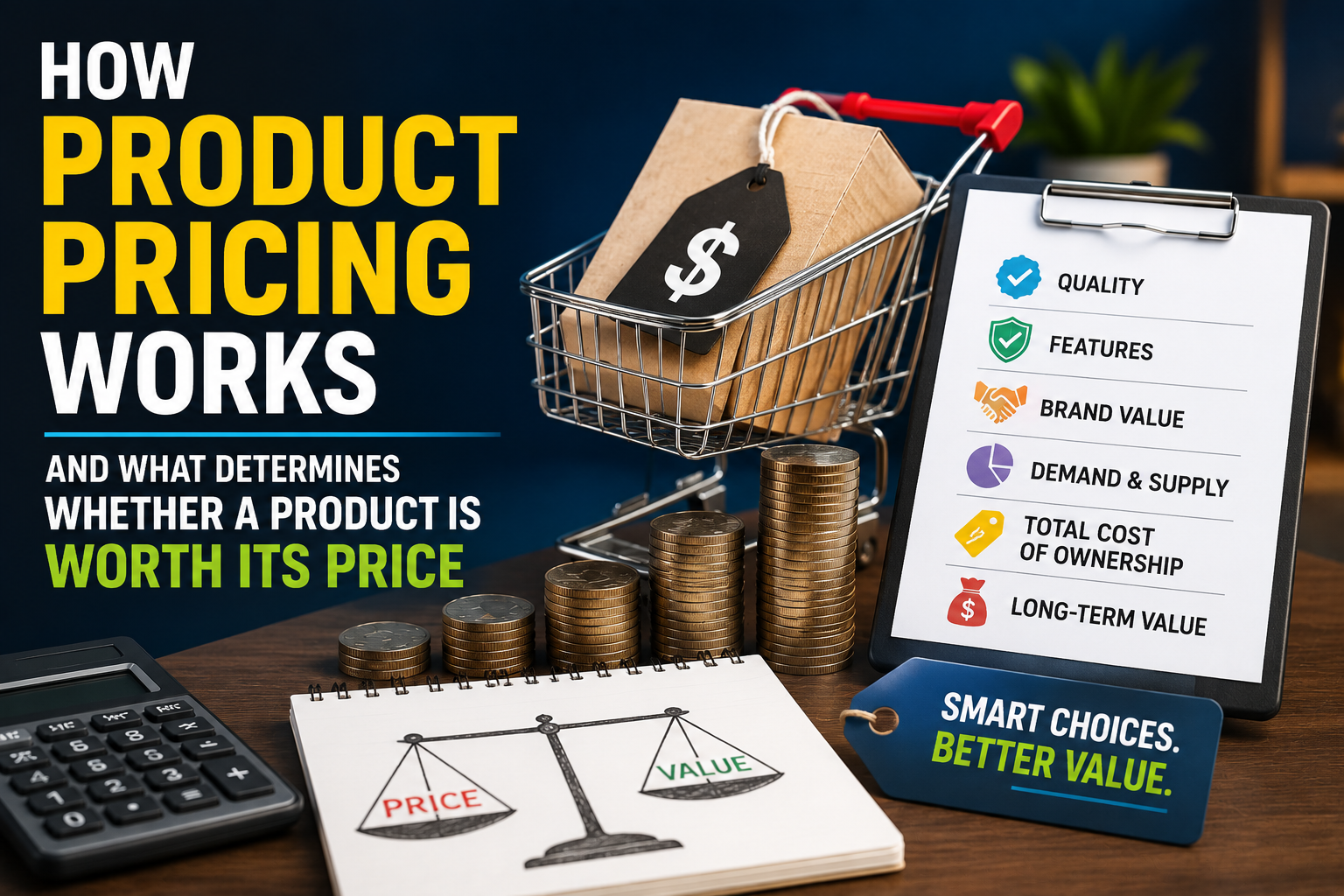
How Product Pricing Works and What Determines Whether a Product Is Worth Its Price
A product’s price can look deceptively simple.
A pair of headphones may cost $50 while another pair costs $300. A basic smartphone might sell for a few hundred dollars, while a flagship model can cost more than twice as much. Two nearly identical-looking products can also have surprisingly different prices.
That raises an important question for consumers:
What actually determines how much a product costs, and how can you tell whether it is worth the price?
The answer involves much more than manufacturing costs.
Product pricing is influenced by production expenses, supply and demand, competition, brand positioning, distribution, marketing, taxes, retailer margins, product quality, technology, customer expectations, and the perceived value of the product.
Understanding these factors can make shopping decisions much easier. Instead of assuming that an expensive product is automatically better—or that a cheap product is automatically a bargain—consumers can evaluate what they are actually receiving for their money.
For a broader framework on evaluating products before buying, see The Complete Guide to Choosing the Right Products.
What Is Product Pricing?
Product pricing is the process of determining how much a business charges customers for a product.
A company’s pricing decision usually needs to account for several objectives at once.
The business needs to:
- Cover its costs
- Generate a profit
- Remain competitive
- Attract customers
- Communicate the product’s market position
- Respond to demand
- Support long-term business goals
A price can therefore serve several purposes beyond simply recovering the cost of making an item.
For example, a premium price may communicate exclusivity or advanced quality, while a low price may be used to attract customers quickly or compete in a highly price-sensitive market.
The Difference Between Cost and Price
One of the most important concepts in understanding pricing is the difference between cost and price.
Cost refers to what a company spends to create, acquire, market, distribute, and sell a product.
Price is what the customer pays.
Suppose a company spends $40 producing and distributing a product and sells it for $70.
The $30 difference is not necessarily pure profit. The business may still have expenses such as salaries, software, rent, taxes, customer support, research, advertising, and administrative costs.
This is why looking only at manufacturing cost rarely explains a product’s retail price.
What Is Profit Margin?
Profit margin measures how much of a company’s revenue remains after certain costs are accounted for.
A simplified gross-margin calculation is:
Gross Margin = (Selling Price − Cost of Goods Sold) ÷ Selling Price × 100
For example, if a product sells for $100 and its cost of goods sold is $60:
($100 − $60) ÷ $100 × 100 = 40%
The company has a 40% gross margin before other operating expenses.
Margins vary dramatically between industries and products.
A physical product with substantial manufacturing and distribution costs may have a different margin structure from software, luxury goods, financial products, or professional services.
Supply and Demand Influence Prices
One of the most fundamental forces affecting prices is supply and demand.
When demand is high and supply is limited, sellers may be able to charge more.
When supply is abundant and demand is weak, businesses may need to lower prices to encourage purchases.
This relationship can be seen during product launches, shortages, seasonal sales, and major changes in consumer preferences.
A product does not necessarily become more expensive because it costs more to manufacture.
Sometimes it becomes more expensive because many people want it and relatively few units are available.
Scarcity Can Increase Perceived Value
Limited availability can influence what consumers are willing to pay.
Scarcity can result from:
- Limited production
- Rare materials
- Seasonal availability
- Exclusive releases
- Geographic restrictions
- Collectible status
- Temporary supply disruptions
Businesses sometimes intentionally produce limited quantities to create exclusivity.
This can make consumers perceive a product as more desirable even when its functional characteristics are not dramatically different from those of more widely available alternatives.
Competition Places Pressure on Pricing
Companies rarely set prices in isolation.
They need to consider what competitors charge for similar products.
If several companies offer comparable products for $50, a new competitor may struggle to sell an equivalent product for $100 without offering a compelling reason.
That reason could be:
- Better quality
- Stronger warranty
- Better customer service
- More features
- Superior design
- Greater durability
- A trusted brand
- A unique technology
Competitive pricing therefore depends on how customers perceive differences between products.
The Cheapest Product Is Not Always the Best Value
Price comparisons can be misleading if consumers compare only the initial purchase price.
Imagine two products:
- Product A costs $100 and lasts two years.
- Product B costs $160 and lasts five years.
Product B costs more upfront but may be less expensive over its useful life.
A simple way to examine this is to calculate the approximate annual ownership cost.
Product A:
$100 ÷ 2 years = $50 per year
Product B:
$160 ÷ 5 years = $32 per year
In this simplified example, the more expensive product provides a lower annual cost.
This is why price and value are not the same thing. The Product Value Guide: How to Find the Best Value provides a broader framework for comparing price, quality, durability, performance, and ownership costs.
What Does “Worth the Price” Actually Mean?
A product is worth its price when the benefits it provides are sufficiently valuable to the buyer relative to what the buyer gives up to obtain it.
That value is personal.
A $1,000 laptop may be unnecessary for someone who only browses the internet and writes occasional documents.
For a professional video editor, software developer, engineer, or designer, that same laptop might save enough time and provide enough performance to justify the expense.
Value depends on the buyer, the use case, and the alternatives available.
Price-to-Value Ratio
Consumers can think about purchasing decisions using a simple concept: the relationship between price and useful benefits.
A product offering significantly more useful performance for only slightly more money may have strong value.
Another product might be twice as expensive while providing only marginal improvements.
That does not automatically make the second product a bad purchase.
It simply means its additional benefits need to matter enough to justify the additional cost.
Features Do Not Automatically Create Value
Manufacturers often advertise long lists of features.
More features can make a product appear more advanced, but additional features do not necessarily make it more valuable.
A feature is valuable when the customer actually benefits from it.
For example, a smartphone with an extremely sophisticated camera system may be worth paying extra for someone who regularly photographs professional content.
For someone who mainly uses a phone for messaging, navigation, and calls, the same camera system may have little practical value.
The important question is not:
“How many features does it have?”
It is:
“How many of those features will I actually use?”
Brand Reputation Can Affect Price
Branding is another major component of product pricing.
Consumers may be willing to pay more for a brand they associate with:
- Quality
- Reliability
- Design
- Innovation
- Customer service
- Status
- Longevity
- Resale value
A strong brand can reduce perceived purchasing risk.
If customers believe a company’s products are consistently reliable, they may be willing to pay a premium compared with an unfamiliar manufacturer.
However, brand reputation should not be confused with objective value.
A well-known brand can produce excellent products, but the brand name itself does not guarantee that every product is worth its asking price.
Premium Pricing and Luxury Products
Some products deliberately use high prices as part of their positioning.
This is known as premium pricing.
Luxury brands may charge significantly more than production costs would suggest because customers are purchasing more than functionality.
They may also be paying for:
- Design
- Exclusivity
- Heritage
- Craftsmanship
- Status
- Experience
- Brand identity
For these products, perceived value is a significant part of the pricing strategy.
Whether the premium is worthwhile depends heavily on what the buyer values.
For a direct comparison of value-focused and premium products, see Best Value vs Premium Products Explained.
Psychological Pricing Influences Perception
Businesses also use pricing techniques designed to influence how consumers perceive prices.
One familiar example is pricing an item at $9.99 instead of $10.
Other strategies include:
- Anchoring
- Discount framing
- Bundle pricing
- Tiered pricing
- Premium positioning
- Decoy pricing
- Limited-time offers
These techniques can influence how consumers evaluate a product.
For example, if a retailer presents a product as “normally $200, now $129,” the $200 figure can become an anchor against which the sale price is evaluated.
Consumers should therefore consider whether the discounted price represents genuine value rather than assuming that a large advertised discount automatically means a good deal.
Discounts Can Be Misleading
A discount is valuable only if the original price is meaningful and the product is something the consumer actually needs.
Buying a $100 product for $70 does not save $30 if the product would never have been purchased without the promotion.
The consumer still spends $70.
This is one reason shoppers should ask:
“Would I buy this product at the current price if I had not seen the discount?”
That question can help separate genuine value from promotional psychology.
Retailers Add Their Own Costs
The price consumers see in stores or online can include several layers between the manufacturer and the final buyer.
A simplified supply chain might look like:
Manufacturer → Distributor → Retailer → Consumer
Each stage may have its own costs and margin requirements.
Expenses can include:
- Transportation
- Warehousing
- Insurance
- Retail operations
- Customer service
- Payment processing
- Marketing
- Returns
- Inventory management
The final retail price therefore reflects the economics of the entire distribution system.
Taxes and Import Costs Affect Final Prices
The advertised product price may not always represent the final amount a consumer pays.
Depending on the country and product, the final cost may include:
- Sales tax
- Value-added tax
- Import duties
- Customs charges
- Shipping
- Handling fees
- Local levies
This is particularly important when comparing products across countries.
A product that appears cheaper in one market may become considerably more expensive after taxes, shipping, or import costs are included.
Currency Exchange Rates Matter
International consumers also need to consider exchange rates.
A product priced at $500 may not have the same effective cost for consumers in different countries.
Currency fluctuations can change the local price of imported products even when the manufacturer has not changed its U.S.-dollar price.
This is one reason consumer electronics and other internationally traded products can experience significant price differences between markets.
Manufacturing Costs Influence Price
Manufacturing remains an important component of pricing.
Costs can include:
- Raw materials
- Components
- Labor
- Factory equipment
- Energy
- Quality control
- Packaging
- Production waste
Products requiring specialized components or complex manufacturing processes can cost more to produce.
However, manufacturing cost alone does not determine retail price.
A product with relatively inexpensive components can still command a high price if customers perceive its design, brand, technology, or other benefits as valuable.
Research and Development Can Be Expensive
Some products require years of research before they reach consumers.
Technology companies, pharmaceutical manufacturers, automobile companies, aerospace firms, and other industries may spend substantial amounts on research and development.
The price of successful products can help companies recover those investments.
R&D spending can cover:
- Product design
- Engineering
- Prototyping
- Testing
- Software development
- Research
- Regulatory work
- Product certification
Consumers therefore sometimes pay for years of development that are not visible in the finished product.
Marketing Also Contributes to the Cost
Companies spend significant amounts on making consumers aware of their products.
Marketing expenses can include:
- Advertising
- Influencer campaigns
- Sponsorships
- Product demonstrations
- Retail displays
- Public relations
- Content creation
- Search advertising
Those costs can eventually become part of the economics behind the product’s price.
This does not mean that heavily marketed products are automatically overpriced.
Marketing can help a company build demand, reach customers, and create a profitable distribution system.
But consumers should recognize that they are sometimes paying indirectly for the cost of creating and maintaining a product’s market presence.
Customer Service and Warranty Have Value
A product’s price can also reflect what happens after the sale.
Two products may have similar specifications but very different levels of after-sales support.
One manufacturer may provide:
- A longer warranty
- Local repair centers
- Replacement parts
- Telephone support
- Software updates
- Easy returns
Another may offer minimal support.
The first product may reasonably cost more because the manufacturer is providing additional services and assuming greater warranty obligations.
For expensive purchases, these services can be particularly valuable.
Total Cost of Ownership Matters
The purchase price is only one part of the cost of owning many products.
Total cost of ownership, or TCO, considers expenses that occur throughout the product’s useful life.
Depending on the product, these may include:
- Purchase price
- Accessories
- Maintenance
- Repairs
- Replacement parts
- Energy consumption
- Subscriptions
- Insurance
- Consumables
- Upgrades
- Disposal
A printer is a classic example.
The printer itself may be relatively inexpensive, but replacement ink can represent a substantial long-term expense.
Similarly, an inexpensive appliance that consumes large amounts of electricity may cost more over several years than a more efficient model.
Subscriptions Can Change the Real Price
Some products increasingly depend on recurring payments.
A device may have a relatively low upfront cost but require a monthly or annual subscription for certain features.
Examples can include:
- Cloud storage
- Security services
- Software
- Connected-device features
- Premium support
- Content services
Consumers should calculate the long-term subscription cost rather than evaluating only the initial purchase price.
A $200 device with a $10 monthly subscription costs another $120 per year.
Over several years, the recurring cost can become larger than the original purchase price.
Durability Is an Important Part of Value
Durability can significantly influence whether a product is worth its price.
A durable product may cost more initially but require fewer replacements.
This is especially important for products that are expensive or difficult to replace.
When comparing products, consumers should consider:
- Materials
- Construction quality
- Expected lifespan
- Repairability
- Availability of replacement parts
- Warranty coverage
- Historical reliability
A product designed to last longer can provide better value even if its initial price is higher.
Repairability Can Lower Long-Term Costs
Repairability is another factor that is often overlooked.
If a product can be repaired easily, consumers may be able to replace an individual component rather than the entire product.
This can be especially valuable for:
- Smartphones
- Laptops
- Appliances
- Bicycles
- Vehicles
- Power tools
A repairable product can potentially remain useful for longer, reducing replacement costs.
Resale Value Can Change the Economics
Some products retain more of their value than others.
Vehicles, smartphones, cameras, computers, watches, and certain consumer electronics can have meaningful resale markets.
Suppose one product costs $1,000 but can be resold for $500 after three years, while another costs $800 but is worth only $100 after the same period.
The initial prices suggest that the second product is cheaper.
But the effective ownership cost tells a different story.
Product A:
$1,000 − $500 resale value = $500 ownership cost
Product B:
$800 − $100 resale value = $700 ownership cost
Resale value can therefore be an important component of overall value.
Reviews Can Help, but They Are Not the Final Answer
Product reviews are useful because they can reveal experiences that specifications do not show.
Reviews may identify:
- Build-quality problems
- Software bugs
- Battery-life issues
- Comfort concerns
- Reliability problems
- Poor customer support
- Unexpected strengths
- Long-term weaknesses
However, reviews should be interpreted in context.
A reviewer may have different priorities from the buyer.
A professional photographer may evaluate a camera differently from a casual traveler.
A gamer may prioritize performance differently from someone who mainly uses a computer for office work.
The most useful review is therefore one that evaluates the product against your intended use case.
Specifications Need Context
Manufacturers often highlight specifications because they provide measurable points of comparison.
These can include:
- Processor speed
- Storage capacity
- Screen resolution
- Battery capacity
- Camera resolution
- Weight
- Dimensions
- Memory
- Power consumption
Specifications are useful, but higher numbers do not automatically mean a better product.
A larger battery does not guarantee better battery life.
A higher camera megapixel count does not automatically produce better photographs.
More storage is useful only if the buyer needs it.
Consumers should therefore focus on real-world performance rather than comparing numbers in isolation.
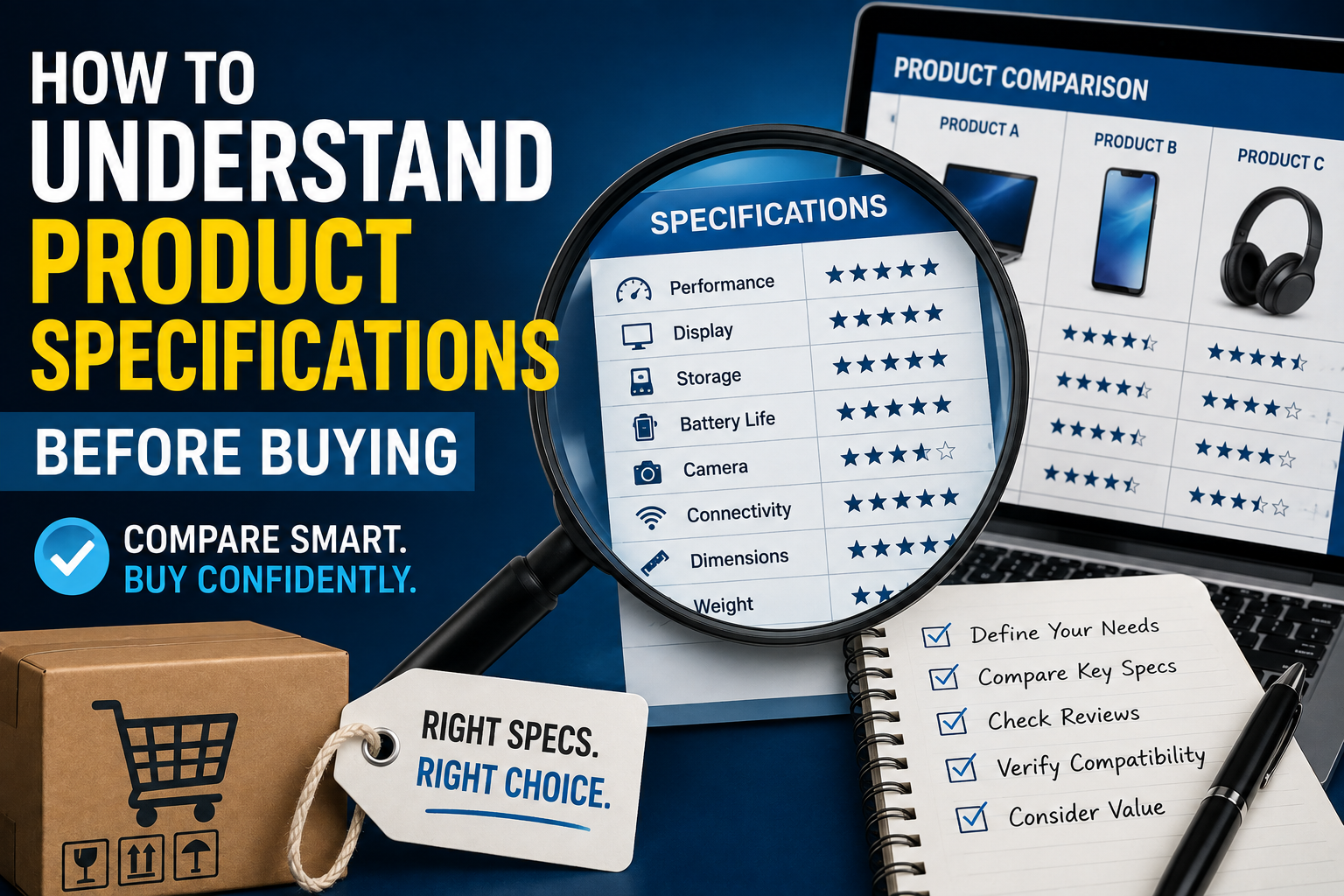
For a deeper explanation of interpreting technical specifications, see How to Understand Product Specifications Before Buying.
Opportunity Cost Is Part of the Price
Every purchase involves an opportunity cost.
Money spent on one product cannot be spent on something else.
If someone spends $1,500 on a premium smartphone, that money cannot simultaneously be used for a laptop, vacation, savings, education, or another financial priority.
A product can therefore be objectively excellent and still be a poor purchase for a particular person.
The question is not only:
“Is this product good?”
It is also:
“Is this the best use of my money right now?”
Personal Use Determines Value
The same product can have completely different value for different buyers.
Consider a professional camera.
For a professional photographer, its advanced autofocus, lens compatibility, image quality, and reliability may directly contribute to income.
For someone who takes occasional vacation photos, a smartphone camera may provide sufficient quality.
The professional camera is not necessarily overpriced.
It simply delivers benefits that one buyer values far more than another.
How to Compare Products Properly
A useful product comparison should go beyond price.
Consumers can compare products across several categories:
| Factor | Questions to Ask |
|---|---|
| Price | What is the actual purchase cost? |
| Quality | How well is it built? |
| Performance | Does it meet my needs? |
| Durability | How long is it likely to last? |
| Features | Which features will I actually use? |
| Warranty | What protection comes with the purchase? |
| Repairability | Can it be repaired economically? |
| Running costs | What will I pay after purchase? |
| Support | How good is customer service? |
| Resale value | Could I recover part of the cost later? |
| Reviews | What do long-term users report? |
This framework makes comparisons more meaningful than simply choosing the product with the lowest price.
Beware of Paying for Features You Do Not Need
One of the easiest ways to overspend is buying a product designed for needs you do not have.
Manufacturers often divide products into basic, mid-range, and premium models.
The premium version may include advanced capabilities that are impressive but unnecessary for the average consumer.
Before upgrading, ask:
Will this feature meaningfully improve how I use the product?
If the answer is no, the cheaper model may provide better value.
When Paying More Makes Sense
There are legitimate reasons to spend more.
A higher-priced product may be worth the additional cost if it provides:
- Significantly better durability
- Meaningfully better performance
- Longer software support
- Lower operating costs
- Better safety
- Superior comfort
- Better warranty protection
- Greater repairability
- Higher resale value
- A feature that is genuinely important to the buyer
The key is that the additional benefit should matter.
When a Cheaper Product Is the Better Choice
A cheaper product may be the better purchase when:
- It meets all of your essential requirements.
- The more expensive alternatives offer unnecessary features.
- Reliability is comparable.
- Long-term ownership costs are similar.
- Warranty and support are adequate.
- You do not need premium performance.
- The product is unlikely to be used heavily.
Paying more simply because a product has a premium label does not automatically create additional value.
Watch Out for False Economies
A low purchase price can sometimes hide higher long-term costs.
Examples include:
- Cheap appliances with high energy consumption
- Inexpensive printers with costly ink
- Low-cost products that break frequently
- Devices with expensive proprietary accessories
- Products with short warranties
- Cheap tools that need frequent replacement
The lowest price is therefore not necessarily the lowest cost.
Calculate the Cost Per Use
For products used frequently, cost per use can be a helpful way to think about value.
Suppose a $200 pair of shoes is worn 400 times.
$200 ÷ 400 uses = $0.50 per use
Another pair costs $100 but lasts only 100 uses.
$100 ÷ 100 uses = $1 per use
The more expensive pair has a lower cost per use.
This approach can work particularly well for:
- Clothing
- Shoes
- Tools
- Kitchen equipment
- Fitness equipment
- Luggage
- Electronics
The method is not perfect, but it encourages consumers to consider longevity rather than focusing exclusively on upfront price.
Price Changes Can Create Better Buying Opportunities
Product prices are not always static.
Retailers may discount products because of:
- New model releases
- Seasonal promotions
- Excess inventory
- Holiday sales
- Competitive pressure
- Product discontinuation
Understanding normal pricing can help consumers identify genuine opportunities.
If a product is regularly discounted, a supposed “limited-time” promotion may not be particularly unusual.
Price tracking can therefore be useful for expensive purchases.
New Products Often Carry a Premium
Newly released products sometimes cost more because manufacturers are targeting early adopters.
These customers may be willing to pay for access to the latest technology.
As competition increases and manufacturing becomes more efficient, prices may eventually decline.
Waiting can therefore be financially sensible when a product is not urgently needed.
However, waiting also has an opportunity cost.
A buyer may decide that having the product earlier is worth more than the potential savings from waiting.
Product Value Changes Over Time
A product that is worth its price today may not offer the same value several years later.
Technology becomes outdated.
Competitors introduce better products.
Repair parts become harder to find.
Software support eventually ends.
This is particularly important for technology products.
When evaluating an expensive device, consumers should consider not only its current capabilities but also how long it is likely to remain useful.
How to Decide Whether a Product Is Worth It
Before making a purchase, consumers can work through a simple process.
Step 1: Define the Need
Identify the actual problem the product needs to solve.
Step 2: Set a Realistic Budget
Determine how much you can comfortably spend without compromising more important financial priorities.
Step 3: Identify Essential Features
Separate must-have features from attractive extras.
Step 4: Compare Alternatives
Look at several products rather than evaluating one in isolation.
Step 5: Check Long-Term Costs
Consider maintenance, subscriptions, accessories, repairs, energy use, and replacement costs.
Step 6: Evaluate Reliability
Look for information about long-term ownership rather than only first impressions.
Step 7: Consider the Warranty
A strong warranty can reduce the financial risk of an expensive purchase.
Step 8: Think About Resale Value
For certain products, resale value can significantly affect total ownership cost.
Step 9: Ask Whether the Upgrade Matters
If you already own a similar product, determine whether the improvement is substantial enough to justify replacing it.
Step 10: Sleep on Expensive Purchases
Waiting before buying can help distinguish genuine need from temporary excitement.
The Difference Between Expensive and Overpriced
These terms are not interchangeable.
An expensive product has a high price.
An overpriced product has a price that is difficult to justify based on the value it provides to the target customer.
A product can be expensive but excellent value.
Another product can be relatively cheap but still overpriced if it provides poor quality, has high operating costs, or fails quickly.
The appropriate question is therefore not:
“Is it expensive?”
It is:
“What am I receiving in exchange for the money I am spending?”
Value Is the Real Measure of a Purchase
Product pricing is shaped by a complex combination of economics, competition, manufacturing, branding, distribution, consumer psychology, technology, and perceived value.
That is why two products with similar production costs can have dramatically different retail prices.
For consumers, the most useful approach is to look beyond the number on the price tag.
Consider how well the product solves the intended problem. Examine its quality and expected lifespan. Look at warranties, repairability, running costs, subscriptions, and resale value. Compare meaningful features rather than impressive specifications.
Most importantly, evaluate the product against your own needs.
A $300 product that solves an important problem for years may be a better purchase than a $100 product that disappoints after a few months. Likewise, a $1,500 premium model may be unnecessary when a $700 alternative does everything the buyer actually needs.
The best purchase is rarely the most expensive or the cheapest option.
It is the product that delivers the right combination of usefulness, quality, longevity, reliability, and overall ownership cost for the person buying it.