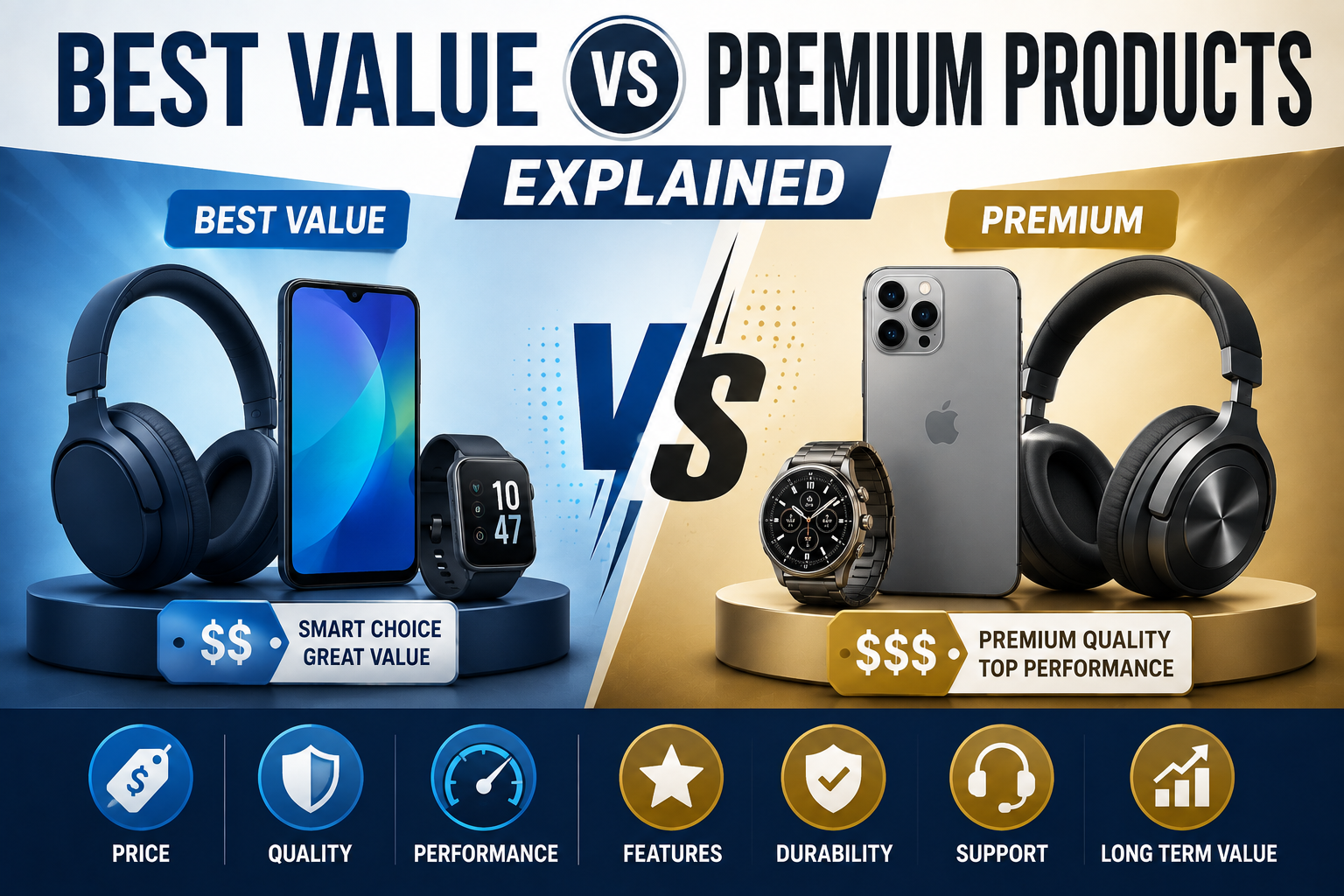
Best Value vs Premium Products Explained
Whether you’re shopping for a smartphone, laptop, kitchen appliance, television, running shoes, or household tool, you’ll often face the same question: Should you buy the best-value option or invest in a premium product? While premium products promise top-tier performance and advanced features, value-focused products aim to deliver the best balance of quality and affordability.
Choosing between the two isn’t always straightforward. A higher price doesn’t automatically mean a better purchase, and the cheapest option isn’t always the most economical in the long run. The right choice depends on your budget, priorities, usage, and long-term needs.
This guide explains the differences between value and premium products, their advantages and disadvantages, and how to determine which option offers the best value for your specific situation. For a broader framework covering product selection, specifications, reviews, durability, and ownership costs, see The Complete Guide to Choosing the Right Products.
What Are Best Value Products?
Best value products provide the strongest combination of price, quality, performance, and reliability within a particular category.
Rather than simply being inexpensive, value products aim to maximize what consumers receive for every dollar spent.
Characteristics often include:
- Competitive pricing
- Reliable performance
- Good durability
- Essential features
- Strong customer reviews
- Affordable maintenance
- Practical design
- Broad appeal
Value products are designed to satisfy the needs of most buyers without including expensive extras that many people may never use.
What Are Premium Products?
Premium products are positioned at the higher end of the market and typically emphasize superior materials, advanced technology, enhanced performance, refined design, and exclusive features.
Common characteristics include:
- High-quality materials
- Advanced engineering
- Premium finishes
- Longer feature lists
- Enhanced performance
- Brand prestige
- Luxury aesthetics
- Extended warranties or premium support
Premium products often target consumers who prioritize performance, innovation, or long-term ownership over initial purchase price.
Why This Comparison Matters
Understanding the difference between value and premium products helps consumers make smarter purchasing decisions.
A thoughtful comparison can help you:
- Avoid overspending
- Maximize long-term value
- Choose products that fit your needs
- Reduce buyer’s remorse
- Improve return on investment
- Prioritize important features
The best purchase isn’t necessarily the cheapest or the most expensive—it’s the one that offers the greatest overall value for your circumstances.
Price vs. Value
Price and value are closely related, but they are not the same.
- Price is the amount you pay.
- Value is what you receive in return.
A premium product may justify its higher cost if it lasts longer, performs better, or offers features you’ll use regularly. Likewise, a lower-priced product can represent excellent value if it reliably meets your needs.
For a deeper look at the relationship between price, quality, performance, and usefulness, see How Product Pricing Works and What Determines Whether a Product Is Worth Its Price.
Performance Differences
Performance is often one of the biggest distinctions between value and premium products.
Best Value Products
Typically provide:
- Reliable everyday performance
- Solid build quality
- Core features
- Good efficiency
- Consistent usability
Premium Products
Often offer:
- Faster performance
- Higher-quality components
- Additional capabilities
- Greater precision
- Enhanced user experience
The performance gap varies by product category and may be more noticeable for professional or intensive use.
Build Quality
Premium products frequently use higher-end materials.
Examples include:
- Aluminum instead of plastic
- Stainless steel instead of coated metals
- Premium fabrics
- Tempered glass
- Higher-grade electronics
- Improved manufacturing tolerances
Value products generally prioritize functional durability while keeping costs lower.
When durability is a major part of the purchasing decision, How to Determine Whether a Product Is Durable and Reliable provides a useful framework for evaluating long-term product quality.
Features and Technology
Premium models often include advanced features that may not be available in budget-friendly alternatives.
Examples include:
- AI-powered functions
- Better displays
- Faster processors
- Advanced camera systems
- Smart connectivity
- Noise cancellation
- Enhanced safety technologies
- Premium software experiences
However, many users may never fully utilize these additional capabilities.
Reliability
Reliability depends on design, manufacturing quality, and long-term testing rather than price alone.
Many value products earn excellent reputations by offering dependable performance over many years.
For a more comprehensive approach to investigating this factor before purchasing, see the Complete Guide to Evaluating Product Reliability Before Buying.
Reading professional reviews and long-term user feedback can provide valuable insights into real-world reliability.
Long-Term Cost of Ownership
Purchase price is only one part of overall ownership cost.
Other expenses may include:
- Maintenance
- Repairs
- Replacement parts
- Software subscriptions
- Energy consumption
- Accessories
- Extended warranties
A higher-priced product that lasts significantly longer may ultimately cost less over its lifetime.
For a detailed breakdown of these expenses, see the Product Ownership Costs: Complete Guide to True Cost.
Brand Reputation
Established brands often build trust through consistent quality, customer support, and product reliability.
Premium brands may offer:
- Better service
- Longer software support
- Easier access to repairs
- More extensive warranties
- Strong resale value
However, lesser-known brands sometimes provide exceptional value by offering similar performance at lower prices.
Who Should Choose Best Value Products?
Value-focused products are often ideal for:
- Students
- First-time buyers
- Casual users
- Families
- Budget-conscious shoppers
- Individuals replacing older equipment
- Consumers who prioritize practicality
If a product satisfies your everyday needs, paying extra for premium features may not provide meaningful benefits.
Who Should Consider Premium Products?
Premium products may be worth the investment for:
- Professionals
- Enthusiasts
- Frequent users
- Creative professionals
- Gamers
- Business users
- Individuals seeking maximum performance
When a product directly supports work, productivity, or daily use, additional performance and durability may justify the higher cost.
Common Buying Mistakes
Consumers sometimes make purchasing decisions based on marketing rather than actual needs.
Common mistakes include:
- Buying features you’ll never use
- Choosing the cheapest option without considering quality
- Ignoring long-term ownership costs
- Overlooking warranty coverage
- Focusing only on brand prestige
- Skipping independent reviews
- Purchasing without comparing alternatives
Careful research often leads to better purchasing decisions.
How to Compare Products
Before buying, evaluate products using consistent criteria.
Consider:
- Price
- Performance
- Features
- Build quality
- Warranty
- Repairability
- Customer reviews
- Professional reviews
- Long-term reliability
- Total ownership cost
Comparing these factors provides a clearer picture than focusing on specifications alone.
Questions to Ask Before Buying
Ask yourself:
- How often will I use this product?
- Which features do I actually need?
- Will premium features improve my experience?
- How long do I plan to keep it?
- Is repair or replacement likely?
- Does the warranty provide good coverage?
- What do long-term reviews say?
- Does the higher price provide measurable benefits?
Answering these questions helps identify the option that best matches your needs.
Examples Across Product Categories
Smartphones
Premium phones often offer faster processors, superior cameras, brighter displays, and longer software support, while value phones provide excellent everyday performance at a lower cost.
Laptops
Premium laptops may feature higher-resolution displays, lighter materials, longer battery life, and more processing power, whereas value models are suitable for web browsing, office work, and media consumption.
Kitchen Appliances
Premium appliances often include advanced features, quieter operation, and longer lifespans, while value models handle everyday cooking and food preparation effectively.
Home Electronics
Premium televisions, speakers, and headphones typically deliver improved image quality, sound performance, and build quality, although value models continue to improve significantly.
Emerging Trends
Advances in manufacturing and competition are narrowing the gap between value and premium products.
Current trends include:
- AI-powered consumer devices
- Better mid-range performance
- Longer software support
- Sustainable materials
- Improved energy efficiency
- Repair-friendly designs
- Smart home integration
- Enhanced product durability
Many mid-range products now deliver experiences that were once exclusive to premium devices.
Tips for Making Smarter Buying Decisions
Before making a purchase:
- Set a realistic budget.
- Prioritize essential features.
- Read independent reviews.
- Compare long-term ownership costs.
- Check warranty terms.
- Consider repairability.
- Avoid impulse purchases.
- Wait for seasonal discounts when possible.
- Buy based on your actual needs rather than marketing claims.
- Focus on overall value instead of price alone.
For additional guidance on making structured purchasing decisions, see How to Make Better Buying Decisions When Choosing Products.
Thoughtful research often results in greater satisfaction and better long-term value.
Final Thoughts
The choice between best value and premium products ultimately depends on your priorities, budget, and intended use. Premium products often provide outstanding performance, advanced technology, and refined design, but they are not always the most economical choice. Likewise, value products can deliver exceptional reliability and functionality without unnecessary expense.
By comparing performance, durability, features, long-term ownership costs, and real-world reviews, consumers can make informed purchasing decisions that maximize value rather than simply minimizing price. In many cases, the smartest purchase is not the most expensive product on the shelf—it is the one that best meets your needs while providing the greatest return on your investment.