What IT Governance Is and How Organizations Manage Technology Decisions, Accountability and Risk
Technology has become central to almost every modern organization. Companies depend on software, cloud platforms, data systems, networks, cybersecurity tools, artificial intelligence, and digital services to operate and compete.
But having technology is not the same as managing it effectively.
Organizations need to decide which technologies to adopt, how much to spend, who should have access to systems, how risks should be controlled, and how technology investments should support broader business goals. These decisions can become complicated as companies grow and their technology environments become more interconnected.
This is where IT governance comes in.
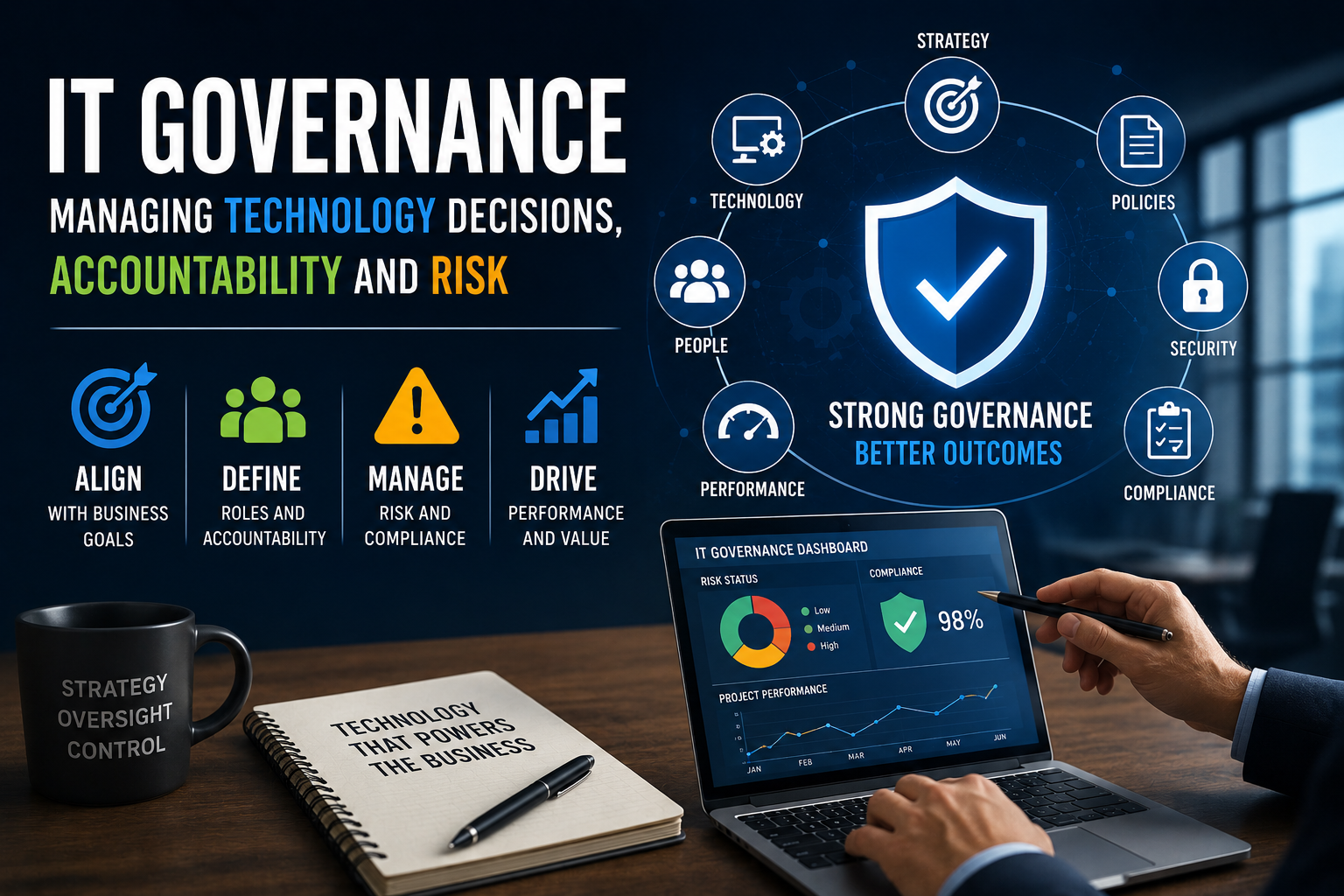
IT governance provides a framework for making technology decisions in a structured, accountable, and risk-aware way. It connects technology management with business objectives while establishing responsibilities, controls, policies, and oversight.
For organizations looking at technology as a broader business capability, the Complete Guide to Business Software provides useful context for understanding how different software systems fit into business operations.
What Is IT Governance?
IT governance is the system of processes, policies, responsibilities, and decision-making structures an organization uses to direct and control its information technology.
Its purpose is to make sure technology supports the organization’s objectives while risks are identified and managed.
IT governance can address questions such as:
- Which technology investments should the organization make?
- Who has authority to approve major IT projects?
- How should technology budgets be allocated?
- Who is responsible when a technology project fails?
- How should sensitive information be protected?
- Which risks are acceptable?
- How should vendors and cloud services be evaluated?
- How should technology performance be measured?
- What policies should employees follow?
- How should the organization respond to technology failures?
The exact structure varies depending on the size and nature of the organization, but the underlying objective remains similar: make technology decisions deliberately rather than leaving them to chance or isolated departments.
IT Governance Is Different From IT Management
IT governance and IT management are closely related, but they are not the same thing.
IT governance focuses primarily on direction, accountability, oversight, decision rights, and alignment with organizational objectives.
IT management focuses more directly on executing and operating technology.
For example, governance may determine that an organization needs stronger cybersecurity controls and establish who is responsible for approving security investments.
IT management may then implement security software, configure systems, monitor networks, and respond to incidents.
In simple terms, governance helps answer “What should we do, why, and who is accountable?”, while management focuses more heavily on “How do we execute it?”
Why Organizations Need IT Governance
Technology decisions can have significant financial and operational consequences.
A poorly selected software platform can lock a company into expensive contracts. An inadequately secured system can expose sensitive information. A failed technology project can consume substantial resources without delivering its expected benefits.
Organizations also face increasing technology complexity.
A typical company might simultaneously use:
- Cloud infrastructure
- Business applications
- Databases
- Mobile devices
- Collaboration platforms
- Artificial intelligence tools
- Customer-facing websites
- Payment systems
- Cybersecurity products
- Third-party services
- Data analytics platforms
Without a coordinated approach, technology decisions can become fragmented.
Different departments may purchase overlapping tools, security standards may vary between systems, and critical responsibilities may be unclear.
IT governance provides a structure for bringing these decisions together.
Aligning Technology With Business Goals
One of the most important objectives of IT governance is alignment.
Technology should support what the organization is actually trying to achieve.
A retail company may prioritize e-commerce, customer analytics, payment infrastructure, and inventory systems. A manufacturing company may focus on automation, supply-chain technology, industrial systems, and operational data.
A financial institution may place particularly strong emphasis on security, reliability, regulatory compliance, and data management.
IT governance helps ensure that technology investments are connected to these business priorities.
Rather than asking only whether a technology is impressive, decision-makers can ask whether it solves a meaningful business problem.
Technology Investment Requires Prioritization
Organizations rarely have unlimited technology budgets.
There may be dozens of potential projects competing for funding.
Governance helps establish a process for deciding which projects receive priority.
Projects can be evaluated according to factors such as:
- Expected business value
- Cost
- Risk reduction
- Strategic importance
- Customer impact
- Regulatory requirements
- Operational efficiency
- Implementation complexity
- Expected return on investment
- Resource requirements
This can prevent technology spending from being driven primarily by the loudest department or the newest trend.
A structured approach to evaluating technology purchases can be especially useful here. Organizations can assess requirements, costs, risks, integration needs, scalability, and expected returns before committing to a solution.
IT Governance Creates Clear Decision Rights
One of the most important questions in technology management is simply: Who gets to decide?
Without clearly defined decision rights, organizations can experience delays, duplicated work, or disputes over responsibility.
Governance can establish who has authority over different categories of decisions.
For example:
- Senior leadership may approve major technology investments.
- A chief information officer may oversee enterprise technology strategy.
- A chief information security officer may oversee cybersecurity policies.
- Data leaders may establish data governance standards.
- Business units may approve technology needed for their operations.
- Technical teams may make implementation decisions within established boundaries.
The precise arrangement depends on the organization.
The important principle is that authority should be explicit rather than assumed.
The Role of the Board and Senior Leadership
Technology governance is not exclusively an IT department responsibility.
Boards and senior executives increasingly need to understand technology because major business risks can originate from technology systems.
Senior leadership may oversee questions involving:
- Cybersecurity
- Digital transformation
- Technology investment
- Data protection
- Artificial intelligence
- Business continuity
- Technology-related regulatory obligations
- Major system failures
The board does not necessarily need to manage technical details.
Its role is generally more focused on oversight, risk, accountability, and ensuring that technology supports organizational strategy.
The CIO’s Role in IT Governance
The chief information officer, or CIO, often plays an important role in connecting technology with business leadership.
A CIO may be responsible for developing technology strategy, managing IT operations, overseeing technology investments, and helping senior leadership understand technology-related opportunities and risks.
However, the CIO’s exact responsibilities vary considerably between organizations.
In some companies, the CIO primarily oversees internal technology operations. In others, the role may extend into digital transformation, data, artificial intelligence, customer technology, or broader business strategy.
Regardless of the organizational structure, effective governance requires technology leadership to communicate in terms that business leaders can understand.
Cybersecurity Is a Governance Issue
Cybersecurity is often treated as a technical function, but it is also a governance responsibility.
Security decisions involve risk tolerance, financial investment, legal obligations, business continuity, and organizational accountability.
Governance can establish questions such as:
- What level of cyber risk is acceptable?
- Which systems are considered critical?
- Who is responsible for security decisions?
- How frequently should security controls be reviewed?
- How should serious incidents be escalated?
- What security requirements should vendors meet?
- How should employees handle sensitive information?
Technical teams implement controls, but leadership ultimately needs to understand and manage the business risks associated with cybersecurity.
Managing Technology Risk
Every technology environment contains risk.
Systems can fail. Software can contain vulnerabilities. Employees can make mistakes. Vendors can experience outages. Data can be lost or exposed.
IT governance provides a framework for identifying and managing these risks.
Organizations may assess risks according to factors such as:
- Likelihood
- Potential financial impact
- Operational consequences
- Customer impact
- Legal or regulatory consequences
- Reputation
- Recovery difficulty
Once risks are identified, organizations can decide whether to avoid, reduce, transfer, or accept them.
Risk Appetite Guides Technology Decisions
Not every risk can be eliminated.
Attempting to eliminate every possible technology risk could be prohibitively expensive and could prevent an organization from adopting useful technologies.
Instead, organizations often establish a risk appetite.
Risk appetite describes the amount and type of risk an organization is willing to accept while pursuing its objectives.
For example, a company may accept relatively low risks associated with an internal productivity application while maintaining extremely strict controls around payment systems or sensitive customer information.
Governance helps ensure these decisions are deliberate rather than accidental.
Compliance Is Part of IT Governance
Organizations may be subject to laws, regulations, contractual obligations, and industry standards that affect how technology and data must be managed.
Compliance requirements can involve:
- Data protection
- Financial information
- Healthcare information
- Payment systems
- Employee records
- Cybersecurity
- Record retention
- Industry-specific controls
IT governance helps translate these requirements into organizational policies and technical controls.
Compliance should not simply mean checking boxes before an audit. Effective governance integrates compliance requirements into everyday technology decisions.
Data Governance and IT Governance
Data has become one of the most valuable assets in many organizations.
Companies use data to understand customers, manage operations, make forecasts, develop products, and train artificial intelligence systems.
Data governance establishes rules for how data is collected, classified, stored, accessed, used, shared, and protected.
This can involve:
- Data ownership
- Data quality
- Access controls
- Privacy
- Retention
- Classification
- Metadata
- Data security
- Regulatory compliance
Data governance and IT governance often overlap because technology systems provide the infrastructure through which data is stored and processed.
For organizations building more mature data capabilities, the Complete Guide to Business Data Management explains the broader processes involved in managing business data effectively.
Artificial Intelligence Creates New Governance Questions
The rapid adoption of AI has introduced new governance challenges.
Organizations need to determine which AI systems employees can use, what information they can provide to AI tools, how AI-generated outputs should be reviewed, and which decisions should remain under human control.
Governance may also address:
- AI security
- Data privacy
- Intellectual property
- Model accuracy
- Bias
- Transparency
- Human oversight
- Third-party AI services
- AI agent permissions
The challenge is to encourage useful AI adoption without allowing uncontrolled experimentation to create unacceptable risks.
Shadow IT Can Undermine Governance
Shadow IT refers broadly to technology systems or applications used within an organization without appropriate approval or oversight.
Employees may adopt unauthorized tools because they are convenient or because official systems do not meet their needs.
For example, an employee might use an unapproved cloud storage service to share files or an external AI application to summarize confidential documents.
The employee may be trying to solve a legitimate problem, but the organization may lose visibility into where sensitive information is going.
Effective governance should therefore balance control with usability.
If official technology processes are excessively slow or difficult, employees may be more likely to bypass them.
Vendor Management Is a Governance Responsibility
Organizations increasingly depend on third-party technology providers.
These can include:
- Cloud providers
- Software vendors
- Managed service providers
- Cybersecurity companies
- Payment processors
- Data providers
- AI platforms
- Consultants
Third-party relationships can introduce additional risks.
A vendor may experience a security breach, service outage, financial problem, or operational failure that affects its customers.
IT governance can establish processes for evaluating vendors before contracts are signed and monitoring important relationships afterward.
Cloud Computing Changes Technology Governance
Cloud computing has changed how organizations acquire and operate technology.
Instead of purchasing and maintaining every server themselves, organizations can obtain computing resources from cloud providers.
This can improve flexibility and scalability, but it also changes responsibility.
Organizations must understand which security, compliance, availability, and data-management responsibilities belong to the cloud provider and which remain with the customer.
Governance helps define these responsibilities and establish appropriate oversight.
Technology Architecture Needs Governance Too
Enterprise architecture describes how an organization’s technology systems fit together.
Without architectural governance, companies can accumulate disconnected applications and duplicated systems.
A governance framework can establish standards for:
- Software platforms
- APIs
- Databases
- Cloud services
- Security architecture
- Integration
- Infrastructure
- Data flows
The goal is not necessarily to force every system into a single technology.
Instead, architectural governance helps ensure that technology decisions fit together in a manageable and sustainable way.
IT Policies Turn Governance Into Rules
Governance principles need to be translated into practical policies.
An organization may create policies covering:
- Password and authentication requirements
- Acceptable technology use
- Data classification
- Software installation
- Remote access
- Device management
- Cloud usage
- AI usage
- Cybersecurity
- Incident response
- Vendor management
Policies establish expectations for employees and technology teams.
They also provide a basis for enforcement and accountability.
Controls Help Enforce Policies
Policies alone are not enough.
Organizations need controls that help ensure policies are followed.
Controls can be administrative, technical, or physical.
Examples include:
- Multi-factor authentication
- Access approvals
- Network monitoring
- Security logging
- Automated backups
- Encryption
- Change-management procedures
- Segregation of duties
- Periodic access reviews
Good governance connects policies with measurable controls.
Change Management Reduces Unnecessary Disruption
Technology environments are constantly changing.
Software is updated, systems are migrated, applications are replaced, and new infrastructure is introduced.
Poorly managed changes can cause outages or unexpected security problems.
Change management provides a structured process for evaluating and approving significant changes.
A typical process may consider:
- What is changing?
- Why is the change necessary?
- What could go wrong?
- How will the change be tested?
- Who must approve it?
- When should it happen?
- How can the organization recover if something fails?
The objective is not to prevent change.
It is to make change more predictable.
IT Governance Supports Business Continuity
Technology failures can interrupt business operations.
A company may lose access to important applications because of a cyberattack, hardware failure, software problem, power outage, natural disaster, or supplier disruption.
Business continuity and disaster recovery planning help organizations prepare for these situations.
Governance establishes expectations around:
- Critical systems
- Recovery priorities
- Backup requirements
- Recovery time objectives
- Recovery point objectives
- Emergency responsibilities
- Testing
- Communication
Planning does not eliminate failures, but it can reduce their consequences.
Measuring IT Performance
Organizations need ways to determine whether technology investments are producing useful results.
Governance can establish key performance indicators and other measures.
These might include:
- System availability
- Incident response time
- Security incidents
- Project delivery performance
- Technology spending
- User satisfaction
- System performance
- Automation rates
- Project benefits
- Recovery performance
The most useful metrics are connected to business outcomes rather than simply measuring how busy the IT department is.
Data analytics and business intelligence can also help organizations turn operational information into measurable insights. The Complete Guide to Data Analytics for Business explores how businesses use analytics to understand performance and support decision-making.
Technology Projects Need Accountability
Large technology projects can fail for many reasons.
Requirements may be unclear. Costs can increase. Timelines can slip. Employees may resist new systems. Integrations can prove more difficult than expected.
IT governance can introduce project-stage reviews and clear ownership.
Major projects may be required to demonstrate:
- A clear business case
- Defined objectives
- Approved budget
- Assigned leadership
- Risk assessment
- Implementation plan
- Success metrics
- Post-project evaluation
This creates accountability throughout the project lifecycle.
Governance Helps Avoid Technology for Technology’s Sake
Technology can be exciting, particularly when new developments such as artificial intelligence, cloud computing, automation, or advanced analytics attract attention.
But adopting technology simply because it is fashionable can produce disappointing results.
Governance encourages organizations to ask practical questions:
What problem are we solving?
What value will this create?
What risks will it introduce?
How much will it cost?
How will success be measured?
These questions help separate meaningful technology investments from projects driven primarily by hype.
IT Governance Frameworks Provide Structure
Organizations do not necessarily have to design governance systems from scratch.
Various frameworks and standards provide guidance for areas such as IT governance, information security, risk management, service management, and internal controls.
Frameworks can help organizations define processes, responsibilities, controls, and measurement approaches.
However, a framework should be adapted to the organization’s circumstances.
A small business does not necessarily need the same governance structure as a multinational corporation with thousands of employees and highly regulated operations.
Governance Should Match Organizational Size
The complexity of governance should generally reflect the complexity of the organization.
A small company may need only a few core policies, clear decision-making responsibilities, basic security controls, vendor oversight, and a straightforward technology budget.
A large enterprise may require multiple committees, specialized governance functions, formal architecture review, extensive risk management, detailed compliance processes, and board-level oversight.
Too little governance can create uncontrolled risk.
Too much bureaucracy can slow innovation and make technology unnecessarily difficult to manage.
The objective is to find an appropriate balance.
The Importance of Accountability
Good IT governance makes responsibility visible.
When an important system fails, organizations need to know who owns the system, who manages the risk, who approved the relevant decisions, and who is responsible for fixing the problem.
This does not mean governance exists to assign blame.
Instead, clear accountability makes it easier to identify gaps and improve future decisions.
Without ownership, important risks can fall between organizational departments.
Transparency Builds Trust
Technology decisions can involve significant amounts of money and affect employees, customers, and business partners.
Transparency helps stakeholders understand why major decisions are being made.
For example, an organization might explain why it is replacing a core application, changing a cloud provider, introducing an AI system, or increasing cybersecurity spending.
Transparency does not mean revealing confidential information.
It means providing enough information for appropriate stakeholders to understand the reasoning, responsibilities, and expected outcomes behind significant decisions.
IT Governance and Digital Transformation
Digital transformation often involves changing fundamental aspects of how an organization operates.
That can make governance even more important.
Transformation projects may involve new business models, cloud migration, automation, artificial intelligence, customer platforms, and major changes to data infrastructure.
Without governance, transformation can become a collection of disconnected projects.
With effective governance, technology initiatives can be prioritized around strategic objectives and managed according to shared principles.
Organizations exploring this broader relationship can also see how Complete Guide to Digital Transformation for Businesses connects technology adoption with wider organizational change.
Governance Should Support Innovation
Good governance should not automatically mean saying no to new technology.
Organizations need room to experiment.
A useful governance model can establish controlled environments where new technologies can be tested without exposing critical systems or sensitive information unnecessarily.
For example, an organization might allow employees to experiment with a new AI tool using non-confidential information before considering an enterprise-wide deployment.
This approach creates a balance between innovation and risk management.
Building an Effective IT Governance Model
Organizations developing or improving IT governance can begin with several fundamental questions.
1. What Are the Business Priorities?
Technology governance should begin with organizational objectives.
2. Who Makes Which Decisions?
Decision rights should be clearly assigned.
3. What Are the Most Important Technology Risks?
Organizations should identify risks that could materially affect operations, finances, customers, or reputation.
4. Which Policies Are Necessary?
Policies should address the organization’s most important technology and information risks.
5. How Will Performance Be Measured?
Technology investments should have meaningful performance and business-outcome measures.
6. How Will Governance Be Reviewed?
Technology changes over time, so governance processes should also evolve.
Common IT Governance Mistakes
Several problems can weaken otherwise well-designed governance systems.
Treating Governance as an IT-Only Responsibility
Technology decisions affect the entire organization, so business leaders need to participate.
Creating Too Much Bureaucracy
Excessive approval processes can slow useful technology initiatives.
Focusing Only on Compliance
Compliance is important, but governance should also address business value, risk, performance, and strategy.
Ignoring Human Behavior
Employees may bypass systems that are inconvenient. Governance should account for how people actually work.
Failing to Measure Outcomes
Approving a project is not the same as proving that it delivered value.
Allowing Responsibilities to Remain Unclear
If nobody clearly owns a system or risk, problems can remain unresolved.
Treating Technology Risk as Static
New applications, vendors, threats, and regulations can change an organization’s risk profile.
The Future of IT Governance
Technology governance will continue to evolve as organizations adopt new technologies.
Artificial intelligence, autonomous software agents, cloud computing, connected devices, automation, and increasingly distributed digital infrastructure will create new decision-making challenges.
Organizations will need governance systems capable of answering questions that were less important in previous technology environments.
Who is accountable when an AI system makes an important decision?
What permissions should an autonomous software agent have?
How should organizations govern data used to train AI systems?
How quickly should security policies change when new threats emerge?
How should organizations balance experimentation with regulatory and operational risk?
These questions demonstrate that IT governance is becoming increasingly connected to overall corporate governance.
Making Technology Accountable to the Business
Technology can create extraordinary opportunities, but its value depends on how intelligently it is managed.
IT governance provides the structure needed to connect technology decisions with business objectives, establish accountability, control risk, protect information, and measure results.
Its purpose is not to make technology departments slower or surround every decision with bureaucracy. Effective governance should do the opposite: create enough clarity and control for organizations to make confident technology decisions while leaving room for responsible innovation.
As businesses become increasingly dependent on digital systems, the question is no longer simply whether an organization has good technology.
It is whether the organization knows why it is using that technology, who is responsible for it, what risks it creates, how its performance is measured, and whether it is actually helping achieve the organization’s goals.
That is the central purpose of IT governance—and it is becoming an increasingly important part of responsible business leadership.