Data Analytics for Business Guide
In today’s data-driven economy, information has become one of the most valuable business assets. Every customer interaction, online transaction, marketing campaign, and operational process generates data that can reveal valuable insights. Organizations that effectively analyze this information can make smarter decisions, improve efficiency, reduce costs, identify new opportunities, and gain a competitive advantage.
Data analytics is no longer reserved for large corporations with dedicated data science teams. Advances in cloud computing, artificial intelligence, and business intelligence platforms have made data analysis more accessible to businesses of all sizes.
This guide explains what business data analytics is, why it matters, the different types of analytics, key tools, implementation strategies, and emerging trends shaping the future of data-driven decision-making.
Data analytics is also an important capability within the wider technology environment used by modern organizations. The Complete Guide to Business Software provides broader context on the business applications and technology systems that support organizational operations.
## What Is Business Data Analytics?
Business data analytics is the process of collecting, organizing, analyzing, and interpreting data to support informed business decisions.
Rather than relying solely on intuition, organizations use analytics to identify patterns, measure performance, forecast outcomes, and improve operations.
Business data may come from numerous sources, including:
-
Sales transactions
-
Customer relationship management (CRM) systems
-
Websites
-
Mobile applications
-
Marketing campaigns
-
Financial records
-
Supply chain systems
-
Social media platforms
-
Customer feedback
-
Internet of Things (IoT) devices
The goal is to transform raw information into actionable insights.
For organizations building a modern data environment, analytics is closely connected to business data management, databases, cloud computing, and IT infrastructure.
## Why Data Analytics Matters
Organizations generate more information than ever before.
Effective analytics helps businesses:
-
Make better decisions
-
Improve customer experiences
-
Increase operational efficiency
-
Reduce costs
-
Identify market trends
-
Measure business performance
-
Detect fraud
-
Improve forecasting
-
Optimize inventory
-
Support innovation
Companies that consistently use data to guide decisions are often better positioned to respond to changing market conditions.
Reliable analytics also depends on the systems used to store and manage information. Businesses can learn more about these foundations in our complete guide to database software and complete guide to databases.
## Types of Business Analytics
Business analytics can generally be divided into four major categories.
### Descriptive Analytics
Descriptive analytics explains what has already happened.
Examples include:
-
Monthly sales reports
-
Website traffic summaries
-
Revenue dashboards
-
Customer demographics
These reports provide historical insight into business performance.
### Diagnostic Analytics
Diagnostic analytics explores why something happened.
Businesses may investigate:
-
Sales declines
-
Marketing campaign performance
-
Customer churn
-
Operational bottlenecks
This type of analysis helps uncover the causes behind business outcomes.
### Predictive Analytics
Predictive analytics uses historical data, statistical models, and machine learning to estimate future outcomes.
Common applications include:
-
Sales forecasting
-
Customer demand prediction
-
Inventory planning
-
Risk assessment
-
Equipment maintenance forecasting
Predictions help organizations prepare for likely future scenarios.
### Prescriptive Analytics
Prescriptive analytics recommends possible actions based on available data.
Examples include:
-
Product recommendations
-
Pricing optimization
-
Route planning
-
Resource allocation
-
Marketing optimization
This approach supports decision-making by evaluating multiple potential strategies.
## Common Business Analytics Tools
Organizations use a wide variety of technologies to analyze data.
Popular categories include:
-
Business intelligence (BI) platforms
-
Spreadsheet software
-
Database management systems
-
Data visualization tools
-
Statistical analysis software
-
Cloud analytics platforms
-
Artificial intelligence solutions
-
Machine learning platforms
-
Dashboard applications
-
Data warehouse systems
The appropriate solution depends on organizational size, complexity, and business goals.
Cloud computing has made many analytics capabilities easier to deploy and scale. Organizations considering cloud-based data environments can explore the complete guide to cloud computing for businesses for additional background.
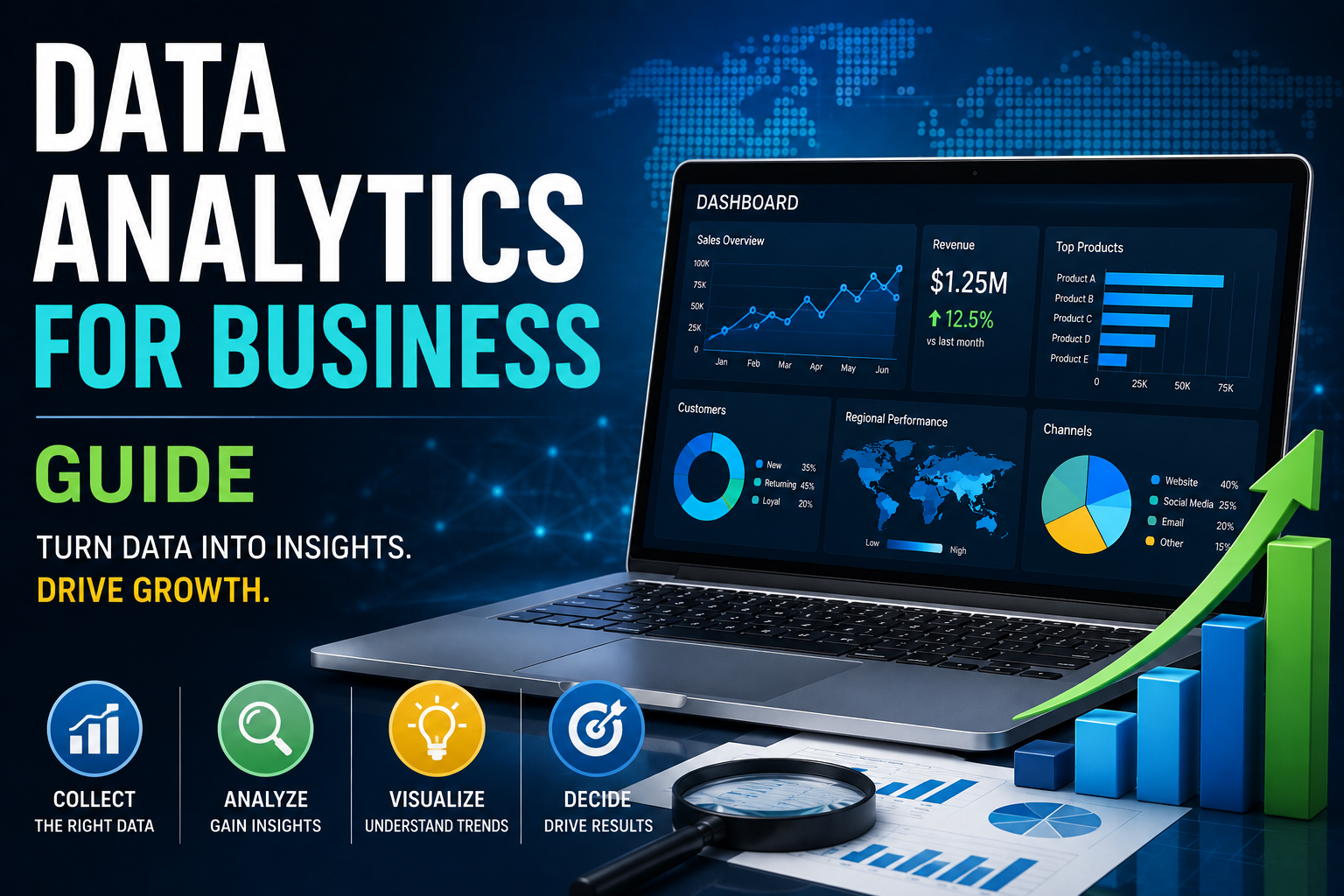
## The Data Analytics Process
Successful analytics projects typically follow several key stages.
### 1. Data Collection
Organizations gather information from relevant internal and external sources.
### 2. Data Cleaning
Incomplete, duplicate, or inaccurate records are corrected or removed to improve data quality.
### 3. Data Organization
Information is structured into databases, warehouses, or cloud storage systems.
The way information is represented and processed also depends on underlying data structures, which are fundamental to software and data systems.
### 4. Data Analysis
Analytical methods identify patterns, relationships, and trends.
### 5. Visualization
Charts, dashboards, and reports make complex information easier to understand.
### 6. Decision-Making
Business leaders use analytical insights to support strategic and operational decisions.
## Key Business Metrics
Different organizations monitor different performance indicators.
Common metrics include:
-
Revenue growth
-
Profit margins
-
Customer acquisition cost
-
Customer lifetime value
-
Conversion rate
-
Employee productivity
-
Inventory turnover
-
Website traffic
-
Customer retention
-
Return on investment (ROI)
Tracking meaningful metrics allows organizations to measure progress over time.
## Data Visualization
Visualizing information makes complex data easier to interpret.
Popular visualization formats include:
-
Line charts
-
Bar charts
-
Pie charts
-
Heat maps
-
Dashboards
-
Geographic maps
-
Scatter plots
-
Trend graphs
Clear visualizations help decision-makers quickly identify important patterns.
## The Role of Artificial Intelligence
Artificial intelligence is transforming business analytics by automating many analytical tasks.
AI-powered analytics can assist with:
-
Pattern recognition
-
Demand forecasting
-
Customer segmentation
-
Fraud detection
-
Predictive maintenance
-
Recommendation systems
-
Natural language queries
-
Automated reporting
These capabilities allow businesses to extract insights more efficiently from growing volumes of data.
AI applications also rely on reliable databases, cloud infrastructure, APIs, and data-management systems. Businesses interested in the broader technology environment can explore the Cloud Computing Explained guide.
## Data Governance
Reliable analytics depends on trustworthy data.
Good governance includes:
-
Data quality standards
-
Access controls
-
Security policies
-
Documentation
-
Privacy compliance
-
Data ownership
-
Regular audits
-
Backup procedures
Strong governance improves confidence in business decisions.
Effective governance is a core part of business data management, particularly when information is distributed across multiple systems and departments.
Organizations also need clear technology responsibilities and decision-making processes when managing data, analytics platforms, and other technology systems. The guide to IT governance and technology decision-making explains how governance can establish accountability, oversight, and risk management around technology.
## Challenges in Business Analytics
Organizations often encounter obstacles when implementing analytics programs.
Common challenges include:
-
Poor data quality
-
Data silos
-
Limited technical expertise
-
Integration difficulties
-
Privacy concerns
-
Cybersecurity risks
-
High implementation costs
-
Resistance to organizational change
Addressing these challenges requires both technical planning and organizational commitment.
Data integration can be particularly important when analytics platforms need information from multiple applications. APIs provide one way for systems to exchange information, making an APIs and Integrations Guide for Developers useful for understanding this part of the technology environment.
## Analytics Across Business Functions
Nearly every department can benefit from data analysis.
### Marketing
Analytics measures campaign performance, customer engagement, and return on investment.
### Sales
Sales teams use analytics to forecast revenue, identify opportunities, and improve conversion rates.
### Finance
Financial analysis supports budgeting, profitability assessment, and risk management.
### Operations
Operational analytics improves productivity, supply chain performance, and resource utilization.
### Human Resources
HR departments analyze workforce trends, recruitment effectiveness, and employee retention.
## Data Privacy and Security
As organizations collect more information, protecting customer data becomes increasingly important.
Businesses should prioritize:
-
Encryption
-
Access controls
-
Secure authentication
-
Regulatory compliance
-
Data minimization
-
Employee security training
-
Incident response planning
Strong privacy practices build customer trust while reducing organizational risk.
Data security should extend across the infrastructure supporting business analytics, including databases, applications, cloud services, and storage systems.
## Emerging Trends
Business analytics continues to evolve rapidly.
Important trends include:
-
Artificial intelligence integration
-
Real-time analytics
-
Cloud-native data platforms
-
Self-service analytics
-
Predictive decision support
-
Data automation
-
Embedded analytics
-
Natural language reporting
-
Edge analytics
-
Responsible AI governance
Cloud-native analytics is particularly important as organizations move workloads away from traditional infrastructure and toward scalable cloud environments.
## Best Practices for Implementing Data Analytics
Businesses can improve results by following proven practices:
-
Define clear business objectives.
-
Focus on high-quality data.
-
Select meaningful performance metrics.
-
Invest in employee training.
-
Automate routine reporting where appropriate.
-
Protect sensitive information.
-
Encourage data-driven decision-making.
-
Continuously evaluate analytical outcomes.
-
Scale analytics gradually.
-
Foster collaboration across departments.
A thoughtful implementation strategy increases the likelihood of long-term success.
Businesses should also ensure that their underlying technology can support growing analytical workloads. A broader understanding of IT infrastructure for businesses can help organizations evaluate the systems that support data collection, storage, processing, networking, and analytics.
## The Future of Business Data Analytics
As digital transformation accelerates, data analytics will become even more central to business strategy. Advances in artificial intelligence, automation, cloud computing, and machine learning will enable organizations to process larger volumes of information faster while uncovering increasingly sophisticated insights.
Businesses that successfully combine technology with sound decision-making practices will be better equipped to adapt to evolving customer expectations, market conditions, and competitive pressures.
Business intelligence will also become increasingly connected with analytics platforms. Organizations can explore how business intelligence helps businesses make better data-driven decisions to understand how analytical information can be translated into practical business actions.
## From Business Data to Better Decisions
Data analytics has become an essential capability for modern organizations seeking to improve performance, understand customers, and make informed decisions.
By transforming raw information into actionable insights, businesses can identify opportunities, solve complex problems, optimize operations, and support sustainable growth.
Whether implemented by a small business using simple reporting tools or a global enterprise leveraging advanced artificial intelligence, effective data analytics empowers organizations to replace guesswork with evidence-based decision-making.
The strongest analytics strategies begin with reliable data, appropriate technology, clear objectives, and disciplined governance. As businesses continue adopting cloud platforms, automation, artificial intelligence, and increasingly connected systems, the ability to turn information into useful knowledge will become even more important.
Organizations that invest in strong data foundations today will be better positioned to use emerging technologies effectively tomorrow.