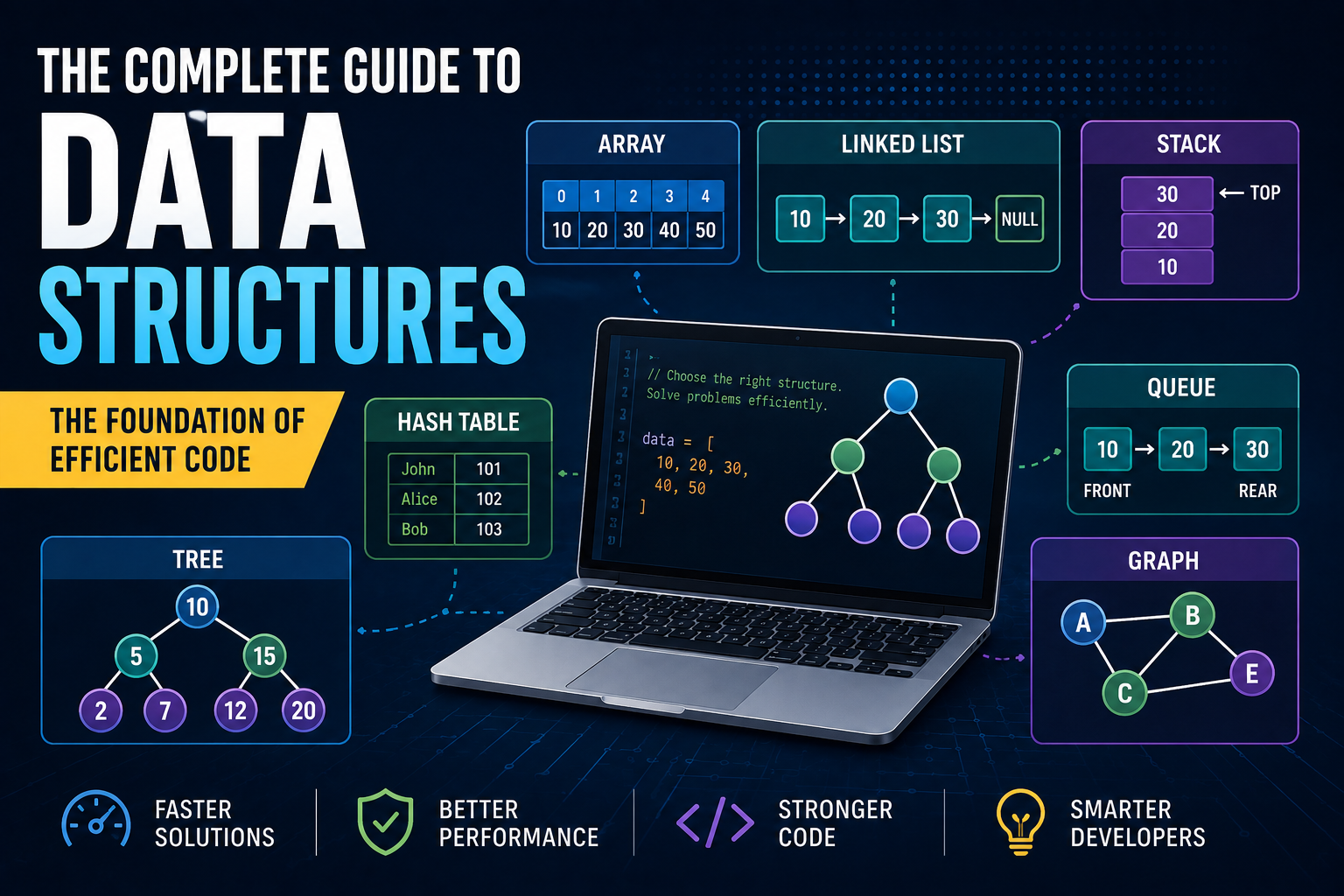
The Complete Guide to Data Structures
Data structures are one of the most important foundations of software development. Every application, from a simple mobile app to a large-scale cloud platform, needs an efficient way to store, organize, access, and manipulate information.
Understanding data structures helps developers write programs that are faster, more reliable, easier to maintain, and better suited to handling large amounts of data. While the subject can initially seem highly technical, its core ideas become much easier to understand once developers know what each structure is designed to accomplish.
Data structures also work closely with algorithms. An algorithm describes the steps used to solve a problem, while a data structure determines how the information required by that algorithm is organized.
Data structures are also fundamental to the systems that store and process information in modern computing environments. In cloud-based applications, for example, efficient data organization can affect application performance, scalability, and how effectively computing resources are used. For a broader understanding of the environment in which many modern applications operate, see Cloud Computing Explained.
This complete guide explains the major types of data structures, how they work, where they are used, their performance characteristics, and how developers can choose the right structure for different programming problems.
What Are Data Structures?
A data structure is a method of organizing and storing data so that a computer program can use it efficiently.
Consider a collection of customer records. A program could store those records in several different ways depending on what it needs to do with them. If the application frequently searches for customers by identification number, one structure may be more appropriate than another. If the application constantly adds and removes items, a different structure may provide better performance.
Data structures therefore are not simply containers for information. They also determine how efficiently information can be accessed and modified.
Common data structures include:
-
Arrays
-
Linked lists
-
Stacks
-
Queues
-
Hash tables
-
Trees
-
Graphs
-
Heaps
Learning these structures is an important part of building strong programming fundamentals. Developers who are still learning the broader concepts of programming may also benefit from our guide to what programming is and how it works.
Why Data Structures Matter
The choice of data structure can have a significant impact on software performance.
A program that works perfectly with a few hundred records may become slow when it has to process millions of records. An inefficient data structure can increase memory usage, slow searches, and make common operations unnecessarily expensive.
Good data structures can help developers:
-
Store information efficiently
-
Search data quickly
-
Insert and remove elements effectively
-
Reduce unnecessary memory usage
-
Organize complex relationships
-
Build scalable applications
-
Improve algorithm performance
Data structures are also closely connected to algorithms. Choosing an appropriate structure can make an algorithm simpler and more efficient.
For a broader understanding of how algorithms solve computational problems, see the complete guide to algorithms.
Understanding Arrays
An array is one of the simplest and most commonly used data structures.
It stores multiple values in an ordered collection. In many programming languages, elements in an array can be accessed using an index.
For example, an array might contain:
[10, 20, 30, 40, 50]The first element can generally be accessed using index 0, the second using index 1, and so on.
Advantages of Arrays
Arrays provide fast access to elements when their position is known. They are particularly useful when applications need to work with collections of similar data.
Typical uses include:
-
Storing lists of numbers
-
Holding collections of objects
-
Processing tabular information
-
Representing fixed sequences of values
Limitations of Arrays
Arrays can become less convenient when frequent insertion and deletion operations are required, particularly when elements need to be shifted to maintain their order.
For this reason, other structures may be more appropriate for dynamic collections.
The exact behavior of arrays can also differ between programming languages. Developers learning Python, for example, should understand how Python’s built-in collection types relate to traditional data-structure concepts. Our Python programming guide provides additional programming context.
Understanding Linked Lists
A linked list stores data in individual nodes. Each node contains a value and a reference to another node.
A simple linked list can be represented as:
[Data | Next] → [Data | Next] → [Data | Next] → NULLUnlike a traditional array, linked-list elements do not necessarily need to occupy adjacent locations in memory.
Types of Linked Lists
Common variations include:
-
Singly linked lists
-
Doubly linked lists
-
Circular linked lists
A singly linked list typically points from one node to the next. A doubly linked list contains references in both directions.
When Linked Lists Are Useful
Linked lists can be useful when applications frequently insert or remove elements from a collection.
They are also valuable for learning fundamental programming concepts involving references, memory allocation, nodes, and dynamic data organization.
Understanding linked lists also makes it easier to compare different approaches to solving the same problem, which is an important part of algorithmic thinking.
Understanding Stacks
A stack follows the Last In, First Out (LIFO) principle.
The most recently added item is the first item removed.
Imagine a stack of plates. A new plate is placed on top, and the top plate is removed first.
The primary stack operations are:
-
Push: Add an element
-
Pop: Remove the top element
-
Peek: View the top element without removing it
Stacks are widely used in software development.
Examples include:
-
Function call management
-
Undo functionality
-
Expression evaluation
-
Browser navigation
-
Backtracking algorithms
Stacks are particularly important when working with recursion and certain algorithmic techniques.
Understanding Queues
A queue generally follows the First In, First Out (FIFO) principle.
The first item added is the first item removed.
This resembles a line of people waiting for service. The person who arrives first is normally served first.
Common queue operations include:
-
Enqueue: Add an element
-
Dequeue: Remove an element
-
Front: Inspect the next element
Queues are useful for:
-
Task scheduling
-
Message processing
-
Print systems
-
Network requests
-
Breadth-first search
Priority Queues
A priority queue is a specialized type of queue in which elements are processed according to priority rather than simply according to arrival order.
Priority queues are commonly implemented using heaps.
This makes the relationship between data structures and algorithms particularly important. For example, priority queues are frequently used in graph algorithms such as Dijkstra’s shortest-path algorithm.
Understanding Hash Tables
A hash table stores data using key-value relationships.
For example:
username → account information

product ID → product details

country code → country name
A hashing function helps determine where a particular key should be stored.
Hash tables are particularly useful when applications need fast lookup operations.
They are commonly used for:
-
Caches
-
Dictionaries
-
Database indexing
-
Configuration data
-
Counting occurrences
-
Lookup systems
Hash Collisions
Two different keys can sometimes produce the same hash location. This is known as a collision.
Hash-table implementations use techniques such as chaining or open addressing to handle collisions.
The quality of the hashing function and the implementation strategy can have a major impact on performance.
Hash tables are a good example of why developers should consider both data structures and algorithmic complexity when designing software.
Understanding Trees
A tree is a hierarchical data structure made up of nodes connected by relationships.
A simplified tree might look like this:
        A
       / \
      B   C
     / \   \
    D   E   F
The top node is called the root. Nodes connected below another node are its children, while the node above them is their parent.
Trees are useful for representing hierarchical information.
Examples include:
-
File systems
-
Organizational structures
-
Website navigation
-
Decision systems
-
Database indexes
Trees become especially important when applications need to represent relationships that are naturally hierarchical.
Binary Trees
A binary tree is a tree in which each node has at most two children.
Those children are commonly referred to as the left and right children.
Binary trees form the foundation for several other important structures, including binary search trees and heaps.
They also provide useful practice for recursive algorithms because each subtree can itself be treated as a smaller tree.
Binary Search Trees
A binary search tree organizes values according to an ordering rule.
Typically, values smaller than a node are placed on one side while larger values are placed on the other.
This organization can make searching, inserting, and deleting values efficient when the tree remains appropriately balanced.
However, a poorly balanced binary search tree can become inefficient. In the worst case, it can resemble a linked list.
Balanced tree structures help address this problem.
Developers studying algorithms should understand this relationship because the shape and organization of a data structure can directly affect algorithm performance.
Balanced Trees
Balanced tree structures are designed to prevent a search tree from becoming excessively skewed.
Examples include:
-
AVL trees
-
Red-black trees
Maintaining balance can help keep common operations efficient as data is added and removed.
Balanced trees are particularly useful when predictable performance is important.
Heaps
A heap is a specialized tree-based structure commonly used when applications need quick access to the highest- or lowest-priority element.
Two common forms are:
-
Min-heap: The smallest element has priority.
-
Max-heap: The largest element has priority.
Heaps are particularly important for implementing priority queues and are also used by certain sorting algorithms.
They also play an important role in graph algorithms and other optimization problems.
Understanding Graphs
Graphs are designed to represent relationships between objects.
A graph consists of vertices, also called nodes, and edges, which represent connections between them.
For example:
A ─── B
│     │
│     │
C ─── D
Graphs can represent many real-world systems.
Examples include:
-
Social networks
-
Road systems
-
Computer networks
-
Recommendation systems
-
Flight routes
-
Dependency relationships
Graphs are particularly useful when relationships between entities are more important than a simple hierarchy.
Directed and Undirected Graphs
In an undirected graph, relationships work in both directions.
In a directed graph, edges have a specific direction.
For example:
A → B → CThis could represent a sequence of dependencies or connections where direction matters.
Weighted Graphs
Some graphs assign values to edges.
A road network, for example, could assign distances or travel times to connections between locations.
Weighted graphs are important in routing and optimization problems.
They form the foundation for algorithms such as Dijkstra’s algorithm and A* search.
Choosing Between Common Data Structures
There is no universally best data structure. The right choice depends on what a program needs to accomplish.
| Data Structure | Common Strength | Typical Uses |
|---|---|---|
| Array | Fast indexed access | Ordered collections |
| Linked List | Dynamic insertion and removal | Sequential collections |
| Stack | Last-in-first-out processing | Undo, recursion, backtracking |
| Queue | First-in-first-out processing | Scheduling and processing |
| Hash Table | Fast key-based lookup | Dictionaries and caches |
| Tree | Hierarchical organization | File systems and indexes |
| Heap | Priority-based access | Priority queues |
| Graph | Relationship modeling | Networks and routing |
The best decision requires considering the operations that will occur most frequently.
For example, if an application frequently performs key-based lookups, a hash table may be appropriate. If it needs to represent relationships between locations, a graph may be more suitable.
Data Structures and Big O Notation
Developers often use Big O notation to describe how an operation’s resource requirements grow as the amount of input increases.
Common complexity categories include:
-
O(1): Constant time
-
O(log n): Logarithmic time
-
O(n): Linear time
-
O(n log n): Linearithmic time
-
O(n²): Quadratic time
For example, accessing an element directly by its index in an array is typically an O(1) operation.
Searching through an unsorted collection one element at a time may require O(n) time.
Understanding these differences helps developers make informed decisions when designing software.
For a deeper explanation of complexity, searching, sorting, recursion, and other algorithmic concepts, see Algorithms Explained: Complete Programming Guide.
Data Structures and Algorithms Work Together
Data structures and algorithms should not be considered separate subjects.
An algorithm’s effectiveness often depends on how data is organized.
For example, a search algorithm designed for sorted data can take advantage of that organization to eliminate large portions of the search space. Similarly, graph algorithms depend on structures capable of representing connections between nodes.
Learning both subjects together gives developers a stronger understanding of computational problem-solving.
This relationship becomes even more important as software systems become larger and more complex.
Data Structures in Modern Software
Data structures appear throughout modern software development.
A web application may use arrays or lists to process records, hash tables to perform fast lookups, queues to manage background jobs, trees to represent hierarchical data, and graphs to model relationships.
Different layers of a software system may therefore use different data structures for different purposes.
Understanding how these structures fit into larger applications is part of understanding how modern software works.
Data structures can also influence the architecture of an application because the way data is stored and accessed affects performance, memory usage, and scalability.
For a broader look at how software components are organized, see how software architecture organizes applications.
Modern applications also frequently depend on databases and data-management systems. Developers who want to understand how structured information is stored and managed can explore The Complete Guide to Databases.
Data structures also connect directly with the broader discipline of managing business information. Organizations that need to understand how data is collected, stored, governed, protected, and maintained across their systems can explore the Complete Guide to Business Data Management.
Common Mistakes When Learning Data Structures
Beginners often make several mistakes when studying data structures.
Memorizing Without Understanding
Simply memorizing definitions does not provide much practical benefit.
Developers should understand why a structure exists, what problem it solves, and what trade-offs it introduces.
Focusing Only on Syntax
Programming-language syntax is important, but data structures are fundamentally about concepts.
A developer should be able to explain how a structure works even when switching between programming languages.
Ignoring Complexity
A solution that works on a small dataset may perform poorly at scale.
Understanding time and space complexity helps developers anticipate these problems.
Learning Structures Without Practical Examples
Implementing a structure or using it in a small project can make abstract concepts much easier to understand.
Assuming One Structure Is Always Better
Every structure involves trade-offs.
A hash table may be excellent for key-based lookup but inappropriate for maintaining a specific ordering. An array may provide convenient indexed access but be less suitable for frequent insertions in the middle of a collection.
The goal is not to find one structure that is universally superior.
The goal is to select the structure that fits the application’s requirements.
How Beginners Can Learn Data Structures
A practical learning path can make the subject much easier.
Start with fundamental structures such as arrays and linked lists. Then move into stacks and queues before studying hash tables, trees, heaps, and graphs.
A useful progression is:
-
Learn arrays and indexing.
-
Understand linked lists and references.
-
Study stacks and queues.
-
Learn hashing and hash tables.
-
Explore trees and binary search trees.
-
Study heaps and priority queues.
-
Learn graph representations.
-
Practice common algorithms.
-
Analyze time and space complexity.
-
Build small projects using different structures.
Developing a strong programming foundation first can make this progression easier. Developers who want to strengthen their general programming knowledge can start with What Is Programming and How Does It Work?.
The goal should be to understand when and why a particular structure should be used rather than simply being able to reproduce its implementation.
Practicing Data Structures With Real Projects
One of the most effective ways to understand data structures is to use them in practical software projects.
For example, imagine building a simple contact management application.
A small application might store contacts in an array or list:
Alice

Bob

Carol

David
As the application grows, different requirements could lead to different choices.
A hash table could provide fast lookup by contact ID.
A trie could support prefix-based searches such as autocomplete.
A queue could manage incoming processing tasks.
A tree could represent organizational relationships.
A graph could model connections between people.
The appropriate choice depends on what the application needs to do.
This illustrates an important programming principle: data structures should be selected according to the operations and relationships that matter most to the application.
Data Structures and Software Quality
Choosing an appropriate data structure can also contribute to software quality.
A suitable structure can make code:
-
Easier to understand
-
Easier to test
-
More predictable
-
More efficient
-
Easier to maintain
-
Better suited to future growth
However, developers should not automatically choose the most sophisticated structure available.
A simple array may be preferable to a complex tree if the application’s requirements are straightforward.
The best implementation is generally the one that provides sufficient performance while remaining understandable and maintainable.
This principle is closely related to writing maintainable and high-quality software code.
Data Structures and Software Testing
Data structures should also be tested carefully.
Different structures can introduce different edge cases.
For example, developers may need to test:
-
Empty collections
-
Single-element collections
-
Duplicate values
-
Very large datasets
-
Missing keys
-
Invalid indexes
-
Repeated insertions
-
Repeated deletions
-
Already sorted data
-
Reverse-sorted data
Testing helps confirm that the implementation behaves correctly under both normal and unusual conditions.
For a broader understanding of software quality practices, see What Is Software Testing and How Do Developers Ensure Software Quality?.
Data Structures and Performance
Data structures can have a major effect on application performance.
When an application becomes slow, developers may need to examine how information is stored and accessed.
Potential improvements can include:
-
Selecting a more appropriate data structure
-
Reducing unnecessary searches
-
Improving indexing
-
Avoiding repeated computation
-
Reducing memory usage
-
Caching frequently accessed information
-
Choosing more efficient algorithms
Performance optimization should ideally be based on measurement rather than assumptions.
Profiling can help developers identify actual bottlenecks instead of optimizing code that was never responsible for the slowdown.
For more on this topic, see how developers optimize software performance and application speed.
Data Structures in Databases
Databases rely heavily on data structures and algorithms.
They use sophisticated techniques for:
-
Searching
-
Sorting
-
Indexing
-
Query optimization
-
Joining datasets
-
Managing transactions
-
Organizing stored information
Database indexes are particularly important because they can allow systems to locate records without scanning every record in many situations.
Understanding trees, hashing, and other structures therefore provides useful background for understanding how database systems achieve efficient data access.
Developers looking for a broader explanation of database technologies can also explore Complete Guide to Database Software.
For developers who want to understand the broader database landscape, including how databases store, organize, retrieve, and manage structured information, the Complete Guide to Databases provides additional context.
Data Structures in Search Systems
Search systems process enormous quantities of information.
They need efficient methods for:
-
Storing information
-
Finding relevant records
-
Organizing data
-
Matching queries
-
Ranking results
-
Representing relationships
Search-related software can therefore use a combination of data structures and algorithms rather than relying on a single technique.
For example, trees, hash tables, indexes, and graph structures can all be useful depending on the problem being solved.
Data Structures in Artificial Intelligence
Artificial intelligence and machine learning systems also rely on fundamental data structures.
Applications may need to organize:
-
Training data
-
Features
-
Model parameters
-
Graph relationships
-
Search states
-
Results
-
Queues of processing tasks
Graphs and trees are particularly important in areas involving search, decision-making, relationships, and structured information.
Understanding foundational data structures therefore remains valuable even as AI-assisted programming becomes increasingly common.
Data Structures and Modern Programming Languages
Programming languages provide built-in structures that developers use every day.
Depending on the language, developers may encounter collections such as:
-
Arrays
-
Lists
-
Sets
-
Maps
-
Dictionaries
-
Tuples
-
Objects
The terminology and implementation details differ between languages.
The underlying concepts, however, remain broadly transferable.
A developer who understands why a hash table is useful can apply that knowledge in multiple programming environments even when the language uses a different name or syntax.
This is one reason learning fundamental programming concepts is often more valuable than memorizing language-specific syntax.
How to Choose the Right Data Structure
When choosing a data structure, developers should begin by examining what the application actually needs to do.
Important questions include:
-
How much data will the application handle?
-
How frequently will data be searched?
-
How frequently will data be inserted?
-
How frequently will data be removed?
-
Does the data need to remain ordered?
-
Are relationships between items important?
-
Is fast key-based lookup required?
-
How much memory is available?
-
How predictable does performance need to be?
-
Which operations are most common?
The answers can help narrow down the appropriate structure.
For example:
-
Need fast indexed access? Consider an array.
-
Need key-based lookup? Consider a hash table.
-
Need LIFO processing? Consider a stack.
-
Need FIFO processing? Consider a queue.
-
Need priority-based processing? Consider a heap or priority queue.
-
Need hierarchical relationships? Consider a tree.
-
Need to represent arbitrary relationships? Consider a graph.
The best choice depends on the application’s actual requirements.
Data Structures and Maintainable Software
Good data-structure decisions can make software easier to understand and maintain.
Developers should consider not only theoretical performance but also:
-
Code readability
-
Implementation complexity
-
Testing requirements
-
Debugging difficulty
-
Memory usage
-
Future changes
-
Team familiarity
A theoretically efficient structure may not be the best option if it introduces unnecessary complexity.
Software development is therefore a balance between performance, simplicity, reliability, and maintainability.
These principles are also central to the broader software development process.
Why Data Structures Remain Important
Modern development involves enormous amounts of information.
Applications need to process user records, transactions, messages, files, relationships, events, and other forms of data efficiently.
Although programming languages, frameworks, libraries, and development tools continue to change, the underlying principles of organizing and processing information remain fundamental.
A developer who understands data structures can reason more effectively about:
-
Performance
-
Scalability
-
Memory usage
-
Algorithm design
-
Application architecture
-
Software reliability
These skills remain useful across programming languages and development environments.
They are also increasingly relevant to cloud-based applications, where systems may need to process large and distributed datasets while scaling resources according to demand. Understanding the broader infrastructure behind these applications is part of learning Cloud Computing Explained.
Building Stronger Programming Foundations
Data structures are ultimately about making information useful to software.
Arrays organize sequential data. Linked lists connect dynamically stored elements. Stacks and queues control processing order. Hash tables enable efficient key-based lookup. Trees represent hierarchy. Heaps manage priorities, while graphs model complex relationships.
Learning these structures gives developers a foundation for understanding more advanced areas of computer science and software engineering.
It also makes algorithmic problem-solving easier because developers can recognize which structures are appropriate for particular problems.
For example, a graph combined with an appropriate algorithm can solve routing problems, while a hash table can make repeated key-based lookups highly efficient.
The broader goal is not to memorize every possible data structure.
It is to understand the strengths, limitations, costs, and appropriate applications of the structures available.
From Data Structures to Better Software
Data structures are not merely theoretical concepts taught in computer science courses. They are practical tools used throughout software development.
The choice between an array, linked list, stack, queue, hash table, tree, heap, or graph can influence how efficiently an application processes information and how easily developers can maintain its code.
The most important lesson is therefore simple:
Choose the data structure that matches the problem.
When developers understand the data they are working with, the operations an application performs, the expected scale, and the relevant performance trade-offs, they can make much stronger engineering decisions.
Combined with a solid understanding of algorithms, programming principles, software architecture, testing, and performance optimization, data structures form one of the most important foundations for building reliable and scalable software.