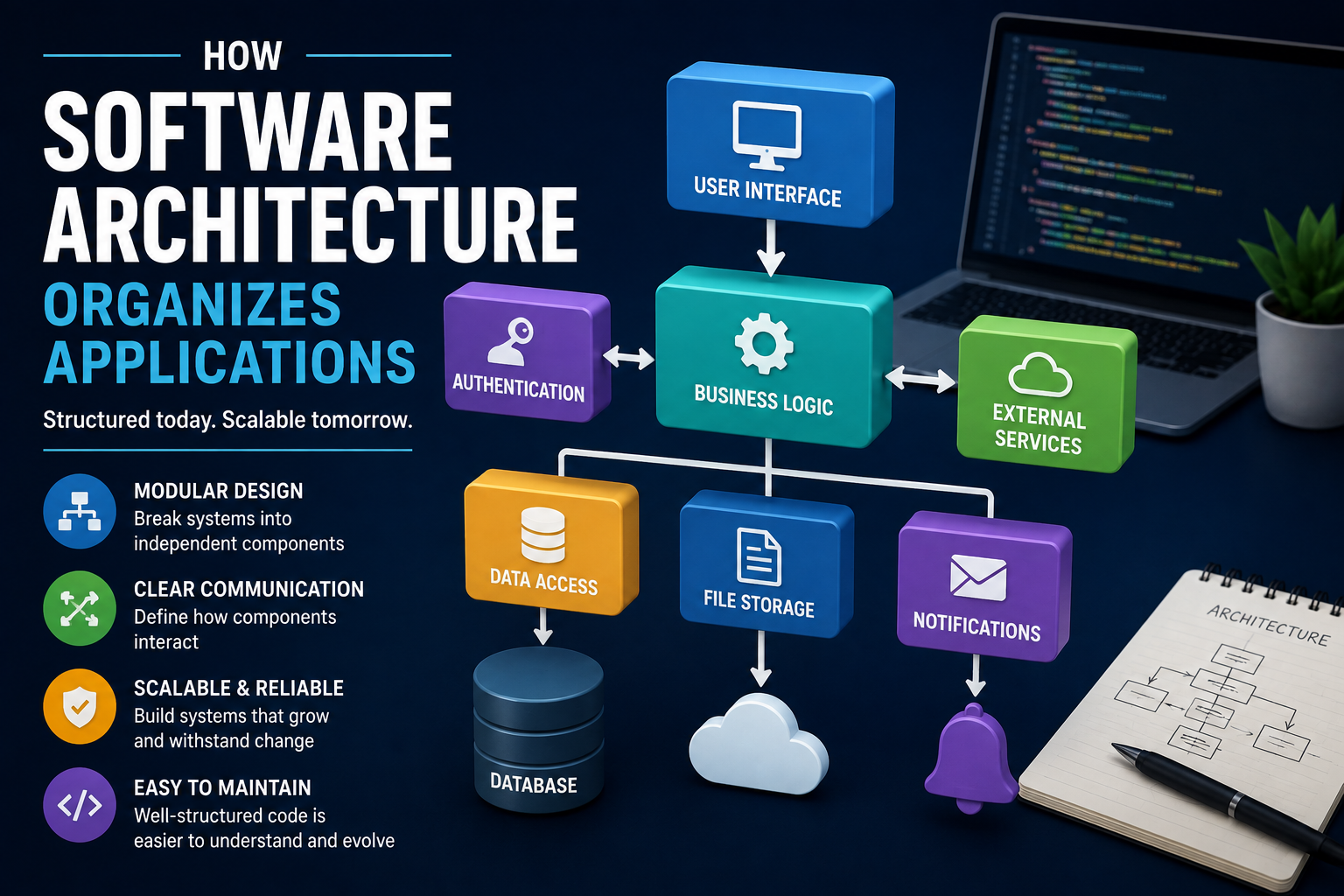
How Software Architecture Organizes Applications
Software applications can start out surprisingly simple. A developer may create a few files, connect a database, add an interface and have a working product in a short period of time.
The challenge comes later.
As an application gains users and features, the codebase can become increasingly difficult to understand and maintain. Different parts of the system begin depending on one another, new developers need more time to understand the code, and seemingly minor changes can create unexpected problems elsewhere.
This is where software architecture becomes important.
Software architecture provides the structure and principles that determine how an application is divided into components, how those components communicate and where responsibilities belong. Good architecture does not eliminate complexity, but it gives teams a way to organize and manage it.
For a broader understanding of how software is built and operates, see the complete guide to software development processes.
What Is Software Architecture?
Software architecture is the high-level structure of a software system.
It describes the major components of an application, their responsibilities, how they interact and the technical decisions that shape the system.
While individual lines of code implement specific behavior, architecture determines how those pieces fit together.
An application might contain separate components for:
- User interfaces
- Authentication
- Business logic
- Data storage
- Payments
- Notifications
- External APIs
- Background processing
- Logging and monitoring
Architecture establishes boundaries between these areas and defines how information moves between them.
Understanding how modern software works provides useful context for seeing how these architectural components work together.
Why Architecture Matters
Without deliberate architecture, software systems often grow organically.
A developer adds a feature wherever it is easiest to implement. Another developer modifies the same area to solve a different problem. Over time, responsibilities become mixed together.
Eventually, a change that should take an hour can require modifications across dozens of files.
Good architecture helps prevent this by creating clear boundaries.
A well-structured application makes it easier to answer questions such as:
Where does this functionality belong?
Which component should be responsible for this decision?
How should this service communicate with the database?
What happens if this component needs to change?
These questions become increasingly important as software grows.
The broader software development process also depends on making architectural decisions that support development, testing, deployment and maintenance.
Architecture and Code Are Not the Same Thing
Software architecture is sometimes confused with writing clean code.
The two are related, but they operate at different levels.
Clean code focuses on individual functions, classes, modules and files.
Architecture focuses on larger relationships.
For example, a function might be beautifully written while still being located in the wrong part of the application.
Similarly, a database query may be technically correct but create architectural problems if every part of the application is allowed to access the database directly.
Architecture therefore considers the structure around the code, not just the quality of individual implementations.
Developers also need strong programming fundamentals to implement architectural decisions effectively. The guide to programming and how it works explains the underlying concepts that make software architecture possible.
The Importance of Separation of Concerns
One of the central ideas in software architecture is separation of concerns.
The principle suggests that different parts of an application should have distinct responsibilities.
For example, an application could separate:
- Presentation logic
- Business rules
- Data access
- Authentication
- External integrations
This makes individual components easier to understand and change.
Imagine an online store where the code responsible for displaying a product page also calculates taxes, communicates directly with the database and processes payments.
Changing the payment provider could then require modifications to the user interface.
A better architecture separates those responsibilities so that changing one part does not unnecessarily disrupt the others.
This principle is closely connected to writing maintainable and high-quality software code.
Layers Provide Structure
Many applications use some form of layered architecture.
A common structure includes:
Presentation Layer
This is responsible for interacting with users.
It might contain web pages, mobile interfaces, controllers or API endpoints.
Developers working on this part of an application may benefit from understanding what frontend development is and how developers build interactive web interfaces.
Business Logic Layer
This layer contains the rules that determine how the application behaves.
For an online store, it might calculate discounts, validate orders or determine whether a customer is eligible for a particular offer.
Data Access Layer
This layer handles communication with databases and other storage systems.
Separating data access from business logic can make it easier to change database technologies or modify queries without rewriting the rest of the application.
Layered architecture is not appropriate for every system, but it provides a useful mental model for organizing many applications.
Modular Architecture Breaks Large Systems Into Smaller Pieces
Another important architectural principle is modularity.
Instead of treating an application as one enormous block of code, developers divide it into smaller modules with clearly defined responsibilities.
A business application might have modules for:
- Users
- Orders
- Inventory
- Payments
- Reporting
- Notifications
Each module can contain the code needed to perform its particular responsibilities.
Good modules aim for high cohesion, meaning that related functionality stays together.
They also aim for low coupling, meaning that modules should avoid unnecessary dependencies on one another.
This balance can make systems easier to modify.
High Cohesion and Low Coupling
These two concepts appear frequently in discussions about software design.
High cohesion means that the responsibilities within a component are closely related.
For example, a user authentication module should primarily handle authentication-related functionality rather than unrelated inventory calculations.
Low coupling means that components are not excessively dependent on one another.
If changing one module requires changes throughout the entire application, the system may be too tightly coupled.
Reducing unnecessary coupling allows teams to make changes with less risk.
These principles also influence how developers organize code when applying object-oriented programming and other programming approaches.
APIs Define Boundaries Between Components
Application programming interfaces, or APIs, are commonly used to define how software components communicate.
An API specifies what functionality is available and how another component can request it.
For example, an e-commerce application might expose an order service that allows other parts of the system to:
- Create an order
- Retrieve an order
- Update an order
- Cancel an order
The user interface does not need to know how the order is stored internally.
It simply communicates with the service through its defined interface.
This abstraction can make systems more flexible.
APIs are also central to how modern software works, because applications increasingly depend on multiple internal and external services.
Abstraction Hides Unnecessary Complexity
Abstraction is another fundamental architectural idea.
The principle is to expose what other components need to know while hiding unnecessary implementation details.
A payment service, for example, might provide a simple operation such as:
processPayment()
The rest of the application does not necessarily need to know whether the payment is processed through one provider, another provider or a combination of systems.
This makes it easier to change the underlying implementation without affecting every part of the application.
Monolithic Architecture
A monolithic application is generally built and deployed as a single unit.
This does not automatically mean the application is poorly designed.
A well-structured monolith can be easier to develop, test and deploy than a distributed system, particularly when a project is small or has a relatively straightforward set of requirements.
Monolithic systems can offer advantages such as:
- Simpler deployment
- Easier local development
- Straightforward testing
- Fewer network dependencies
- Simpler infrastructure
However, very large monolithic applications can become difficult to modify if their internal boundaries are poorly maintained.
Understanding these architectural choices is an important part of the wider software development process.
Microservices Take a Different Approach
Microservices architecture divides an application into multiple independently deployable services.
Each service typically focuses on a specific business capability.
An online marketplace might have separate services for:
- User accounts
- Product catalogs
- Orders
- Payments
- Shipping
- Notifications
The services communicate over defined interfaces, often through APIs or messaging systems.
This approach can allow teams to develop and deploy components independently.
But microservices introduce additional complexity.
Teams now have to manage network communication, service discovery, monitoring, distributed failures, deployment coordination and data consistency.
For that reason, microservices are not automatically better than monolithic architecture.
The right choice depends on the application’s requirements and the organization’s ability to manage the additional complexity.
Event-Driven Architecture
Some applications communicate through events rather than direct requests.
In an event-driven architecture, one component publishes an event when something happens, and other components can respond to that event.
For example:
Order placed → payment service processes payment → inventory service updates stock → notification service sends confirmation
The components do not necessarily need to call one another directly.
This approach can make systems more loosely coupled and can work particularly well for applications that need to process large numbers of events.
However, event-driven systems can also be more difficult to understand and debug because activity may be distributed across multiple services.
Choosing the Right Data Architecture
Data is one of the most important considerations in application architecture.
Developers need to determine:
- Where data will be stored
- How it will be structured
- Who can access it
- How it will be updated
- How it will be backed up
- How it will be secured
- How it will scale
Different applications may use relational databases, document databases, key-value stores, search systems, object storage or combinations of these technologies.
Architecture should reflect the application’s actual requirements rather than following technology trends.
A simple application may not need a complicated collection of databases.
Scalability Starts With Architecture
As applications grow, their architecture needs to handle increasing workloads.
Scalability can involve supporting:
- More users
- More transactions
- More data
- More requests
- More geographic locations
A system can scale vertically by adding resources to existing machines or horizontally by adding more instances of services.
Architectural decisions influence how easily either approach can be implemented.
Stateless application components, caching, load balancing and asynchronous processing can all contribute to scalable designs.
Performance and scalability are closely connected. Developers can explore this further in how developers optimize software performance and application speed.
Performance Is an Architectural Concern
Performance problems are not always caused by inefficient code.
Sometimes the architecture itself creates bottlenecks.
For example, an application that requires every request to communicate with several remote services may experience significant latency.
Similarly, repeatedly querying a database for information that rarely changes can waste resources.
Architectural techniques such as caching, asynchronous processing, batching and content delivery networks can help address these issues.
The important point is that performance should be considered at the system level rather than only at the function level.
For a broader look at application performance, see how developers optimize software performance and application speed.
Security Belongs in the Architecture
Security should not be treated as something added after an application has been built.
Architectural decisions affect security from the beginning.
Systems need appropriate controls for:
- Authentication
- Authorization
- Data encryption
- Secret management
- Network access
- Input validation
- Logging
- Session management
- Dependency security
Separating sensitive operations into controlled services can reduce unnecessary access.
Likewise, limiting permissions between components can reduce the potential impact of a compromised system.
This approach is often described as defense in depth.
Security also needs to be considered throughout the software development process, rather than only after development is complete.
Reliability and Failure Handling
Every software system eventually encounters failures.
Servers go offline. Networks become unavailable. Databases experience problems. External APIs stop responding.
Good architecture assumes that failures will occur.
Applications can therefore incorporate mechanisms such as:
- Retries
- Timeouts
- Circuit breakers
- Redundancy
- Health checks
- Backups
- Failover systems
- Queues
- Graceful degradation
The objective is not to create a system that never fails.
Instead, the goal is to prevent one failure from unnecessarily bringing down everything else.
Observability Helps Teams Understand the System
As applications become more complex, developers need ways to understand what is happening inside them.
Observability typically involves:
- Logs
- Metrics
- Traces
- Alerts
- Health checks
These tools can help teams determine where a request failed, which service caused a delay and whether a system is behaving normally.
Architecture should therefore make important system behavior observable.
A highly distributed application without adequate monitoring can become extremely difficult to troubleshoot.
Architecture Should Support Testing
Good architecture can make software easier to test.
When components have clear responsibilities and limited dependencies, developers can test them individually.
For example, business logic can often be tested without requiring a real database or external payment service.
This is one reason dependency injection and interfaces are frequently used in well-designed applications.
Testing becomes more complicated when components are tightly intertwined.
A seemingly simple unit test may require an entire application environment just to execute one piece of logic.
Software testing is also a major stage of the software development lifecycle.
Architecture Decisions Involve Trade-Offs
There is rarely a perfect architecture.
Every decision involves trade-offs.
A highly distributed architecture might improve independent scalability but increase operational complexity.
A simple monolith might be easier to manage but eventually require more careful internal boundaries as the application grows.
A highly normalized database structure may reduce duplication but require more complex queries.
Caching can improve performance but introduce data-consistency challenges.
Good architects therefore do not simply ask:
“What is the best architecture?”
They ask:
“What architecture best fits the current requirements and constraints?”
The answer should be influenced by the development team’s skills, application requirements, expected scale, security needs and operational resources.
Architecture Should Evolve With the Application
A system designed for ten users may not need the same architecture as one serving ten million.
Trying to predict every future requirement can lead to unnecessary complexity.
This is why many teams prefer to start with a relatively simple architecture and evolve it as actual requirements emerge.
That does not mean ignoring future growth.
It means avoiding expensive architectural decisions based entirely on hypothetical problems.
The architecture should be capable of evolving without requiring the entire system to be rebuilt.
This principle fits into the broader software development lifecycle, where requirements, implementation and maintenance continue to evolve over time.
Documentation Makes Architecture Understandable
Architecture exists partly in code, but important architectural decisions should also be documented.
Documentation can explain:
- Major components
- System boundaries
- Data flows
- External dependencies
- Deployment architecture
- Security assumptions
- Important design decisions
- Reasons behind technical choices
This information becomes especially valuable when new developers join a project.
Without documentation, teams may have to reconstruct architectural decisions by reading thousands of lines of code.
Architecture and the Developer Experience
Good architecture can improve the daily experience of developers.
When responsibilities are clearly separated, developers can find relevant code faster.
When APIs and modules have predictable boundaries, they can make changes without understanding the entire system.
When automated testing and deployment are integrated into the architecture, developers can receive faster feedback.
This means architecture is not merely an abstract technical concern.
It directly affects how efficiently teams can build and maintain software.
Common Architectural Mistakes
Several problems repeatedly appear in growing software systems.
One is overengineering.
Developers may introduce microservices, message queues, multiple databases and complex infrastructure before the application actually needs them.
Another is tight coupling, where components depend heavily on one another.
A third is allowing business logic to become scattered across interfaces, database queries and utility functions.
Other problems include:
- Poorly defined module boundaries
- Excessive duplication
- Hidden dependencies
- Lack of documentation
- Weak error handling
- Insufficient monitoring
- Ignoring security requirements
- Designing around technologies rather than business needs
These problems can make future development progressively more expensive.
Following a structured software development process can help teams identify many of these issues before they become deeply embedded in a project.
Architecture Is a Long-Term Investment
Software architecture is ultimately about managing complexity.
As an application grows, developers need a way to understand what each component does, how those components interact and where changes should be made.
Good architecture creates boundaries that make that understanding possible.
It separates responsibilities, controls dependencies, supports security and reliability, enables testing and provides a foundation for scaling.
The most effective architecture is not necessarily the most sophisticated one.
A small application may benefit from a straightforward modular monolith, while a large organization with independently managed product teams may have legitimate reasons to adopt distributed services.
The important principle is to choose structure deliberately.
Good software architecture gives developers room to change the system without constantly fighting the system itself.
As applications become more complex, that ability to change may ultimately be one of the most valuable technical advantages a software team can have.