Complete Guide to Object-Oriented Programming
Object-oriented programming, commonly known as OOP, is one of the most influential approaches to software development. It provides a structured way to design programs around objects, data, and the operations that work with that data.
From web applications and enterprise software to mobile apps, games, desktop programs, and large-scale backend systems, object-oriented concepts continue to shape how developers organize and maintain complex codebases.
If you’re new to programming, it helps to understand OOP alongside broader programming concepts, algorithms, data structures, and software development practices. The complete guide to software development processes provides useful context for understanding where programming and design fit within the wider software lifecycle.
This complete guide to object-oriented programming explains what OOP is, how it works, its core principles, common concepts, advantages and disadvantages, popular programming languages, design principles, and practical examples.
What Is Object-Oriented Programming?
Object-oriented programming is a programming paradigm that organizes software around objects that contain data and behavior.
Instead of treating a program as a collection of unrelated procedures, OOP allows developers to model software as interacting objects.
An object can contain:
- Data, often called properties, fields, or attributes
- Behavior, usually represented by methods or functions
- Identity, which distinguishes one object from another
For example, a banking application might represent a customer as an object.
A Customer object could contain:
- Name
- Account number
- Account balance
It could also provide behaviors such as:
- Deposit money
- Withdraw money
- Transfer funds
- View balance
The goal is to keep related data and behavior together in meaningful structures.
Before learning OOP in depth, it is useful to understand what programming is and how it works. Programming provides the broader foundation, while OOP is one approach for organizing the resulting software.
How Object-Oriented Programming Works
OOP typically starts with defining classes.
A class acts as a blueprint that describes what an object should contain and what it should be able to do.
For example:
class Car:
    def __init__(self, brand, model):
        self.brand = brand
        self.model = model

    def start(self):
        print("The car has started.")
The class describes a general car.
An actual car can then be created as an object:
my_car = Car("Toyota", "Corolla")The object has its own data:
my_car.brand
my_car.model
And it can perform behaviors defined by the class:
my_car.start()This distinction between classes and objects is fundamental to OOP.
Python is particularly approachable for learning these concepts. If you want to build a broader foundation first, see this Python programming guide.
Classes and Objects Explained
What Is a Class?
A class is a blueprint or template for creating objects.
It defines:
- Attributes an object can have
- Methods an object can perform
- Rules governing its behavior
Consider:
class Dog:
    def __init__(self, name):
        self.name = name

    def bark(self):
        print(f"{self.name} says woof!")
The Dog class defines what a dog object looks like and what it can do.
What Is an Object?
An object is an instance of a class.
For example:
dog1 = Dog("Max")
dog2 = Dog("Bella")
Both objects belong to the Dog class, but they contain different data.
dog1 → Max
dog2 → Bella
They can also independently execute the class’s methods:
dog1.bark()
dog2.bark()
This allows developers to create many related objects without duplicating the underlying class definition.
The Four Core Principles of OOP
Object-oriented programming is commonly explained through four fundamental principles:
- Encapsulation
- Abstraction
- Inheritance
- Polymorphism
These principles help developers create software that is easier to organize, extend, test, and maintain.
1. Encapsulation
Encapsulation means combining data and the methods that operate on that data while controlling how the internal state can be accessed or modified.
For example, consider a bank account.
Instead of allowing any part of an application to directly modify the balance, the class can provide controlled methods.
class BankAccount:
    def __init__(self, balance):
        self._balance = balance

    def deposit(self, amount):
        if amount > 0:
            self._balance += amount

    def get_balance(self):
        return self._balance
The application interacts with the account through defined operations rather than directly manipulating its internal implementation.
Why Encapsulation Matters
Encapsulation can:
- Protect internal state
- Reduce accidental changes
- Make code easier to maintain
- Establish clear interfaces
- Reduce dependencies between components
In larger applications, these benefits become increasingly important.
2. Abstraction
Abstraction means exposing the important aspects of an object while hiding unnecessary implementation details.
A familiar real-world example is driving a car.
A driver uses:
- Steering wheel
- Brake
- Accelerator
- Gear controls
The driver does not need to understand every internal mechanical and electrical process happening inside the vehicle.
Software abstraction works similarly.
For example:
class EmailService:
    def send_email(self, recipient, message):
        # Complex implementation hidden from the caller
        print(f"Sending email to {recipient}")
A developer using this class only needs to know how to call:
email_service.send_email(
    "user@example.com",
    "Welcome!"
)
The underlying email delivery process can remain hidden.
Why Abstraction Matters
Abstraction helps developers:
- Reduce complexity
- Create simpler interfaces
- Hide implementation details
- Make systems easier to use
- Change internal implementations without necessarily changing callers
3. Inheritance
Inheritance allows one class to derive characteristics and behaviors from another class.
For example:
class Animal:
    def eat(self):
        print("The animal is eating.")
A more specialized class can inherit from it:
class Dog(Animal):
    def bark(self):
        print("Woof!")
A Dog object can now use both:
dog.eat()
dog.bark()
The child class inherits behavior from the parent class while adding its own capabilities.
Why Inheritance Is Useful
Inheritance can help with:
- Code reuse
- Hierarchical modeling
- Shared functionality
- Specialization
However, inheritance should not automatically be used whenever two concepts are related.
Modern software engineering often favors composition over deep inheritance hierarchies when composition produces a simpler design.
4. Polymorphism
Polymorphism means that different objects can respond to the same interface or operation in different ways.
For example:
class Dog:
    def speak(self):
        print("Woof!")


class Cat:
    def speak(self):
        print("Meow!")
Both classes provide a speak() method.
The calling code can work with either object:
animals = [Dog(), Cat()]

for animal in animals:
    animal.speak()
The result is:
Woof!
Meow!
The same operation produces behavior appropriate to the specific object.
Polymorphism is particularly useful when designing systems that need to work with different implementations through a common interface.
Other Important Object-Oriented Concepts
The four major principles are only part of OOP.
Several additional concepts are important for understanding real-world object-oriented systems.
Constructors
A constructor or initializer is used to initialize an object when it is created.
In Python, the commonly used initializer is:
def __init__(self):For example:
class User:
    def __init__(self, name):
        self.name = name
Creating:
user = User("Alice")initializes the object’s name property.
Methods
Methods are functions associated with a class or object.
class Calculator:
    def add(self, a, b):
        return a + b
Here, add() is a method.
Methods define what an object can do.
Properties and Attributes
Attributes represent information stored by an object.
class Product:
    def __init__(self, name, price):
        self.name = name
        self.price = price
The object has two attributes:
nameprice
Attributes represent the object’s state.
Interfaces
An interface defines a contract describing how software components should interact.
The exact implementation can vary while the interface remains consistent.
For example, an application might define a payment interface:
processPayment()Different implementations could support:
- Credit card payments
- Bank transfers
- Mobile payments
The rest of the application can interact with them through the same conceptual interface.
Interfaces are particularly important in strongly typed languages and large software architectures.
Abstract Classes
An abstract class provides a common structure for related classes while leaving certain implementation details to subclasses.
Conceptually:
Vehicle
├── Car
├── Motorcycle
└── Truck
The Vehicle abstraction might define common operations while individual vehicle types implement their own behavior.
Object-Oriented Programming Example
Consider an online store.
A simple object-oriented design might include:
- Customer
- Product
- ShoppingCart
- Order
- Payment
- Shipping
Each object has its own responsibilities.
Customer
Attributes:
- Name
- Address
Possible methods:
updateProfile()
viewOrders()
Product
Attributes:
- Name
- Price
- Stock
- Category
Possible methods:
updatePrice()
checkAvailability()
Shopping Cart
Attributes:
- Items
- Total
Possible methods:
addProduct()
removeProduct()
calculateTotal()
Order
Attributes:
- Order number
- Customer
- Products
- Status
Possible methods:
placeOrder()
cancelOrder()
updateStatus()
Instead of having one enormous program responsible for everything, the system is divided into meaningful components.
Object-Oriented Programming Versus Procedural Programming
Procedural programming organizes software primarily around procedures and functions.
OOP organizes software around objects and their interactions.
| Feature | Procedural Programming | Object-Oriented Programming |
|---|---|---|
| Primary organization | Functions and procedures | Objects and classes |
| Data handling | Often separate from functions | Often grouped with behavior |
| Reuse | Functions and modules | Classes, objects, composition |
| Modeling | Procedure-oriented | Entity-oriented |
| Encapsulation | Usually less central | Core concept |
| Inheritance | Generally unavailable as a core feature | Commonly supported |
| Polymorphism | Limited or language-dependent | Major OOP concept |
| Typical strength | Procedure-heavy systems | Complex systems with interacting components |
Neither approach is universally superior.
The appropriate paradigm depends on the problem, language, architecture, team, and requirements.
Object-Oriented Programming Versus Functional Programming
Functional programming treats computation primarily as the evaluation and composition of functions.
OOP emphasizes objects that encapsulate state and behavior.
| Feature | OOP | Functional Programming |
|---|---|---|
| Main abstraction | Objects | Functions |
| State | Often encapsulated in objects | Often minimized or immutable |
| Data transformation | Methods and operations | Function composition |
| Side effects | Can be common | Often deliberately controlled |
| Reuse | Classes, composition, interfaces | Functions and higher-order functions |
| Typical strength | Modeling complex interacting systems | Transforming and processing data |
Modern languages frequently support multiple paradigms.
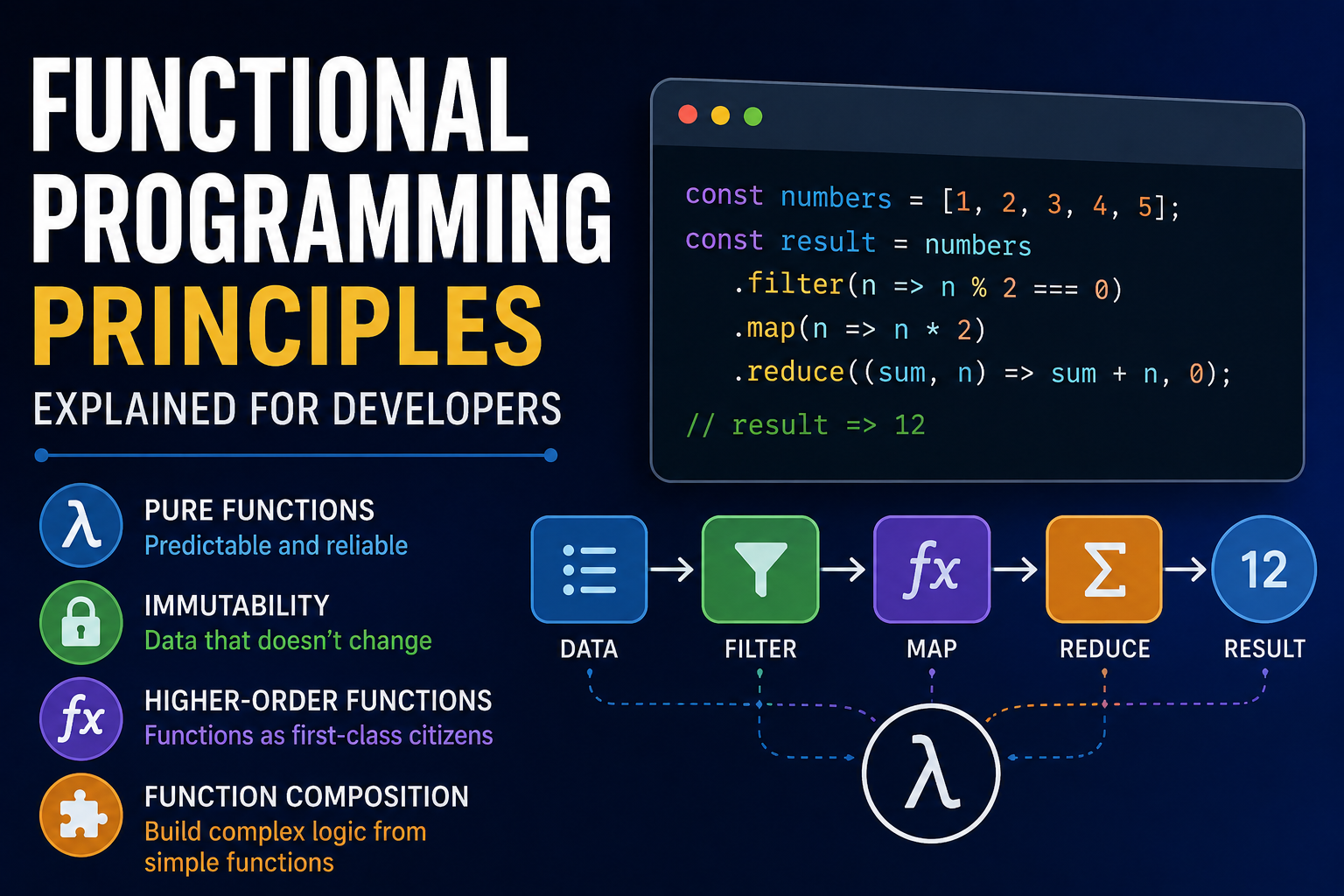
For example, developers can combine object-oriented and functional techniques in the same application. Understanding functional programming principles can therefore complement an understanding of OOP.
Advantages of Object-Oriented Programming
OOP has remained popular partly because it offers useful techniques for managing software complexity.
Code Reusability
Classes and components can be reused in multiple parts of an application.
Inheritance can provide reuse, while composition often provides another flexible mechanism.
Maintainability
Well-designed classes can isolate responsibilities and make changes easier to manage.
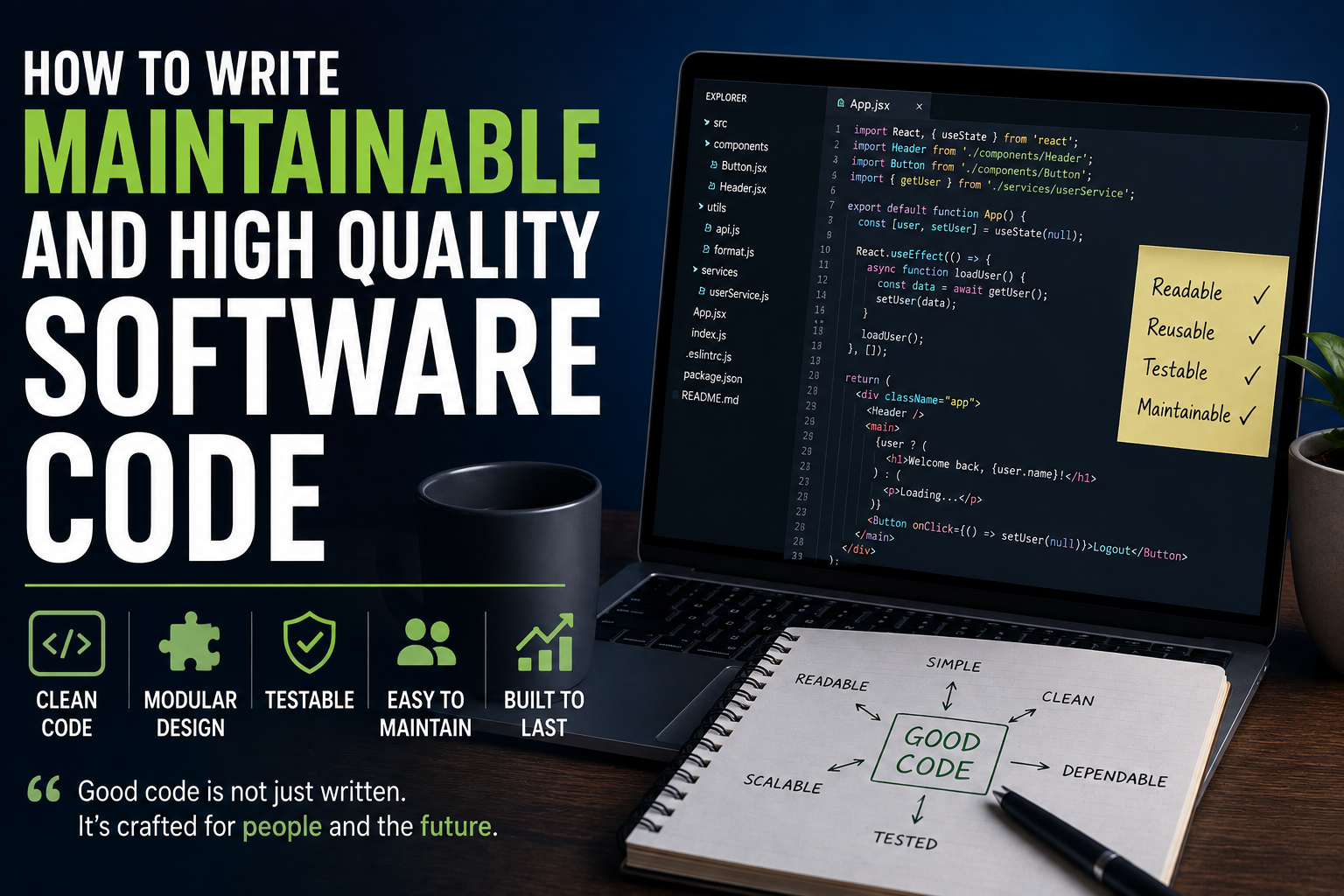
This connects closely with the broader practice of writing maintainable and high-quality software code.
Scalability
OOP can provide useful structures for large applications containing many interacting components.
Modularity
Applications can be divided into logical components.
Data Protection
Encapsulation can restrict how internal state is accessed or modified.
Extensibility
Polymorphism, interfaces, and composition can allow new implementations to be introduced without rewriting every part of an application.
Disadvantages of Object-Oriented Programming
OOP is not automatically the best solution for every programming problem.
Increased Complexity
For small scripts, creating multiple classes can add unnecessary complexity.
A simple function may sometimes be more appropriate than an elaborate object hierarchy.
Overengineering
Developers can create excessive abstractions, interfaces, factories, and inheritance structures that make straightforward problems harder to understand.
Deep Inheritance Problems
Large inheritance hierarchies can become difficult to maintain.
Changes to a parent class may unexpectedly affect many subclasses.
Memory and Performance Considerations
Depending on the language and implementation, objects can introduce overhead.
For most business applications this may not be a major concern, but performance-sensitive systems require careful design and measurement.
Developers can learn more about this broader topic in how software performance and application speed are optimized.
Learning Curve
Beginners must learn several interconnected concepts, including classes, objects, inheritance, polymorphism, interfaces, composition, and abstraction.
Composition Versus Inheritance
One of the most important design decisions in OOP is whether to use inheritance or composition.
Inheritance generally represents an “is-a” relationship.
For example:
Dog is an AnimalComposition represents a “has-a” relationship.
For example:
Car has an EngineA composed class might look conceptually like:
class Engine:
    def start(self):
        print("Engine started")


class Car:
    def __init__(self):
        self.engine = Engine()

    def start(self):
        self.engine.start()
The car contains an engine rather than inheriting from it.
Why Composition Is Often Preferred
Composition can provide:
- Greater flexibility
- Lower coupling
- Easier testing
- More reusable components
- Fewer inheritance-related dependencies
This is why the software engineering principle “favor composition over inheritance” is frequently discussed in object-oriented design.
Common Object-Oriented Programming Languages
Many programming languages support object-oriented programming.
Java
Java has been heavily influenced by object-oriented design and is widely used for enterprise applications, backend systems, and large-scale software.
C++
C++ supports object-oriented programming alongside procedural and generic programming.
It is widely used where performance and low-level control are important.
C#
C# provides extensive support for object-oriented development and is widely used in application development, enterprise software, game development, and the .NET ecosystem.
Python
Python supports OOP while also providing procedural and functional programming capabilities.
Its relatively simple syntax makes it popular for learning OOP concepts.
JavaScript
JavaScript uses a prototype-based object model at its core, although modern JavaScript provides class syntax.
It is widely used for web development and server-side applications.
Developers interested in the client-side side of web applications can also explore frontend development.
Ruby
Ruby was designed with object-oriented programming at its center, with nearly everything represented as an object.
PHP
PHP supports object-oriented programming and is widely used for web applications and server-side development.
Swift
Swift provides classes, structures, protocols, inheritance, and other tools for object-oriented and protocol-oriented programming.
Common OOP Design Patterns
As software systems become more complex, developers frequently encounter recurring design problems.
Design patterns provide established approaches to solving common architectural and design challenges.
Examples include:
Factory Pattern
Creates objects without requiring the calling code to know the exact construction process.
Singleton Pattern
Restricts a class to a single instance in contexts where that design is genuinely appropriate.
Observer Pattern
Allows an object to notify other objects when its state changes.
Strategy Pattern
Allows different algorithms or behaviors to be selected dynamically.
Adapter Pattern
Allows otherwise incompatible interfaces to work together.
Decorator Pattern
Adds behavior to an object without modifying its underlying class.
Design patterns should be treated as tools rather than rules. Applying a pattern simply because it exists can make software more complicated rather than better.
SOLID Principles in Object-Oriented Programming
The SOLID principles are a group of design principles intended to encourage maintainable and flexible object-oriented software.
Single Responsibility Principle
A class should have a focused responsibility rather than becoming responsible for unrelated tasks.
Open-Closed Principle
Software entities should generally be open to extension while minimizing the need to modify stable existing code.
Liskov Substitution Principle
Objects of a subtype should be usable where objects of the parent type are expected without breaking the program’s correctness.
Interface Segregation Principle
Clients should not be forced to depend on interfaces they do not need.
Dependency Inversion Principle
High-level components should depend on abstractions rather than tightly coupling themselves to low-level implementations.
SOLID is most useful when treated as a set of design considerations rather than rigid rules.
Common Object-Oriented Programming Mistakes
Beginners and experienced developers alike can encounter problems when designing object-oriented systems.
Creating Classes for Everything
Not every piece of data requires a class.
Sometimes a function, data structure, or module is a better solution.
Understanding data structures helps developers recognize when a dedicated structure is more appropriate than introducing another class.
Using Excessive Inheritance
Deep inheritance trees can create unnecessary dependencies.
Composition can often provide a cleaner alternative.
Creating Large Classes
A class that handles authentication, payments, reporting, database access, email, and user management is likely doing too much.
Poor Naming
Names should communicate the responsibility of classes, methods, and variables.
Compare:
class Manager:with:
class InvoiceProcessor:The second name communicates considerably more information.
Excessive Abstraction
Abstraction is useful, but unnecessary layers can make code harder to understand.
Ignoring Coupling
Classes that depend heavily on each other’s internal implementation can become difficult to change.
Ignoring Testing
Object-oriented systems should be designed so that individual components can be tested independently where practical.
Testing is an important part of the wider software development process.
Best Practices for Object-Oriented Programming
Good OOP is less about creating as many classes as possible and more about designing understandable systems.
Keep Responsibilities Focused
Each class should have a clear purpose.
Prefer Composition When Appropriate
Use composition when it provides greater flexibility than inheritance.
Minimize Coupling
Components should depend on clearly defined interfaces rather than implementation details.
Maximize Cohesion
Related functionality should live together.
Use Meaningful Names
Names should communicate intent.
Keep Methods Manageable
Extremely long methods are often a signal that responsibilities need to be separated.
Avoid Unnecessary Abstraction
Only introduce abstraction when it solves a real problem.
Design for Testing
Classes and components should be structured so important behavior can be tested reliably.
Document Important Decisions
Documentation should explain complex design choices, assumptions, and trade-offs rather than merely restating obvious code.
How Beginners Can Learn OOP
Learning object-oriented programming is easier when concepts are introduced progressively.
A practical sequence is:
- Learn variables and data types.
- Learn functions.
- Understand basic data structures.
- Learn classes.
- Create simple objects.
- Learn attributes and methods.
- Study constructors.
- Understand encapsulation.
- Learn inheritance.
- Study polymorphism.
- Learn abstraction and interfaces.
- Practice composition.
- Study design principles.
- Build complete projects.
A beginner should avoid trying to memorize every OOP concept at once.
The most effective approach is to use the concepts repeatedly in actual programs.
It is also useful to study algorithms and their design principles alongside OOP because real applications require both data organization and problem-solving techniques.
Practical OOP Project Ideas
Projects provide a useful way to understand how objects interact.
Beginner Projects
Try building:
- A library management system
- A simple banking application
- A student management system
- A basic inventory system
- A contact management application
Intermediate Projects
Move toward:
- An e-commerce backend
- A booking system
- A restaurant management application
- A task management platform
- A customer relationship management system
Advanced Projects
More experienced developers can explore:
- Payment processing architectures
- Multiplayer game systems
- Distributed application components
- Large-scale notification systems
- Enterprise workflow platforms
The objective should not simply be to create many classes. Instead, focus on identifying responsibilities, relationships, dependencies, and appropriate abstractions.
When Should You Use Object-Oriented Programming?
OOP can be particularly useful when software contains many entities with distinct states and behaviors.
Examples include:
- Banking systems
- E-commerce platforms
- Games
- Enterprise applications
- Content management systems
- Desktop applications
- Inventory systems
- Booking platforms
- Customer management software
However, OOP is not mandatory.
A small command-line utility may be better served by a few straightforward functions.
The best programming paradigm is the one that makes the particular problem easier to understand, test, maintain, and evolve.
How OOP Fits Into Modern Software Development
Object-oriented programming is only one part of building software.
Modern development also involves:
- Requirements
- Architecture
- Version control
- Testing
- Deployment
- Monitoring
- Maintenance
- Performance optimization
Developers can explore these broader concepts through the complete guide to software development processes.
Version control is particularly important for collaborative development. The Git and version control guide for developers explains how developers track changes, collaborate on code, and manage software projects.
Why Object-Oriented Programming Still Matters
Programming languages and software architectures continue to evolve, but the fundamental problems OOP attempts to address remain relevant.
Developers still need ways to:
- Manage complexity
- Organize large codebases
- Separate responsibilities
- Reuse components
- Control dependencies
- Model business rules
- Build maintainable systems
Modern development also increasingly combines different programming paradigms.
An application can use object-oriented components alongside functional programming, event-driven architectures, procedural utilities, and declarative technologies.
Understanding OOP therefore remains valuable even when a developer does not use a purely object-oriented design.
Building Better Software Through Object Thinking
Object-oriented programming is ultimately more than a collection of technical terms such as classes, inheritance, and polymorphism.
Its deeper value comes from encouraging developers to think carefully about responsibility, relationships, state, behavior, and boundaries.
A well-designed object-oriented system does not necessarily contain hundreds of classes. Instead, its components have clear responsibilities, communicate through understandable interfaces, and can evolve without creating unnecessary dependencies.
For beginners, the best way to master OOP is to move beyond memorizing definitions and start building progressively more complex projects. For experienced developers, the challenge is often the opposite: knowing when not to use an abstraction, inheritance hierarchy, or design pattern.
That balance—using structure where it genuinely reduces complexity—is what turns object-oriented programming from a set of programming techniques into a practical approach to building software that can survive as it grows.