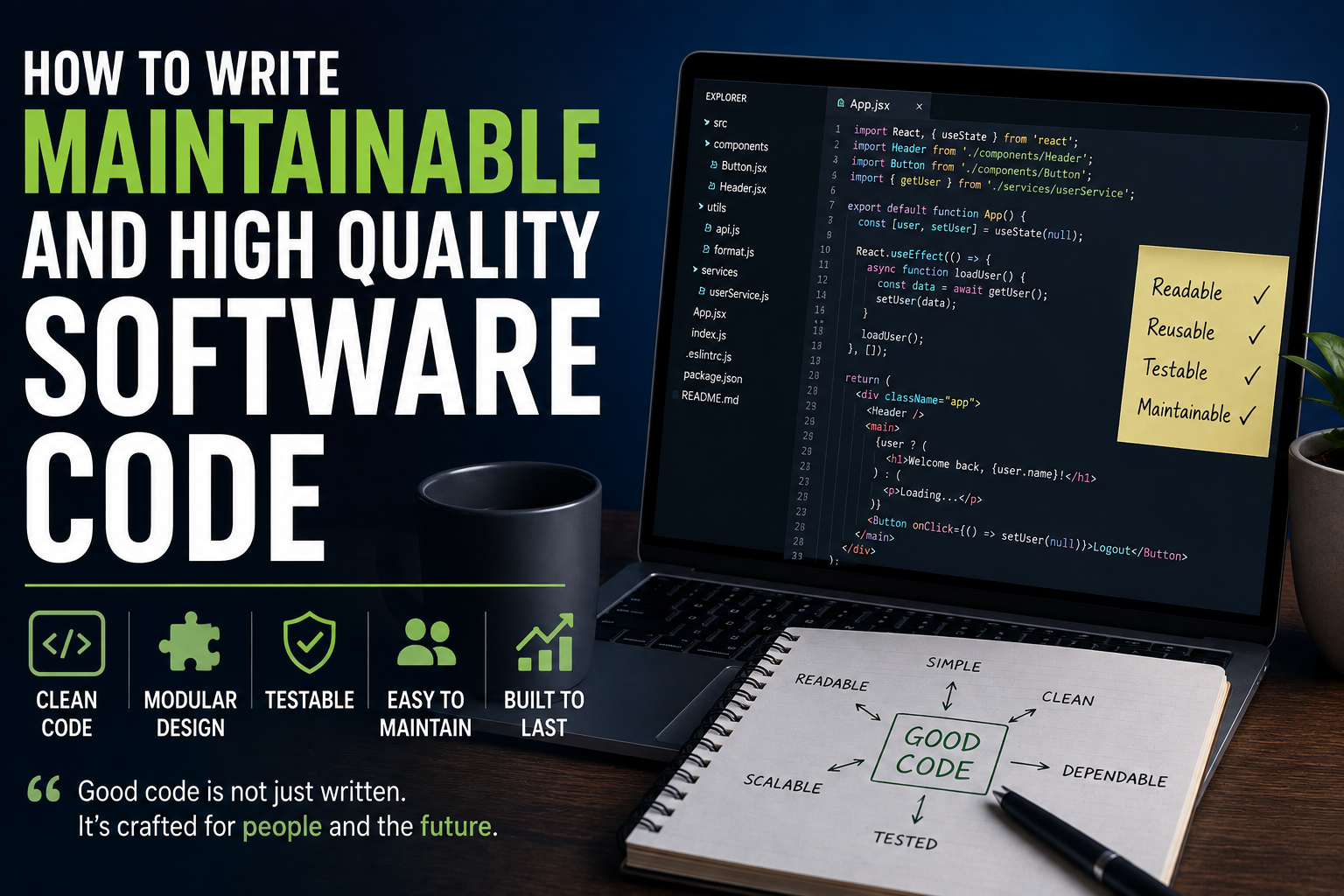
How to Write Maintainable and High-Quality Software Code
Writing code that works is only the beginning of software development. A program can produce the correct result today and still become difficult, expensive and risky to maintain tomorrow.
High-quality code is designed not only for computers to execute, but also for people to understand, modify, test and improve. This becomes increasingly important as applications grow, teams expand and requirements change.
Maintainable software does not necessarily mean writing more code or following complicated engineering practices. In many cases, it means making thoughtful decisions that keep the codebase understandable and predictable.
For a broader understanding of how software is planned, built, tested and maintained, see our complete guide to software development processes.
What Makes Code High Quality?
There is no single definition of perfect code, but maintainable software generally has several characteristics.
Good code is typically:
- Readable — developers can understand what it does.
- Consistent — similar problems are solved in similar ways.
- Testable — important behavior can be verified reliably.
- Modular — different responsibilities are separated appropriately.
- Predictable — functions and components behave as expected.
- Adaptable — reasonable changes do not require rewriting everything.
- Documented where necessary — important decisions and complex behavior are explained.
- Secure — common vulnerabilities and unsafe assumptions are addressed.
- Efficient enough — it uses resources appropriately without unnecessary optimization.
The goal is not to make every line clever. The goal is to make the entire system easier to work with.
Start With Simple Code
One of the most effective principles in software development is also one of the easiest to overlook: prefer simplicity when simplicity is sufficient.
Developers sometimes introduce abstractions, frameworks and design patterns before they are actually needed.
A straightforward function that solves a problem clearly can be better than a highly abstract system designed to handle hypothetical future requirements.
Simple code is generally easier to:
- Understand
- Test
- Debug
- Review
- Modify
- Explain to new developers
This does not mean avoiding abstraction entirely. Abstraction becomes valuable when it reduces duplication, isolates complexity or provides a meaningful boundary between components.
The important question is whether the abstraction makes the system easier to understand.
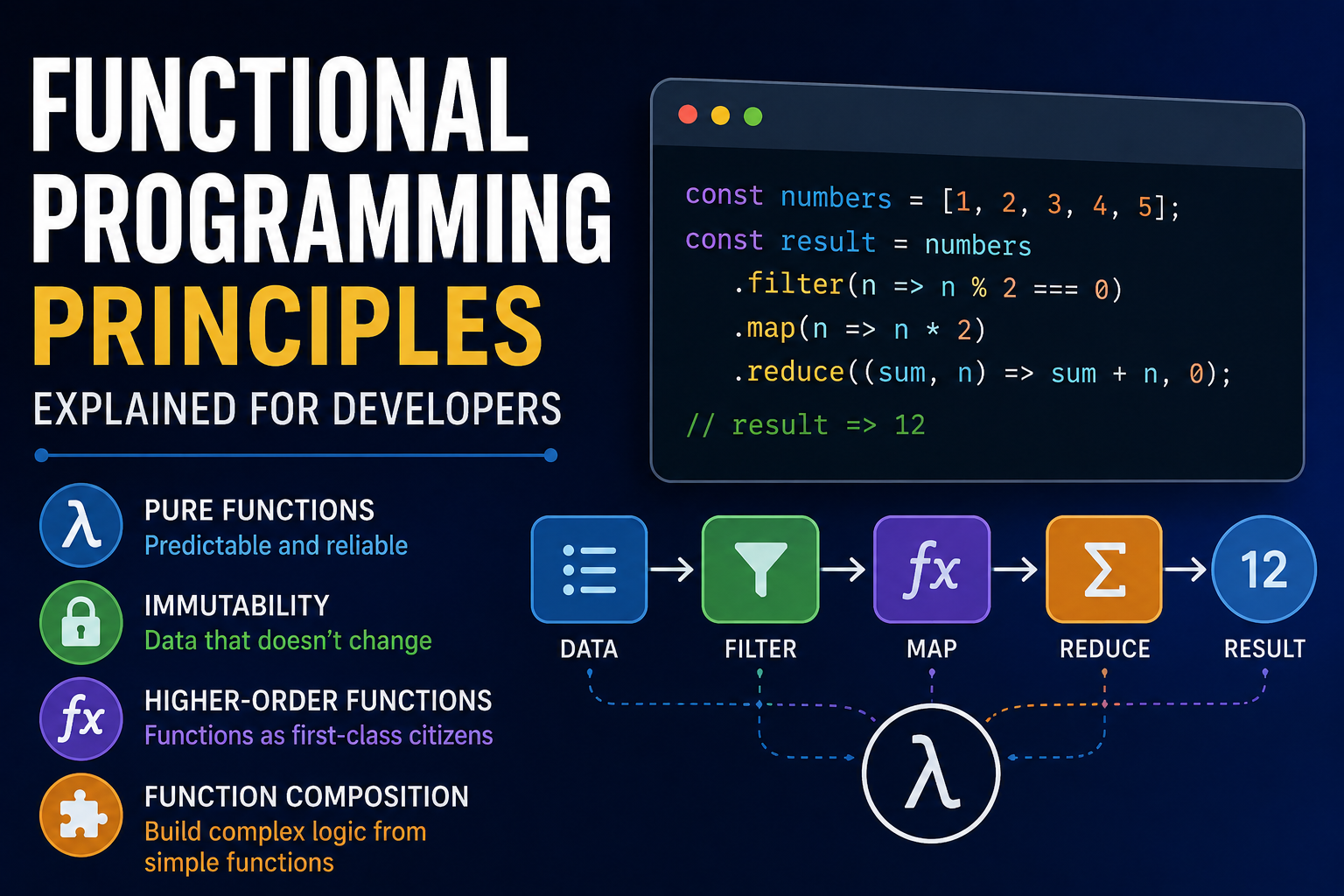
Developers can also apply principles from functional programming when designing small, predictable functions and reducing unnecessary complexity.
Give Code a Clear Structure
As a codebase grows, organization becomes increasingly important.
Related functionality should generally be grouped in logical locations. Modules should have clear responsibilities, and dependencies should be understandable.
A well-structured project makes it easier for a developer to answer questions such as:
- Where does this feature live?
- Which component handles this responsibility?
- Where should a change be made?
- What might be affected if I modify this function?
Poor structure has the opposite effect. Developers may spend significant amounts of time searching through unrelated files simply to understand where a change belongs.
Good architecture reduces that cognitive burden.
Understanding how software architecture organizes applications can help developers think more carefully about boundaries, dependencies and responsibilities as systems grow.
Use Meaningful Names
Names are one of the most important communication tools in source code.
A variable named x may technically work, but something like customerBalance communicates much more clearly what the value represents.
The same principle applies to functions, classes, modules and database fields.
Compare:
process(data)
with:
calculateMonthlySubscriptionCost(customer)
The second name provides substantially more information before a developer even reads the implementation.
Good names should communicate intent rather than simply describe syntax.
Instead of asking, “What is the shortest name I can use?”, ask:
“What name would help another developer understand this code without opening another file?”
Keep Functions Focused
A function becomes harder to maintain when it is responsible for too many unrelated tasks.
For example, a single function that:
- Validates a user
- Calculates an order total
- Saves information to a database
- Sends an email
- Generates a report
may technically work, but changing one responsibility could unexpectedly affect the others.
Breaking the functionality into smaller, logically focused components can make the system easier to understand and test.
This does not mean every function needs to contain only a few lines. The right size depends on the responsibility and complexity.
The key is cohesion: a function should have a clear reason to exist.
This principle closely connects with functional programming principles for developers, particularly the practice of creating small functions with focused responsibilities.
Avoid Unnecessary Duplication
Repeated code creates maintenance problems.
If the same business rule appears in five different places, changing that rule requires finding and updating all five implementations.
There is a risk of updating some but not others.
Reusable functions, modules or components can centralize behavior when the repeated logic genuinely represents the same concept.
However, developers should also avoid taking the “don’t repeat yourself” principle too far.
Two pieces of code may look similar today but represent different business concepts. Forcing them into one abstraction can create unnecessary complexity.
The goal is not to eliminate every repeated line. It is to avoid meaningful duplication of knowledge and behavior.
Write Code That Is Easy to Test
Testing is one of the foundations of maintainable software.
Automated tests provide developers with confidence that changes have not unintentionally broken existing behavior.
Different types of tests serve different purposes.
Unit tests
Unit tests typically verify individual functions or components in isolation.
They can be fast and useful for checking specific business rules.
Integration tests
Integration tests examine how multiple components work together.
They are particularly useful for identifying problems involving databases, APIs, authentication systems and other dependencies.
End-to-end tests
End-to-end tests simulate larger user workflows.
They can verify that an application works correctly across multiple layers of the system.
A strong testing strategy does not necessarily mean testing every possible line of code. It means providing appropriate coverage for important behavior and areas where failures would be costly.
For a deeper look at testing as part of the development process, see what software testing is and how developers ensure software quality.
Make Errors Explicit
Software will encounter unexpected conditions.
Networks fail. Databases become unavailable. Users enter invalid information. External services change behavior.
High-quality code anticipates these possibilities rather than assuming everything will work perfectly.
Error handling should make failures understandable and predictable.
Avoid silently ignoring errors when doing so could hide serious problems.
For example, returning a generic empty result when a database operation fails could make the application appear to have no data when the real problem is that the database is unavailable.
Clear error handling helps both users and developers understand what went wrong.
Avoid Clever Code
Cleverness can be attractive to the person writing the code and frustrating to everyone who has to maintain it later.
A complicated one-line expression might technically be elegant, but if another developer needs ten minutes to understand it, the cleverness may not be worthwhile.
Readable code usually wins.
Prefer:
- Clear control flow
- Descriptive names
- Straightforward logic
- Small, understandable abstractions
- Consistent patterns
Over:
- Obscure shortcuts
- Excessive nesting
- Unnecessary metaprogramming
- Extremely compressed syntax
- Clever tricks that require special knowledge
Code is read far more often than it is written.
Optimize for the reader.
Keep Comments Useful
Comments can improve maintainability, but too many comments can create another maintenance burden.
A comment that says:
// Add 1 to counter
counter += 1
does not provide meaningful information.
The code already explains what is happening.
Useful comments explain why something is being done when the reason is not obvious.
For example, a comment might explain why a seemingly unusual workaround is necessary because of an external API limitation.
Good comments preserve context.
Bad comments merely repeat the implementation.
Document Important Decisions
Some of the most valuable documentation explains decisions rather than syntax.
A future developer may understand what the code does but still wonder:
- Why was this architecture chosen?
- Why does this service use this database?
- Why is this validation rule necessary?
- Why can’t these components be combined?
- Why does this unusual workaround exist?
Recording important architectural and business decisions can prevent future developers from accidentally removing something that appears unnecessary but exists for a good reason.
This type of documentation can be especially valuable in large teams where the people who made the original decisions may eventually move to other projects.
Follow Consistent Coding Standards
Consistency reduces cognitive overhead.
When developers use different naming conventions, formatting styles and architectural patterns throughout the same project, understanding the code requires learning multiple approaches to the same problem.
Teams should establish conventions for areas such as:
- Naming
- Formatting
- File organization
- Error handling
- Testing
- Logging
- Dependency management
- API design
Automated formatters and linters can enforce many of these standards without requiring developers to debate formatting during code reviews.
Consistency allows code reviews to focus more heavily on behavior and design.
Use Version Control Properly
Version control is fundamental to maintaining a healthy codebase.
Systems such as Git allow developers to track changes, collaborate and recover previous versions when something goes wrong.
Good version-control practices include:
- Making focused commits
- Writing meaningful commit messages
- Keeping branches manageable
- Reviewing changes before merging
- Avoiding unnecessary generated files
- Resolving conflicts carefully
Small, focused changes are easier to review and troubleshoot than enormous commits containing unrelated modifications.
Version control should provide a useful history of how the software evolved.
Developers who want to understand this workflow in greater depth can explore our Git and version control guide for developers.
Review Code Before It Reaches Production
Code review provides another developer with an opportunity to examine a change before it becomes part of the main codebase.
A useful review looks beyond formatting.
Reviewers can consider:
- Does the implementation solve the intended problem?
- Is the logic easy to understand?
- Are edge cases handled?
- Are there security concerns?
- Are tests sufficient?
- Could the change break existing functionality?
- Is the abstraction appropriate?
- Will this be easy to maintain later?
Code review should not become an exercise in proving who is the better programmer.
The purpose is to improve the software and share knowledge across the team.
Design for Change, Not Every Possible Future
Software requirements change.
A maintainable system should accommodate reasonable changes without requiring major rewrites.
But developers should avoid designing for every hypothetical future requirement.
It is easy to create complicated architecture based on assumptions about what the application might need years from now.
That can increase development time and create abstractions that never provide value.
A better approach is to build clean boundaries and avoid unnecessary coupling while allowing the architecture to evolve as real requirements emerge.
Design for likely change, not imaginary complexity.
This is one reason understanding how software architecture organizes applications is valuable when building systems intended to evolve over time.
Manage Dependencies Carefully
Modern software rarely operates independently.
Applications rely on libraries, frameworks, APIs and external services.
Each dependency introduces potential maintenance considerations.
Developers should know:
- Why a dependency is needed
- Whether it is actively maintained
- What security risks it introduces
- How frequently it should be updated
- Whether an alternative would be simpler
Adding a package for a problem that could be solved with a few understandable lines of code may sometimes create more maintenance work than it saves.
Dependencies should provide meaningful value.
Think About Security From the Beginning
Security should not be treated as something added after an application is finished.
Developers should consider security during design and implementation.
Important practices include:
- Validating input
- Protecting authentication credentials
- Using secure password storage
- Limiting permissions
- Protecting sensitive data
- Keeping dependencies updated
- Avoiding hard-coded secrets
- Handling authentication and authorization correctly
- Logging security-relevant events appropriately
Security problems can become significantly more expensive to fix after software has been deployed widely.
Building secure defaults into the system is generally more effective than relying on developers to remember security fixes later.
Optimize Only When There Is a Reason
Performance matters, but premature optimization can make code harder to understand without producing meaningful benefits.
Developers should first make software correct, measurable and maintainable.
When performance becomes a real problem, profiling and monitoring can identify where optimization is actually needed.
This approach prevents developers from spending time optimizing code that contributes little to the application’s overall performance.
A simple implementation that is fast enough is often preferable to a complicated implementation that is theoretically faster.
For a broader look at application performance, see how developers optimize software performance and application speed.
Use Logging and Monitoring Wisely
Maintainability extends beyond the source code itself.
Once software is running in production, developers need ways to understand what is happening.
Useful logging and monitoring can help answer questions such as:
- Is the application healthy?
- Which operations are failing?
- How frequently are errors occurring?
- Where are users encountering problems?
- Is a recent deployment causing unexpected behavior?
Logs should provide useful context without exposing sensitive information.
Monitoring should also focus on meaningful signals rather than generating enormous quantities of data that nobody reviews.
Refactor Regularly
Software accumulates complexity over time.
As new features are added, developers may introduce temporary workarounds, duplicate logic or increasingly complicated structures.
Refactoring is the process of improving the internal structure of software without changing its intended external behavior.
Examples include:
- Simplifying complicated functions
- Removing obsolete code
- Improving names
- Extracting reusable components
- Reducing unnecessary dependencies
- Improving module boundaries
Refactoring does not have to be a massive project.
Small improvements made regularly can prevent technical debt from becoming overwhelming.
Treat Technical Debt as a Business Issue
Technical debt refers to the future cost created by shortcuts, outdated systems or design decisions that make software harder to change.
Some technical debt is intentional.
A company might deliberately choose a simpler implementation to launch a product quickly.
The problem occurs when technical debt becomes invisible or is never addressed.
Technical debt can eventually increase:
- Development time
- Bug rates
- Security risks
- Infrastructure costs
- Onboarding difficulty
- Difficulty implementing new features
Engineering teams should therefore discuss technical debt alongside product priorities rather than treating it as an entirely separate concern.
Build a Culture of Quality
Tools and coding standards can help, but maintainability ultimately depends on engineering culture.
Teams that value quality tend to encourage developers to:
- Ask questions
- Review each other’s work
- Test important behavior
- Improve existing code
- Share knowledge
- Document important decisions
- Learn from failures
Leadership also matters.
If developers are consistently pressured to prioritize speed over reliability, quality will eventually suffer.
A sustainable engineering culture recognizes that good software is not simply software that ships quickly. It is software that can continue evolving without becoming increasingly expensive and fragile.
The Developer Who Maintains the Code Comes First
The best measure of maintainable code is not how impressive it looks when it is first written.
It is how understandable it remains six months or three years later.
Good software code communicates its intent clearly, separates responsibilities sensibly, handles errors deliberately and includes enough tests to provide confidence. It avoids unnecessary complexity while leaving room for legitimate change.
Developers should remember that the next person reading the code may be a teammate, a new employee—or themselves after months away from the project.
Writing high-quality software therefore requires more than knowing a programming language. It requires thinking about communication, trade-offs, testing, security, architecture and the long-term cost of every technical decision.
Code that is easy to understand today is easier to change tomorrow—and that is one of the clearest signs of software built to last.