Functional Programming Principles Explained for Developers
Functional programming is one of the most influential approaches to software development, but its core ideas can initially feel unfamiliar to developers who are accustomed to object-oriented or imperative programming.
Instead of focusing primarily on changing data and describing a sequence of commands, functional programming emphasizes functions, immutable data, predictable behavior and the composition of small operations.
The approach can make software easier to reason about, test and maintain. Its principles also appear throughout modern programming languages, including JavaScript, Python, Java, C#, Kotlin, Rust and many others.
Developers do not necessarily need to write applications in a purely functional style to benefit from these ideas. Understanding the principles can improve code quality even in projects that use a mixture of programming paradigms.
For broader context, functional programming is one of several approaches developers can use within the wider software development process.
What Is Functional Programming?
Functional programming is a programming paradigm that treats computation largely as the evaluation and combination of functions.
A function takes inputs and produces an output. Ideally, that output depends only on the inputs provided to the function.
For example:
function add(a, b) {
  return a + b;
}
Given the same values, add() always produces the same result.
Functional programming builds on this idea by encouraging developers to construct programs from small, predictable functions that can be combined to perform more complex operations.
This differs from programming styles that rely heavily on changing shared state, modifying objects or performing operations with hidden side effects.
Developers who are still building their foundation in software development can also benefit from understanding what programming is and how it works.
Pure Functions Are at the Core
One of the most important concepts in functional programming is the pure function.
A pure function has two important characteristics:
- It produces the same output whenever it receives the same input.
- It does not produce observable side effects outside the function.
Consider:
function square(number) {
  return number * number;
}
There is no dependency on external state. The function does not modify anything outside itself.
By contrast:
let total = 0;

function addToTotal(amount) {
  total += amount;
}
The function changes a variable outside its local scope. Its behavior therefore depends on and modifies external state.
Pure functions are valuable because they are easier to understand and test.
A developer can examine the inputs and determine what the function should return without needing to understand the state of the rest of the application.
This principle also connects closely with how developers ensure software quality through software testing, since isolated functions are generally easier to test independently.
Immutability Reduces Unexpected Changes
Functional programming commonly encourages immutability, meaning that data is not modified after it has been created.
Instead of changing an existing value, a program creates a new value representing the desired state.
For example:
const numbers = [1, 2, 3];

const updatedNumbers = [...numbers, 4];
The original numbers array remains unchanged.
This contrasts with:
numbers.push(4);which modifies the existing array.
Immutability can make applications easier to reason about because developers do not have to worry as much about one part of a program unexpectedly changing data that another part is using.
These ideas are particularly useful when working with collections and other structures covered in the complete guide to data structures.
Why Immutability Matters in Large Applications
The benefits of immutable data become particularly noticeable as applications become more complex.
Imagine several components sharing access to the same object. If one component changes that object, another component may suddenly behave differently.
Tracking down that kind of problem can be difficult because the code that experiences the error may not be responsible for changing the data.
Immutable data reduces this type of hidden interaction.
Instead of asking, “Who changed this object?”, developers can often reason about a series of values:
original state
      ↓
transformation
      ↓
new state
      ↓
another transformation
      ↓
final state
This model can make state changes more predictable.
It also becomes important when developers are designing larger applications, where software architecture organizes applications into components and layers with different responsibilities.
Functions Can Be Treated as Values
Functional programming treats functions as first-class values.
That means functions can be:
- Assigned to variables
- Stored in data structures
- Passed as arguments
- Returned from other functions
- Combined with other functions
For example:
const double = number => number * 2;

const numbers = [1, 2, 3];

const result = numbers.map(double);
Here, the double function is passed to map().
This ability to treat functions like ordinary values enables many of the techniques associated with functional programming.
Understanding the fundamentals of programming languages is useful here because different languages provide different ways of expressing and working with functions. The broader concepts are covered in what programming languages are and how different languages work.
Higher-Order Functions
A higher-order function is a function that accepts another function as an argument, returns a function, or both.
For example:
function applyOperation(value, operation) {
  return operation(value);
}

const result = applyOperation(5, x => x * 3);
The applyOperation() function does not need to know what operation will be performed.
The caller provides that behavior.
Higher-order functions can make code more flexible by separating the logic that determines what to do from the logic that determines how to perform the surrounding operation.
This is one example of how developers can use programming concepts to create more reusable solutions rather than repeatedly implementing the same logic.
Map, Filter and Reduce
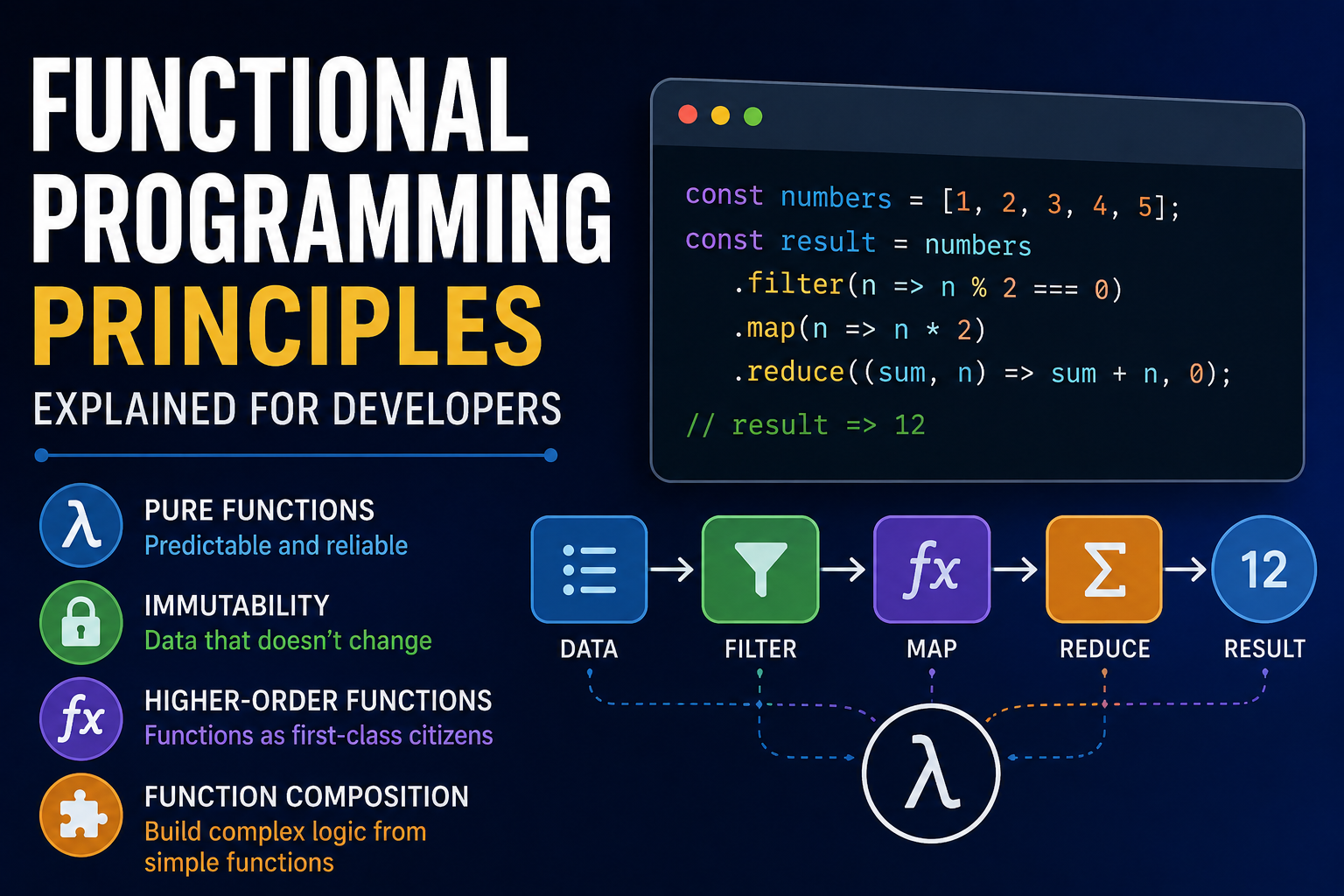
Many developers encounter functional programming through three common operations:
mapfilterreduce
These operations are especially common in JavaScript and other modern programming languages.
Map
map() transforms every element in a collection.
const prices = [10, 20, 30];

const discounted = prices.map(price => price * 0.9);
The original collection remains unchanged, while a new collection is produced.
Filter
filter() selects elements that satisfy a condition.
const numbers = [1, 2, 3, 4, 5, 6];

const evenNumbers = numbers.filter(number => number % 2 === 0);
The result contains only the values that meet the specified condition.
Reduce
reduce() combines elements into a single result.
const numbers = [1, 2, 3, 4];

const total = numbers.reduce(
  (sum, number) => sum + number,
  0
);
The result is 10.
These operations allow developers to express common data transformations without explicitly managing loop counters or mutating collections.
They also demonstrate how programming logic can be broken into smaller operations, an idea that connects functional programming with broader principles discussed in the complete guide to software development processes.
Declarative Code Versus Imperative Code
Functional programming is often associated with declarative programming.
Imperative code generally describes how something should happen step by step.
For example:
const result = [];

for (const number of numbers) {
  if (number > 10) {
    result.push(number * 2);
  }
}
A functional approach might be:
const result = numbers
  .filter(number => number > 10)
  .map(number => number * 2);
The second version describes the transformation more directly:
Take the numbers greater than 10 and double them.
The difference is not simply about shorter code. Declarative programming can make the intent of a transformation easier to identify.
Function Composition
Functional programming encourages developers to build complex behavior by combining smaller functions.
Suppose an application needs to:
- Clean a string.
- Convert it to lowercase.
- Extract a value.
- Format the result.
Instead of creating one enormous function, developers can create smaller operations and compose them.
Conceptually:
input
  ↓
clean
  ↓
normalize
  ↓
extract
  ↓
format
  ↓
output
Each function has a focused responsibility.
This approach can improve readability and make individual pieces easier to test.
It also reflects a broader software engineering principle: breaking complex systems into understandable components. That principle becomes especially important when considering how software architecture organizes applications.
Referential Transparency
A concept closely related to pure functions is referential transparency.
An expression is referentially transparent when it can be replaced by its resulting value without changing the behavior of the program.
For example:
const result = 5 * 5;The expression 5 * 5 can be replaced with 25.
Similarly, a pure function such as:
square(5)can be replaced with:
25without changing the program’s behavior.
This property makes code easier to reason about because developers can treat expressions almost like mathematical equations.
Side Effects Should Be Controlled
Not all side effects are bad.
Real applications need to perform operations such as:
- Writing to databases
- Sending network requests
- Displaying information
- Reading files
- Logging events
- Updating external systems
These are inherently side-effecting activities.
Functional programming does not require developers to eliminate them completely.
Instead, a common goal is to isolate and control side effects.
For example, an application might keep its data-processing functions pure while placing database operations at the edges of the system.
This separation makes the core business logic easier to test.
Separating responsibilities in this way also supports the broader goal of writing maintainable and high-quality software code.
Functional Programming and State Management
Managing state is one of the biggest challenges in software development.
State represents information that can change during the lifetime of an application.
Examples include:
- Logged-in users
- Shopping carts
- Form inputs
- Application settings
- Game scores
- Database records
Functional approaches often treat state transitions as transformations rather than direct mutations.
Instead of:
change existing statethe model becomes:
old state → function → new stateThis approach has influenced modern application architectures and state-management libraries.
Understanding how state moves through an application is also part of understanding how modern software works, particularly as applications become distributed across multiple components and services.
Recursion as an Alternative to Loops
Functional programming has historically placed greater emphasis on recursion than traditional imperative programming.
A recursive function calls itself to solve progressively smaller versions of a problem.
For example:
function factorial(n) {
  if (n <= 1) {
    return 1;
  }

  return n * factorial(n - 1);
}
The function continues until it reaches its base case.
Recursion can be elegant for problems involving trees, nested structures and other naturally recursive data.
However, developers should understand the performance characteristics of recursion in their chosen language. Some languages optimize recursive calls particularly well, while others can encounter call-stack limitations.
Functional programming does not mean every loop should automatically be replaced with recursion.
Algorithms and data structures provide important foundations for understanding when different approaches are appropriate. Developers can explore these concepts further in Algorithms Explained: Complete Programming Guide and The Complete Guide to Data Structures.
Closures Preserve Context
Functional programming languages often make extensive use of closures.
A closure occurs when a function retains access to variables from the environment in which it was created.
For example:
function createMultiplier(multiplier) {
  return function(number) {
    return number * multiplier;
  };
}

const double = createMultiplier(2);

console.log(double(5));
The returned function remembers the value of multiplier.
Closures are useful for creating specialized functions, encapsulating state and implementing abstractions.
They are also an important concept for developers working with JavaScript.
Currying Breaks Functions Into Smaller Steps
Currying is a technique in which a function that normally accepts multiple arguments is transformed into a sequence of functions that each accept one argument.
Instead of:
function multiply(a, b) {
  return a * b;
}
a curried version might look like:
const multiply = a => b => a * b;This allows developers to create specialized functions:
const double = multiply(2);

double(10); // 20
Currying can be useful in functional codebases, although it is not necessary for every application.
Partial Application Creates Reusable Functions
Partial application is related to currying but involves pre-filling some of a function’s arguments.
For example, a generic function might perform an operation based on several parameters. By fixing some of those parameters, developers can create a more specialized function.
This can reduce repetition and make code more expressive.
The broader principle is to create reusable functions that represent specific pieces of business logic rather than repeatedly writing similar operations throughout an application.
Functional Programming Encourages Small Functions
A common functional programming practice is to keep functions relatively small and focused.
Instead of creating a function responsible for reading a database, validating data, calculating a result, formatting a response and sending an HTTP request, developers can separate those responsibilities.
For example:
fetch data
   ↓
validate data
   ↓
transform data
   ↓
calculate result
   ↓
format response
Each step can be implemented and tested independently.
This does not mean every function should contain only a single line. The important idea is that each function should have a clear responsibility.
This principle directly supports the broader goal of writing maintainable and high-quality software code.
Functional Programming Can Improve Testing
Pure functions are particularly easy to unit test.
Suppose a function is defined as:
function calculateTax(price, rate) {
  return price * rate;
}
A test can provide known inputs and compare the result with the expected output.
There is no need to configure a database, start a web server or reproduce a complicated application state.
This isolation can make automated testing faster and more reliable.
When side effects are separated from core logic, developers can test the majority of the application’s important calculations without recreating its entire environment.
For a broader understanding of testing and quality assurance, see What Is Software Testing and How Do Developers Ensure Software Quality?.
Concurrency Can Become Easier to Reason About
Shared mutable state can create difficult problems in concurrent programs.
When multiple processes or threads can modify the same data, developers need to carefully coordinate access to that state.
Immutable data can reduce some of these risks because values cannot unexpectedly change underneath another operation.
This is one reason functional concepts have been particularly influential in systems where concurrency and parallel processing are important.
Functional programming does not automatically solve every concurrency problem, but reducing shared mutable state can simplify the reasoning involved.
Functional Programming Is Not About Writing Cryptic Code
One criticism sometimes directed at functional programming is that heavily functional code can become difficult for newcomers to understand.
This can happen when developers overuse advanced abstractions, deeply nested functions or highly compact expressions.
For example, code that technically follows functional principles may still be unnecessarily difficult to read.
Good functional programming should prioritize clarity over cleverness.
A straightforward loop can sometimes be easier to understand than a complicated chain of transformations.
The goal is not to make code look functional. The goal is to make software predictable, maintainable and understandable.
These concerns connect directly with broader principles of maintainable and high-quality software code.
Functional and Object-Oriented Programming Can Coexist
Developers do not have to choose between functional programming and object-oriented programming.
Many modern applications use both.
Object-oriented programming can be useful for modeling entities, encapsulating behavior and organizing large systems. Functional techniques can be useful for data transformations, validation, calculations and state management.
JavaScript, for example, supports both object-oriented and functional styles.
Similarly, languages such as Java, C# and Kotlin have incorporated increasingly powerful functional features while retaining their object-oriented foundations.
The most effective approach is often to use the technique that best fits the problem.
Developers who want to understand the contrasting paradigm in greater depth can explore the Complete Guide to Object-Oriented Programming.
Common Functional Programming Mistakes
Developers learning functional programming can fall into several traps.
Making Everything Immutable
Immutability is valuable, but forcing every piece of data into an immutable structure can introduce unnecessary complexity.
The goal is controlled state, not dogmatic avoidance of every mutation.
Overusing Abstractions
Higher-order functions, currying and advanced functional patterns can be useful, but excessive abstraction can make simple logic harder to understand.
Ignoring Side Effects
Side effects are unavoidable in real applications. Trying to pretend they do not exist can lead to poor architecture.
A better strategy is to make them explicit and isolate them where practical.
Chaining Too Many Operations
A long chain of map(), filter(), reduce() and other transformations can become difficult to debug.
Sometimes breaking a transformation into named intermediate steps makes the code considerably clearer.
These are ultimately software design decisions, which is why functional techniques should be considered as part of the broader software development process rather than treated as isolated rules.
Where Functional Programming Fits Best
Functional techniques can be particularly valuable in areas involving substantial data transformation and predictable business logic.
Examples include:
- Data-processing pipelines
- Financial calculations
- Analytics systems
- API data transformations
- Validation logic
- State-management systems
- Concurrent applications
- Scientific computing
- Event-processing systems
- Automated testing
That does not mean functional programming is unsuitable for other applications.
Its principles can be applied selectively to almost any software project.
A Practical Way to Learn Functional Programming
Developers do not need to rewrite an entire application to begin using functional programming.
A practical learning path is to start with a few fundamental ideas:
- Write small, pure functions.
- Avoid unnecessary mutation.
- Treat functions as reusable values.
- Learn
map,filterandreduce. - Separate data processing from side effects.
- Practice composing small functions.
- Learn closures and higher-order functions.
- Gradually explore recursion, currying and other advanced techniques.
The objective should be to understand why these techniques are useful rather than memorizing terminology.
Developers who are building their programming fundamentals can also work through What Are Programming Languages and How Do Different Languages Work? and the Python Programming Guide to see how programming concepts are expressed in different environments.
Functional Thinking Can Improve Everyday Code
The most valuable lesson from functional programming is not that every application should become purely functional.
It is that developers can make software easier to understand by reducing unnecessary complexity.
Pure functions make behavior predictable. Immutable data reduces unexpected changes. Small functions clarify responsibilities. Function composition makes complex transformations easier to break down. Controlled side effects make testing simpler.
These principles can improve code regardless of the programming language or architectural style being used.
Functional programming ultimately encourages developers to think carefully about how data changes, where state lives and what each piece of code is responsible for.
Once those ideas become familiar, functional techniques stop being an alternative programming style and become another set of tools developers can use to write software that is easier to reason about, test and maintain.