What Backend Development Is and How Servers Handle Application Logic, Data and Requests
When people use a website or application, they usually interact with buttons, menus, forms, images and other visible elements. That visible layer is only part of the system.
Behind the interface is another layer responsible for processing requests, applying business rules, communicating with databases, authenticating users and returning information to the application. This is known as backend development.
Backend systems are what allow an online store to process an order, a banking application to verify a transaction, a social platform to retrieve a user’s feed and a booking service to confirm a reservation.
Understanding how the backend works provides a clearer picture of what happens between clicking a button and seeing the expected result on a screen. For a broader explanation of how different software components work together, see How Modern Software Works.
What Is Backend Development?
Backend development is the process of building and maintaining the server-side components of an application.
The backend typically handles tasks that users do not directly see, including:
- Processing requests
- Applying business logic
- Managing databases
- Authenticating users
- Authorizing access
- Validating submitted information
- Communicating with other services
- Processing payments
- Managing files
- Returning data to frontend applications
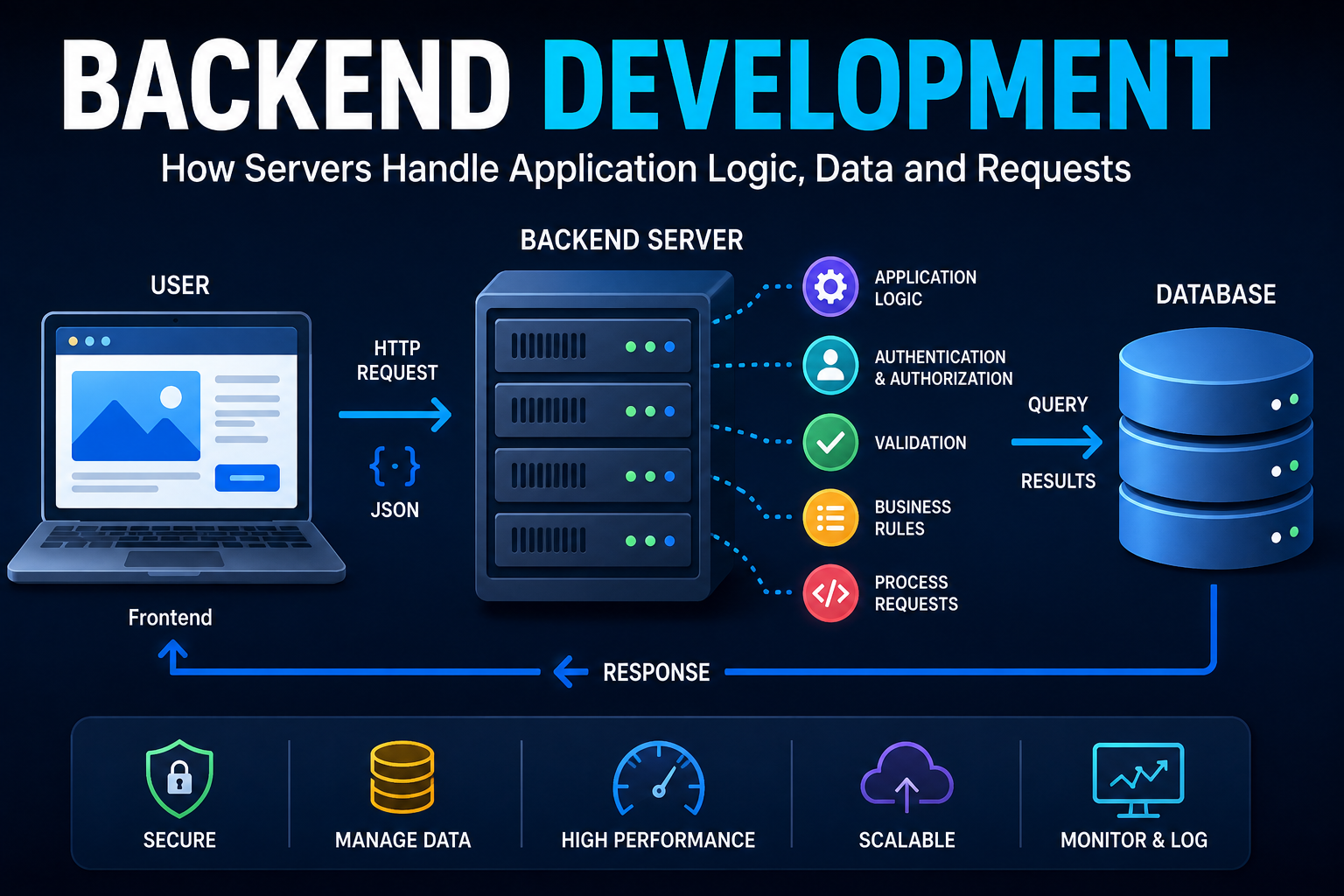
A useful simplified model is:
User → Frontend → Backend → Database or Other Services → Backend → Frontend → User
The frontend provides the interface, while the backend performs much of the underlying work.
Frontend and Backend Work Together
A modern application generally has multiple layers rather than one large block of code.
The frontend runs in a user’s browser or application interface. Developers who want to understand the visible side of this relationship can explore What Frontend Development Is and How Developers Build Interactive Web Interfaces.
The backend runs primarily on servers or cloud infrastructure.
For example, when someone logs into a website:
- The user enters an email address and password.
- The frontend sends the information to the backend.
- The backend validates the request.
- The backend checks the relevant account information.
- Authentication logic determines whether the credentials are valid.
- The server creates or updates an authenticated session.
- A response is returned to the frontend.
- The interface displays the appropriate result.
The user may experience this as a simple login button, but several backend operations can occur within seconds.
What Is a Server?
A server is a computer system or computing environment that provides resources or services to other computers, applications or users.
A backend application can run on:
- Physical servers
- Virtual machines
- Cloud instances
- Containers
- Serverless platforms
- Other managed computing infrastructure
The term “server” can therefore refer to both the physical hardware and the software responsible for responding to requests.
A single application may use many servers, each handling different responsibilities.
What Happens When a User Sends a Request?
Consider someone opening a product page on an online store.
The browser sends a request to the application’s backend.
The request might effectively ask:
“Give me the information for product 123.”
The backend receives the request and determines what needs to happen.
It may:
- Identify the requested resource.
- Check whether the request is valid.
- Verify authentication or permissions if necessary.
- Query a database.
- Process the retrieved information.
- Construct a response.
- Send the response back to the browser.
The browser then uses the response to display the product page.
This basic request-and-response process happens constantly across the internet.
How HTTP Connects Frontends and Backends
Web applications commonly communicate using HTTP, the protocol underlying much of the web.
An HTTP request generally contains information such as:
- Method
- URL
- Headers
- Query parameters
- Body data
Common HTTP methods include:
GET
Usually used to retrieve information.
POST
Often used to submit data or create a resource.
PUT
Commonly used to replace or update a resource.
PATCH
Often used to partially update a resource.
DELETE
Used to request deletion of a resource.
These methods help applications communicate what operation is being requested.
What Is an API?
An Application Programming Interface (API) provides a structured way for software components to communicate.
A backend API can expose specific operations to a frontend or another application.
For example, an online store might provide endpoints such as:
GET /products
GET /products/123
POST /orders
GET /orders/456
The exact design varies between applications.
The important idea is that the API defines how other software can request information or perform operations.
APIs Are Not Limited to Websites
APIs are also used between backend services.
For example:
Payment Service → Order Service → Inventory Service → Notification Service
Each component can communicate with another through defined interfaces.
This allows complex applications to be divided into smaller systems.
How Backend Routing Works
When a request reaches a backend application, the server needs to determine which piece of code should handle it.
This process is commonly called routing.
For example:
GET /users/42
might be routed to code responsible for retrieving information about user 42.
Another request:
POST /orders
might be routed to order-processing logic.
Routing creates a connection between incoming requests and the appropriate application functionality.
What Is Application Logic?
Application logic consists of the rules and processes that determine how an application behaves.
For an online store, business logic might determine:
- Whether an item is available
- Whether a discount applies
- How shipping is calculated
- Whether a customer can place an order
- How taxes are calculated
- When inventory should be reduced
For a banking application, logic could determine:
- Whether a transaction is permitted
- Whether an account has sufficient funds
- Whether additional verification is required
- Whether a transaction exceeds a configured limit
The frontend can display information about these rules, but critical decisions should generally be enforced on the backend because users can manipulate client-side code.
Why Backend Validation Matters
Applications should not automatically trust information received from users or browsers.
A malicious user could modify requests before they reach the server.
Suppose a shopping application allows customers to enter a quantity.
The frontend might prevent users from entering a negative number.
But a malicious user could bypass that interface restriction and send:
quantity = -100
The backend must independently validate the value.
This principle applies to:
- Prices
- Quantities
- Account permissions
- File uploads
- User identifiers
- Transaction amounts
- Access requests
Backend validation provides an essential security boundary.
How Databases Fit Into Backend Development
Most applications need persistent data.
A database provides a structured way to store and retrieve that information.
A website might store:
- User accounts
- Products
- Orders
- Messages
- Payments
- Preferences
- Inventory
- Content
The backend acts as an intermediary between the application and the database.
A simplified process might look like:
Request → Backend → Database Query → Database Result → Backend → Response
This arrangement allows the backend to control how data is accessed and modified.
Relational Databases
Relational databases organize information into tables containing rows and columns.
Popular relational database technologies include:
- PostgreSQL
- MySQL
- MariaDB
- Microsoft SQL Server
- Oracle Database
A relational database might contain tables for:
Users
Products
Orders
Payments
Relationships between tables allow applications to represent complex information.
NoSQL Databases
NoSQL databases use other models for storing data.
Examples include document-oriented, key-value, graph and wide-column databases.
They can be useful for applications with particular scalability or data-model requirements.
The choice between relational and NoSQL systems depends on the application’s needs rather than one technology always being superior.
How Database Queries Work
Suppose an application needs to retrieve a customer record.
The backend may construct a database query requesting information associated with a particular user.
The database processes the query and returns matching records.
The backend then decides what information should be included in the response.
This separation is important.
The backend should not necessarily expose every field stored in the database.
For example, an internal customer record might contain security-related information that should never be returned to the browser.
Data Modeling
Backend developers need to decide how application information should be structured.
This is called data modeling.
A poorly designed data model can create problems such as:
- Duplicate information
- Difficult queries
- Inconsistent records
- Slow performance
- Complicated updates
A good model makes it easier to store, retrieve and maintain information as the application grows.
Database Transactions
Some operations require multiple database changes to succeed together.
Consider an online purchase.
The system might need to:
- Create an order.
- Record payment information.
- Reduce inventory.
- Update the customer’s order history.
If one critical operation fails, the system may need to prevent the others from leaving the database in an inconsistent state.
Database transactions help manage these situations by providing mechanisms for grouping related operations.
What Backend Programming Languages Are Used?
Backend development can be performed with many programming languages.
Common choices include:
- JavaScript and TypeScript
- Python
- Java
- C#
- Go
- PHP
- Ruby
- Kotlin
- Rust
- C++
The language itself is only one part of the backend technology stack.
Developers also work with frameworks, databases, APIs, testing tools, deployment systems and infrastructure. A broader introduction to programming concepts is available in What Is Programming and How Does It Work?.
Developers can also explore What Are Programming Languages and How Do Different Languages Work? to understand how programming languages differ.
Backend Frameworks
Frameworks provide reusable structures and tools for building server-side applications.
Examples include:
- Node.js ecosystem frameworks
- Django
- FastAPI
- Spring Boot
- ASP.NET Core
- Laravel
- Ruby on Rails
Frameworks can provide functionality for:
- Routing
- Request handling
- Authentication
- Database integration
- Validation
- Error handling
- Testing
They allow developers to focus more on application-specific functionality instead of implementing every low-level feature from scratch.
What Is Middleware?
Middleware is software that sits between incoming requests and the main application logic.
It can perform tasks such as:
- Logging
- Authentication
- Authorization
- Request validation
- Rate limiting
- Error handling
- Adding request information
For example, an authentication middleware component can check whether a request contains valid credentials before allowing it to reach a protected endpoint.
Middleware is particularly useful because common behavior can be applied consistently across many routes.
Authentication and Authorization Are Different
These two concepts are often confused.
Authentication asks:
Who are you?
Authorization asks:
What are you allowed to do?
A user may successfully authenticate but still lack permission to perform a particular action.
For example, an employee could log into a company application but have permission to view reports without being allowed to delete them.
Backend systems need to enforce both authentication and authorization.
How Sessions and Tokens Work
After a user successfully logs in, the application needs a way to recognize subsequent requests.
One approach is a session.
The server stores information about the authenticated session and gives the client a session identifier.
Another common approach involves tokens.
A token can represent authenticated information and be sent with subsequent requests.
Different architectures use different approaches, and each has security and implementation considerations.
The important principle is that authentication state must be handled securely.
What Is Encryption?
Encryption protects information by transforming it into a form that unauthorized parties cannot easily understand.
Backend systems use encryption in several important contexts.
Encryption in Transit
Protocols such as HTTPS protect information as it travels between the client and server.
Encryption at Rest
Sensitive data can also be encrypted while stored.
Password Protection
Passwords should not be stored as ordinary readable text.
Instead, secure password-hashing mechanisms are used to store representations that are designed to make recovering the original password difficult.
How Servers Handle Many Requests
A popular website can receive thousands or millions of requests.
A backend must therefore be designed to handle concurrent activity efficiently.
Operating systems, web servers, application runtimes and databases all contribute to this process.
The architecture may use:
- Multiple application processes
- Threads
- Asynchronous programming
- Queues
- Caching
- Load balancing
- Multiple servers
The exact approach depends on the technology and workload.
What Is Load Balancing?
A load balancer distributes incoming traffic across multiple backend servers.
Instead of sending every request to one server:
Users
↓
Load Balancer
↓
Server A
Server B
Server C
The traffic can be distributed across several machines.
This can improve:
- Scalability
- Availability
- Performance
- Fault tolerance
If one server fails, a properly configured load-balancing system may redirect traffic to healthy servers.
Why Caching Improves Performance
Some information does not need to be calculated or retrieved from a database every time someone requests it.
A cache stores frequently used information temporarily so it can be returned more quickly.
For example, a popular product page may be requested thousands of times.
Instead of querying the database for every request, the application could cache appropriate information.
Caching can reduce:
- Database load
- Server processing
- Response times
However, cached information can become outdated, so developers need strategies for determining when cached data should be refreshed.
For more on improving application speed, see How Developers Optimize Software Performance and Application Speed.
What Are Background Jobs?
Not every task needs to happen while a user waits for a response.
Some operations can be moved into background jobs.
Examples include:
- Sending emails
- Processing large files
- Generating reports
- Resizing images
- Updating search indexes
- Processing analytics
- Sending notifications
A user might place an order and immediately receive confirmation while a background process handles additional tasks afterward.
This can make applications feel faster and reduce pressure on the main request-processing system.
Message Queues and Asynchronous Processing
Background jobs are often coordinated through queues.
A simplified system might look like:
Application → Queue → Worker → Task Processing
The application places a job on the queue.
A worker retrieves the job and processes it.
This approach allows systems to handle bursts of activity more effectively.
If thousands of jobs arrive at once, they can wait in the queue instead of overwhelming the application server.
Microservices Versus Monolithic Applications
Backend applications can be structured in different ways.
A monolithic application generally contains many functions within one larger application.
A microservices architecture divides functionality into smaller services.
For example:
User Service
Order Service
Payment Service
Inventory Service
Notification Service
Each service can potentially be developed, deployed and scaled independently.
For a broader look at how applications are organized, see How Software Architecture Organizes Applications.
Why Organizations Use Microservices
Microservices can provide:
- Independent deployment
- Separate scaling
- Team ownership
- Technology flexibility
- Fault isolation
But they also introduce complexity.
Developers now need to manage communication between services, distributed failures, monitoring, data consistency and deployment coordination.
For many applications, a well-designed monolith can be simpler and more effective.
What Is Serverless Computing?
Serverless computing allows developers to run backend code without directly managing traditional servers.
Cloud providers handle much of the underlying infrastructure.
Developers typically deploy functions or services that execute when triggered.
Possible triggers include:
- HTTP requests
- File uploads
- Database events
- Scheduled tasks
- Messages
Despite the name, servers still exist underneath the service. The difference is that infrastructure management is largely handled by the cloud provider.
How Backend Systems Handle Errors
Errors are inevitable.
A database can become unavailable. A network connection can fail. A user can submit invalid information. Another service can return an unexpected response.
Backend systems therefore need structured error handling.
A good backend should:
- Detect failures
- Return appropriate responses
- Log useful information
- Avoid exposing sensitive internal details
- Retry operations when appropriate
- Recover gracefully where possible
A user might see:
“We couldn’t complete your request. Please try again.”
Meanwhile, internal logs can provide developers with much more detailed diagnostic information.
Logging and Observability
Backend developers need to understand what their systems are doing after deployment.
This is where observability becomes important.
Observability commonly involves:
- Logs
- Metrics
- Traces
Logs
Provide records of events.
Metrics
Measure numerical information such as request rates, CPU usage or error rates.
Traces
Show how a request travels through different services.
Together, these tools help developers identify performance problems and failures.
Monitoring Backend Performance
A backend may be functioning correctly but still perform poorly.
Developers and operations teams monitor metrics such as:
- Response time
- Requests per second
- Error rates
- Database latency
- CPU utilization
- Memory consumption
- Network usage
Monitoring can reveal problems before users notice them.
For example, a sudden increase in response time might indicate database overload or an inefficient application change.
This connects closely with the broader principles covered in How Developers Optimize Software Performance and Application Speed.
Testing Backend Applications
Testing helps developers verify that backend systems behave as expected.
Common types include:
Unit Tests
Test individual pieces of application logic.
Integration Tests
Check how multiple components work together.
API Tests
Verify that endpoints return appropriate responses.
End-to-End Tests
Test larger workflows from beginning to end.
Testing is particularly important for backend systems because a small error in business logic can affect large numbers of users.
For a broader explanation of software testing and quality assurance, see What Is Software Testing and How Do Developers Ensure Software Quality?.
Security Is Built Into Backend Development
Backend developers play a major role in application security.
Important practices include:
- Validating input
- Enforcing authorization
- Protecting credentials
- Using secure authentication
- Encrypting sensitive communications
- Managing secrets safely
- Limiting access
- Keeping dependencies updated
- Logging security-relevant events
- Protecting against common application vulnerabilities
Security should not be treated as something added after an application is finished.
It should be considered throughout the development process.
How Backend Systems Scale
An application that serves 100 users may require very different infrastructure from one serving 100 million users.
Scaling can involve several strategies.
Vertical Scaling
Increase the resources available to an existing server.
For example:
- More CPU
- More memory
- Faster storage
Horizontal Scaling
Add more servers or application instances.
This can provide greater capacity and resilience.
Large systems often combine both approaches.
What Happens During a Typical API Request?
Consider a user opening their account dashboard.
A simplified sequence might be:
1. Browser sends request
The frontend sends an HTTPS request to the backend.
2. Network infrastructure receives it
A DNS system, load balancer or other infrastructure directs the request toward the application.
3. Backend receives the request
The server determines which endpoint should handle it.
4. Authentication is checked
The application determines whether the user is authenticated.
5. Authorization is checked
The backend determines what the user is permitted to access.
6. Application logic runs
The appropriate business rules are applied.
7. Database queries execute
The backend retrieves relevant information.
8. Data is processed
The server formats and prepares the information.
9. Response is returned
The backend sends a response to the frontend.
10. Interface updates
The frontend displays the information to the user.
All of this can happen in a fraction of a second.
Why Backend Development Is Essential
Without backend systems, many modern applications would have no reliable way to:
- Store information
- Process transactions
- Authenticate users
- Apply business rules
- Communicate with external services
- Protect sensitive operations
- Manage large amounts of data
The backend provides the infrastructure that turns a collection of interface elements into a functioning application.
What Backend Developers Actually Build
Backend developers may work on a wide range of systems.
Their responsibilities can include:
- Designing APIs
- Building database structures
- Writing business logic
- Implementing authentication
- Integrating payment providers
- Creating background jobs
- Developing microservices
- Improving application performance
- Writing automated tests
- Monitoring production systems
- Fixing security vulnerabilities
- Designing scalable infrastructure
The work can therefore involve both software engineering and systems thinking.
Developers also need to write code that remains understandable and maintainable as systems grow. This is closely related to How to Write Maintainable and High-Quality Software Code.
The Relationship Between Backend Development and DevOps
Backend development increasingly overlaps with DevOps practices.
Developers may need to understand:
- Cloud infrastructure
- Containers
- Deployment pipelines
- Infrastructure as code
- Monitoring
- Logging
- Configuration management
Modern applications are rarely just code running on one computer.
They are often distributed across multiple services and infrastructure components.
Understanding how those pieces are deployed and operated is increasingly valuable for backend engineers. The relationship between development and operations is explored further in How DevOps Connects Software Development With IT Operations.
Backend Development and Artificial Intelligence
AI is also becoming part of backend systems.
Applications can use backend services to connect users with:
- Large language models
- Recommendation systems
- Image-generation services
- Speech recognition
- Predictive models
- Automated classification
The backend may handle authentication, request validation, model selection, data processing, billing and storage around the AI service.
This creates another example of why backend development matters: it provides the infrastructure connecting users and application interfaces to complex computational services.
The Hidden System Behind Every Click
Backend development is essentially the engineering discipline behind the operations users do not normally see.
When someone signs into an application, searches for a product, sends a message, books a service or completes a payment, backend systems receive requests, apply rules, communicate with databases and other services, and return results.
Servers provide the computing environment, APIs establish communication pathways, databases preserve information, authentication controls access, and application logic determines what the system should actually do.
As applications become more connected and distributed, backend development is becoming increasingly sophisticated. Yet its central purpose remains straightforward: take requests, process them reliably and securely, work with the necessary data and services, and return useful results to the software or person that requested them.