How AI Is Changing Everyday Life: 25 Ways Artificial Intelligence Is Already Around You
For many people, artificial intelligence still feels like something from the future—a technology reserved for scientists, self-driving cars, or futuristic robots. In reality, AI has quietly become part of everyday life, influencing how we communicate, shop, travel, work, learn, and entertain ourselves.
Every time you unlock your smartphone with your face, receive a personalized movie recommendation, ask a virtual assistant for directions, or filter spam from your inbox, artificial intelligence is working behind the scenes.
Over the past decade, AI has evolved from an emerging technology into one of the most transformative innovations of the modern era.
Businesses are investing billions of dollars into AI research, governments are developing policies to regulate its use, and consumers are increasingly interacting with intelligent systems—often without realizing it.
As AI continues advancing, understanding how it already shapes daily life helps us prepare for a future where intelligent technology becomes even more deeply integrated into society.
Here are 25 ways artificial intelligence is already changing everyday life.
1. Smartphones That Understand You
Modern smartphones rely heavily on AI agents.
Artificial intelligence powers features such as:
- Face recognition
- Voice assistants
- Camera enhancements
- Battery optimization
- Predictive text
- App suggestions
Rather than simply responding to commands, smartphones learn user habits to improve the overall experience.
AI is also becoming increasingly important in mobile photography. Features such as automatic scene recognition, image processing, portrait effects, and computational photography allow smartphones to produce sophisticated images with minimal manual adjustment. If you want to understand the technology behind these features, how smartphone computational photography works provides a deeper look at how software and AI contribute to modern smartphone photography.
2. Smarter Search Engines
Search engines no longer rely solely on matching keywords.
AI helps them understand:
- User intent
- Context
- Natural language
- Previous searches
This allows search results to become more accurate and personalized.
The growing use of AI in search also demonstrates how artificial intelligence is changing the way people discover information online. Rather than simply matching individual words, modern systems increasingly attempt to understand the meaning behind a query.
3. Personalized Streaming Recommendations
Whether you’re watching movies or listening to music, AI analyzes your preferences.
Streaming platforms recommend content based on:
- Viewing history
- Listening habits
- Similar users
- Genres
- Ratings
This helps users discover content they might otherwise miss.
Recommendation systems are one of the clearest examples of AI operating invisibly in everyday life. Instead of requiring users to manually search through enormous libraries, algorithms can predict which content may be relevant to individual interests.
4. Online Shopping Suggestions
E-commerce websites increasingly use AI to recommend products.
Artificial intelligence analyzes:
- Purchase history
- Browsing behavior
- Shopping preferences
- Seasonal trends
Personalized recommendations improve customer experiences while increasing sales.
However, algorithmic recommendations should not automatically determine what someone buys. Comparing features, prices, quality, and long-term usefulness remains important. Consumers can learn more about evaluating purchases in how to make better buying decisions when choosing products.
5. Virtual Assistants
Digital assistants have become common in homes and smartphones.
They help users:
- Set reminders
- Answer questions
- Control smart devices
- Play music
- Check weather
- Send messages
Natural language processing allows these assistants to understand conversational speech.
As AI assistants become more capable, they are moving beyond simple commands and toward systems that can perform multiple tasks. This development is closely connected to the rise of AI agents, which explores how AI is evolving from systems that primarily answer questions toward systems that can plan and complete tasks.
6. AI-Powered Navigation
Navigation apps use AI to calculate:
- Fastest routes
- Traffic conditions
- Road closures
- Estimated arrival times
Real-time analysis helps millions of commuters save time every day.
AI-powered navigation illustrates how intelligent systems can continuously process changing information and make recommendations in seconds.
7. Smarter Email
Artificial intelligence quietly manages many aspects of email.
It can:
- Filter spam
- Suggest replies
- Correct grammar
- Prioritize important messages
- Organize inboxes
Many users benefit from AI without even noticing it.
These features demonstrate one of AI’s most practical applications: automating small decisions that would otherwise consume people’s time and attention.
8. Better Online Security
Cybersecurity increasingly depends on AI.
Intelligent systems monitor digital activities to detect:
- Fraud
- Malware
- Phishing attacks
- Suspicious logins
- Unusual transactions
This improves online safety for individuals and businesses alike.
At the same time, AI is changing the nature of cybersecurity threats. As intelligent systems become more deeply integrated into digital infrastructure, both attackers and defenders can use increasingly sophisticated AI tools. Cybersecurity in the AI era explores this changing security landscape in greater detail.
9. Banking and Fraud Detection
Banks use AI to monitor financial transactions in real time.
Artificial intelligence identifies unusual spending patterns that may indicate fraud.
This allows suspicious transactions to be investigated within seconds.
Instead of relying exclusively on manually reviewing transactions, financial institutions can use automated systems to identify patterns that deserve further attention.
10. Healthcare Assistance
AI supports healthcare professionals by helping analyze:
- Medical images
- Patient records
- Laboratory results
- Disease risks
Although doctors continue making final decisions, AI can improve speed and efficiency in many information-intensive clinical tasks.
The use of AI in healthcare is part of a much broader transformation in which intelligent software assists professionals with processing and interpreting large amounts of information.
11. Fitness and Wellness Apps
Health apps increasingly use AI to provide personalized guidance.
They can:
- Track activity
- Monitor sleep
- Recommend workouts
- Analyze heart rate
- Suggest healthier habits
The result is a more customized approach to personal wellness.
Rather than providing identical recommendations to every user, AI-powered systems can analyze individual patterns and use that information to deliver more personalized experiences.
12. Smart Home Devices
AI powers many smart home technologies.
Examples include:
- Smart thermostats
- Security cameras
- Voice-controlled lighting
- Robot vacuum cleaners
- Smart speakers
These systems learn household routines to improve convenience and energy efficiency.
The combination of AI with connected devices is helping create increasingly intelligent homes. AI can allow devices to respond to context, recognize patterns, and automate tasks rather than simply following isolated commands.
13. Customer Support Chatbots
Businesses increasingly use AI chatbots to answer common customer questions.
These virtual assistants can:
- Provide account information
- Track orders
- Answer FAQs
- Schedule appointments
- Resolve simple issues
Human agents remain available for more complex requests.
The technology is particularly useful for repetitive questions where customers need quick access to basic information.
As these systems become more capable, some are evolving beyond conventional chatbots into AI agents that can interact with business software and perform multiple actions. This is one reason the rise of AI agents represents a significant development in the evolution of artificial intelligence.
14. Language Translation
AI has dramatically improved language translation.
Modern translation tools understand context far better than earlier software.
This makes international communication faster and more accessible.
AI-powered translation can process natural language at a scale that would be difficult to achieve through human translation alone, helping people communicate across language barriers.
15. Social Media Feeds
Every time you scroll through social media, AI helps determine which posts appear first.
Algorithms analyze:
- Interests
- Engagement
- Relationships
- Viewing behavior
The goal is to show content users are most likely to find engaging.
This means AI influences not only what people search for but also what information is presented to them automatically.
That influence makes understanding algorithmic recommendations increasingly important, particularly as AI becomes more involved in deciding what information users encounter online.
16. Smart Photography
Today’s smartphone cameras rely heavily on AI.
Artificial intelligence automatically adjusts:
- Exposure
- Lighting
- Focus
- Portrait effects
- Image stabilization
Many professional-looking photos now require little manual editing.
These technologies are part of the broader shift toward computational photography, where software plays an increasingly important role in determining the final image.
For a deeper explanation, see how smartphone computational photography works.
17. AI in Education
Students increasingly learn with AI-powered tools.
These systems provide:
- Personalized lessons
- Instant feedback
- Language tutoring
- Practice quizzes
- Adaptive learning paths
Teachers also use AI to reduce administrative workloads.
The potential value of AI in education comes from its ability to provide personalized assistance while processing large amounts of information quickly.
At the same time, students and educators still need to evaluate AI-generated information critically rather than assuming every answer is accurate.
18. Workplace Productivity
Artificial intelligence assists office workers by:
- Summarizing meetings
- Drafting emails
- Organizing calendars
- Creating presentations
- Analyzing documents
Rather than replacing employees, AI often handles repetitive administrative work.
AI is also changing software development itself. Developers can use AI systems to generate code, analyze existing projects, identify potential problems, and accelerate routine programming tasks. AI in software engineering provides a deeper look at how artificial intelligence is transforming the software development process.
As AI tools become more capable, the workplace may increasingly shift toward collaboration between people and intelligent software.
19. Manufacturing Automation
Factories increasingly rely on AI-powered robots.
These machines help with:
- Assembly
- Inspection
- Packaging
- Quality control
- Inventory management
Automation improves both productivity and consistency.
AI allows industrial systems to analyze information and respond to changing conditions, making automation more adaptable than traditional fixed processes.
20. Agriculture
Modern farming has become increasingly data-driven.
AI helps farmers:
- Detect crop diseases
- Monitor soil conditions
- Predict weather impacts
- Optimize irrigation
- Improve harvest planning
This supports more efficient food production.
As agriculture becomes increasingly connected, AI can combine information from sensors, machinery, imagery, and historical data to help farmers make more informed decisions.
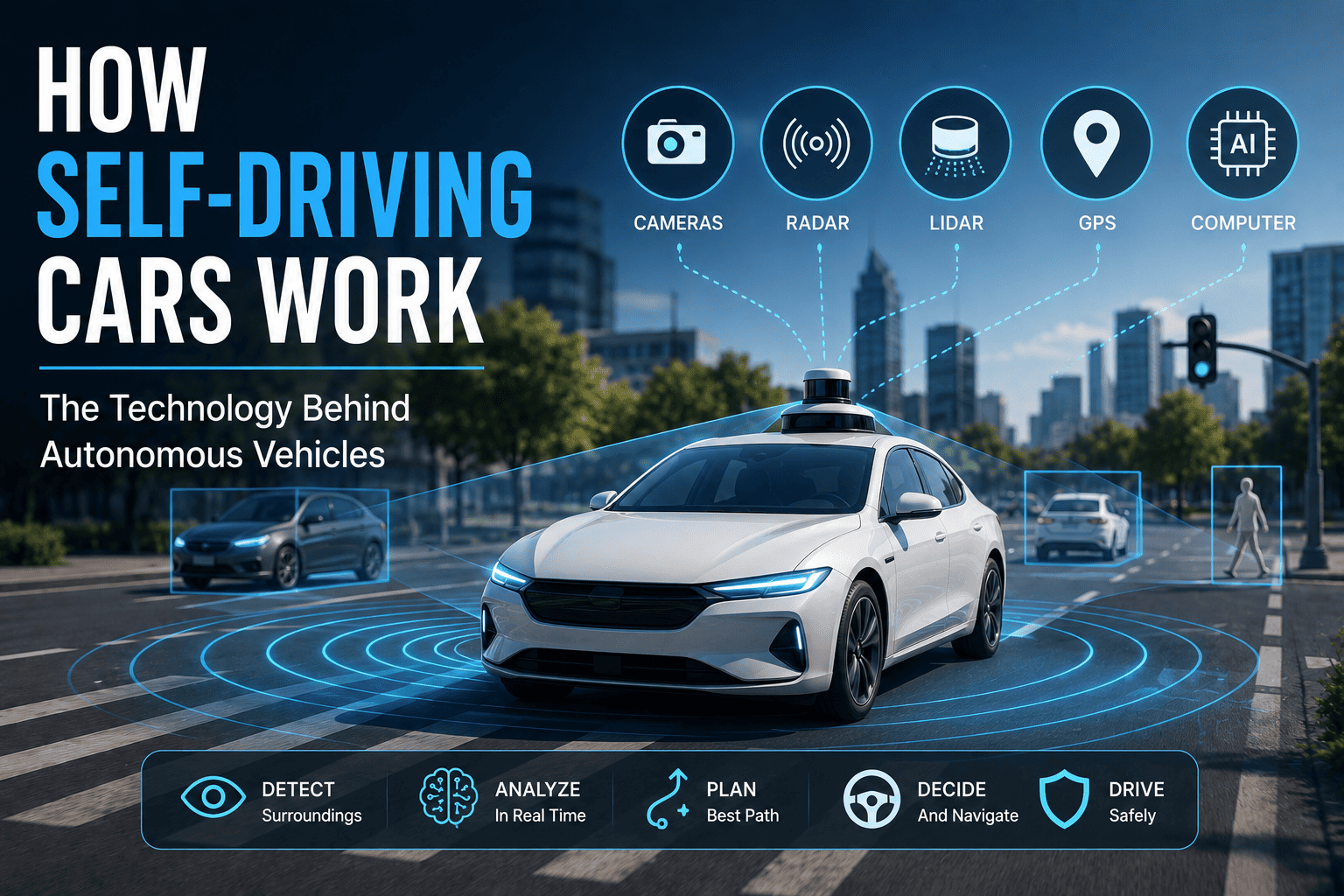
21. Autonomous Vehicles
Although fully self-driving cars remain under development, AI already powers:
- Adaptive cruise control
- Lane assistance
- Automatic parking
- Collision detection
- Driver alerts
These technologies improve road safety while reducing driver workload.
Autonomous driving depends on AI systems that can interpret information from cameras, sensors, maps, and other sources. For a broader explanation of the technology involved, see how self-driving cars work.
22. Smart Energy Management
Artificial intelligence helps manage electricity consumption by:
- Predicting demand
- Balancing power grids
- Optimizing renewable energy
- Reducing waste
Smart energy systems contribute to more sustainable infrastructure.
AI can analyze changing patterns in energy consumption and production, helping operators make decisions that would be difficult to perform manually at the same speed.
23. Entertainment and Gaming
AI makes modern video games more immersive.
It controls:
- Non-player characters (NPCs)
- Dynamic difficulty
- Realistic environments
- Personalized gaming experiences
Entertainment companies also use AI to create visual effects and recommend content.
As AI systems become more capable, their role in entertainment may expand from recommendation and automation toward more interactive and adaptive experiences.
24. Scientific Research
Researchers increasingly rely on AI to analyze massive datasets.
Artificial intelligence accelerates discoveries in:
- Medicine
- Astronomy
- Biology
- Chemistry
- Climate science
Tasks that once required months can sometimes be completed in days.
AI is particularly valuable when researchers need to identify patterns across datasets that are too large or complex to examine manually.
25. AI Assistants and Autonomous Agents
Perhaps the biggest transformation is only beginning.
Next-generation AI systems can:
- Manage schedules
- Plan trips
- Research information
- Complete business workflows
- Generate reports
- Coordinate multiple digital tools
Rather than simply answering questions, these intelligent agents actively perform tasks on behalf of users.
This represents an important evolution from traditional conversational AI toward systems capable of taking actions.
For a deeper look at this development, see AI agents and the tasks they can perform.
The growth of autonomous agents also raises important questions about reliability, oversight, and what happens when an AI system behaves outside its intended boundaries. Understanding what actually happens if an AI system behaves outside its intended boundaries provides useful context for why increasingly autonomous systems require safeguards and human oversight.
Many experts believe AI agents represent one of the next major stages in the development of artificial intelligence.
Benefits of AI in Everyday Life
Artificial intelligence offers numerous advantages.
These include:
- Saving time
- Increasing productivity
- Improving convenience
- Enhancing healthcare
- Strengthening cybersecurity
- Personalizing digital experiences
- Supporting scientific innovation
For many people, AI quietly removes repetitive work, allowing greater focus on creativity and decision-making.
The most significant benefit may be that AI can perform certain information-processing tasks continuously and at enormous scale. This allows intelligent systems to assist people across many different aspects of daily life.
Challenges to Consider
Despite its benefits, AI also raises important concerns.
These include:
- Privacy
- Data security
- Algorithmic bias
- Job displacement
- Misinformation
- Ethical decision-making
Governments, businesses, and researchers continue working to ensure AI develops responsibly.
Privacy is particularly important as AI becomes integrated into smartphones, smart glasses, cameras, assistants, and other connected devices. The increasing popularity of AI-powered wearables has already created questions about how personal information and people in the surrounding environment are recorded and processed.
For example, AI smart glasses and growing privacy concerns examines how the expansion of AI-enabled wearable technology can create new privacy questions.
AI safety is another important consideration. As increasingly capable systems are deployed, testing, oversight, and responsible development become more important. AI safety testing and frontier model incidents provides additional context on this area.
Frequently Asked Questions
Is AI replacing humans?
In most cases, AI is designed to assist rather than replace people.
Many routine tasks become automated, while humans continue making complex decisions.
The impact varies considerably by industry and occupation. In many workplaces, AI is more likely to change how tasks are performed than eliminate every aspect of a particular job.
Do I use AI every day?
Almost certainly.
Most people interact with AI through smartphones, search engines, navigation apps, streaming services, banking systems, and online shopping.
Even when an application does not explicitly advertise itself as an AI product, artificial intelligence may operate behind the scenes to process information, identify patterns, personalize recommendations, or automate decisions.
Is AI safe?
AI can be very beneficial when developed responsibly.
However, privacy, security, transparency, and human oversight remain essential.
The safety of an AI system depends on factors such as how it was designed, what data it uses, how it is tested, what decisions it is allowed to make, and how humans oversee its operation.
What industries benefit most from AI?
Healthcare, finance, education, manufacturing, transportation, agriculture, retail, entertainment, and scientific research all increasingly rely on AI technologies.
AI is particularly useful in areas where organizations need to process large amounts of information, recognize patterns, automate repetitive work, or provide personalized services.
AI Is Becoming Part of the Infrastructure of Daily Life
Artificial intelligence is no longer a distant vision of the future—it has become an integral part of everyday life.
From the moment we wake up and check our smartphones to the time we stream a movie, navigate traffic, shop online, or receive personalized recommendations, AI quietly works behind the scenes to make countless daily tasks faster, smarter, and more convenient.
As technology continues to evolve, its influence will only grow.
Future AI systems are expected to become more capable, more personalized, and more deeply integrated into the devices, services, and workplaces we rely on every day.
At the same time, society must balance innovation with responsibility by addressing important questions around privacy, ethics, security, and employment.
One thing is certain:
Artificial intelligence is no longer changing only the technology industry—it is reshaping how billions of people live, work, learn, and interact with the world, one intelligent decision at a time.