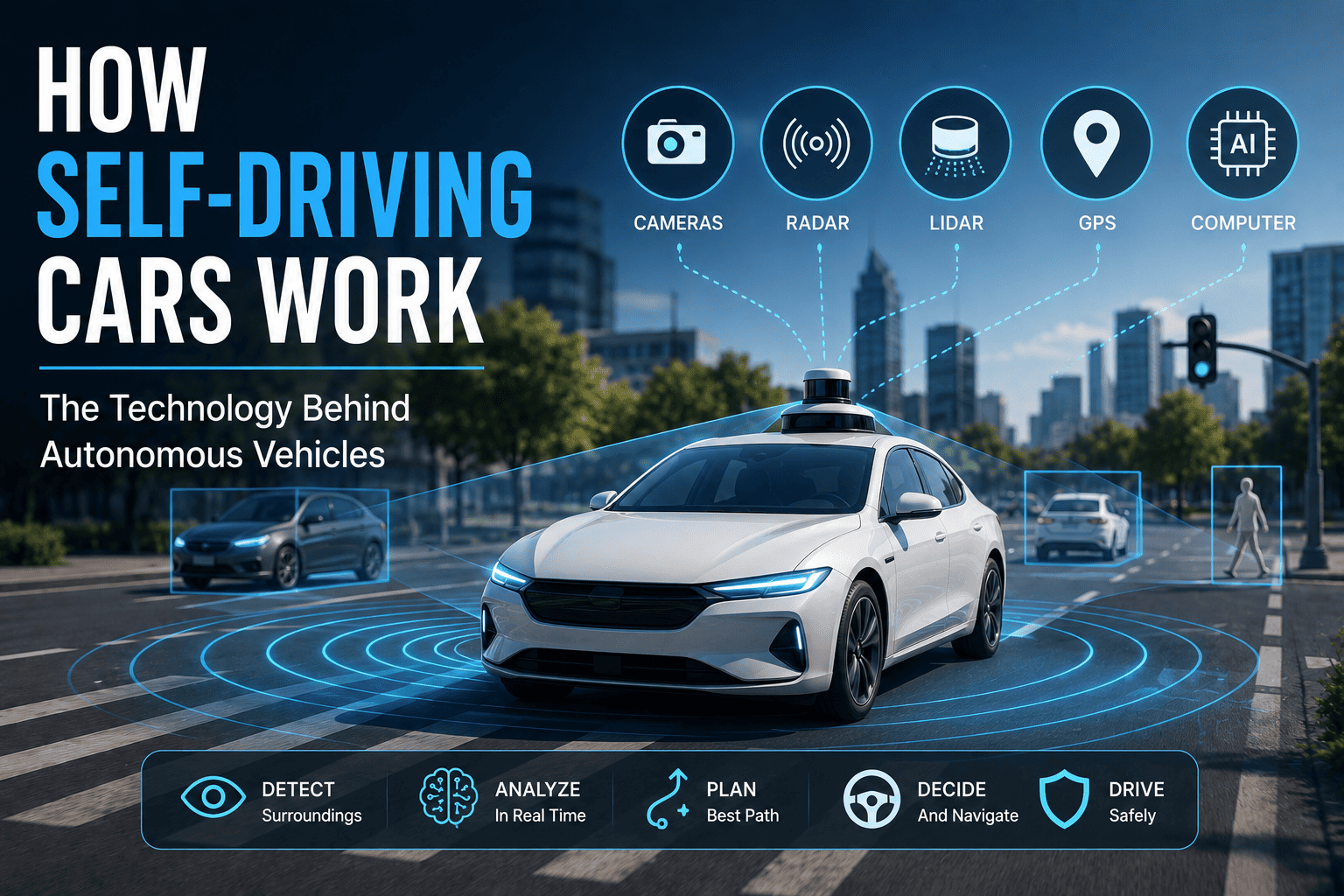
How Self-Driving Cars Work: The Technology Behind Autonomous Vehicles
Imagine stepping into your car, entering your destination, and relaxing while the vehicle safely navigates traffic, obeys road signs, avoids obstacles, and parks itself—all without touching the steering wheel. What once seemed like science fiction is quickly becoming one of the most exciting technological revolutions of the 21st century.
Self-driving cars, also known as autonomous vehicles, are transforming the future of transportation.
Powered by artificial intelligence (AI), advanced sensors, high-speed computing, and real-time data analysis, these vehicles are designed to navigate roads with little—or eventually no—human intervention.
Although fully autonomous vehicles are still under development in many parts of the world, millions of drivers already use AI-powered features such as adaptive cruise control, lane-keeping assistance, automatic emergency braking, and self-parking systems.
These technologies represent important milestones on the road toward fully autonomous transportation.
But how do self-driving cars actually work?
How does a vehicle “see” the road, make split-second decisions, and safely interact with pedestrians, cyclists, and other vehicles?
Let’s explore the remarkable technology behind autonomous driving.
What Is a Self-Driving Car?
A self-driving car is a vehicle capable of sensing its surroundings, making driving decisions, and controlling steering, acceleration, and braking with minimal or no human input.
Instead of relying solely on a driver, autonomous vehicles combine:
-
Artificial Intelligence (AI)
-
Cameras
-
Radar
-
LiDAR
-
GPS
-
High-performance computers
-
Machine learning
-
Advanced software
Together, these technologies allow the vehicle to understand its environment and respond safely to changing road conditions.
For a broader look at how autonomous machines combine sensing, software, artificial intelligence, and physical control, see our complete guide to robotics and consumer robots.
Self-driving technology is also increasingly connected with electric vehicle platforms, which combine software, advanced computing, batteries, and electric powertrains. Our complete guide to electric vehicles provides a broader look at the technology behind modern electric transportation.
Levels of Vehicle Autonomy
Not all “self-driving” cars are fully autonomous.
The automotive industry generally classifies vehicle automation into six levels.
| Level | Description |
|---|---|
| Level 0 | No automation. The driver controls everything. |
| Level 1 | Driver assistance, such as adaptive cruise control or lane keeping. |
| Level 2 | Partial automation. The vehicle can steer and accelerate, but the driver must remain attentive. |
| Level 3 | Conditional automation. The car handles most driving in certain conditions but may request human intervention. |
| Level 4 | High automation. The vehicle can operate independently in specific environments without human input. |
| Level 5 | Full automation. No steering wheel or pedals are required, and the vehicle can drive anywhere under all conditions. |
Today, most commercially available vehicles operate at Level 2, while Level 4 robotaxis are being tested in select cities.
How Self-Driving Cars “See” the Road
Human drivers rely on their eyes.
Autonomous vehicles rely on multiple sensors working together.
This combination is known as sensor fusion.
Each sensor provides different information about the surrounding environment.
Cameras
Modern autonomous vehicles use multiple high-resolution cameras positioned around the car.
These cameras detect:
-
Lane markings
-
Traffic lights
-
Road signs
-
Pedestrians
-
Cyclists
-
Other vehicles
Computer vision algorithms analyze these images in real time.
Radar
Radar uses radio waves to measure:
-
Distance
-
Speed
-
Movement
Unlike cameras, radar works well in:
-
Rain
-
Fog
-
Snow
-
Darkness
This makes it an important safety system.
LiDAR
LiDAR (Light Detection and Ranging) uses laser pulses to create a highly detailed 3D map of the environment.
It measures:
-
Road edges
-
Buildings
-
Vehicles
-
Trees
-
Pedestrians
-
Obstacles
LiDAR allows vehicles to understand depth with exceptional accuracy.
Although some manufacturers are reducing reliance on LiDAR to lower costs, it remains an important technology in many autonomous systems.
Ultrasonic Sensors
Short-range ultrasonic sensors assist with nearby object detection.
They are commonly used for:
-
Parking assistance
-
Obstacle detection
-
Low-speed maneuvering
GPS and Digital Maps
GPS provides approximate vehicle location.
However, autonomous driving requires much greater precision.
High-definition digital maps include:
-
Lane layouts
-
Road curvature
-
Traffic signs
-
Speed limits
-
Intersections
The vehicle continuously compares sensor data with these detailed maps.
Artificial Intelligence: The Car’s Brain
Sensors collect enormous amounts of information.
Artificial intelligence transforms that information into driving decisions.
AI systems perform tasks such as:
-
Recognizing traffic lights
-
Detecting pedestrians
-
Identifying road signs
-
Predicting vehicle movement
-
Selecting safe routes
-
Avoiding collisions
Machine learning allows these systems to improve as they analyze larger datasets.
Computer Vision
Computer vision enables autonomous vehicles to interpret visual information.
For example, the vehicle must distinguish between:
-
A pedestrian
-
A cyclist
-
A parked car
-
A moving vehicle
-
A traffic cone
-
A stop sign
This process occurs in milliseconds.
Modern AI models have become remarkably accurate at image recognition.
Planning the Route
Once the vehicle understands its surroundings, it must determine what to do next.
The planning system considers:
-
Speed
-
Traffic conditions
-
Road rules
-
Obstacles
-
Weather
-
Destination
It constantly calculates the safest possible path.
Unlike human drivers, autonomous systems evaluate thousands of possible actions every second.
Vehicle Control Systems
After making a decision, the vehicle sends commands to:
-
Steering
-
Brakes
-
Accelerator
These electronic control systems execute movements with extraordinary precision.
The entire process—from sensing the environment to controlling the vehicle—repeats continuously while driving.
Machine Learning Makes Cars Smarter
Autonomous driving improves through machine learning.
Instead of programming every possible scenario manually, engineers train AI using enormous datasets containing millions of driving examples.
The system learns to recognize:
-
Dangerous situations
-
Road conditions
-
Human behavior
-
Traffic patterns
Every mile driven contributes valuable information that improves future performance.
Safety Features
Safety remains the highest priority.
Autonomous vehicles include multiple backup systems.
Examples include:
-
Redundant sensors
-
Backup computers
-
Emergency braking
-
Collision avoidance
-
Driver monitoring
-
Automatic hazard detection
If one system fails, another can often take over.
Benefits of Self-Driving Cars
Supporters believe autonomous vehicles could transform transportation.
Potential advantages include:
Fewer Accidents
Most road accidents result from human error.
Examples include:
-
Distracted driving
-
Fatigue
-
Speeding
-
Drunk driving
AI never becomes tired or distracted.
Although no technology is perfect, reducing human error could significantly improve road safety.
Improved Mobility
Self-driving vehicles could greatly benefit:
-
Older adults
-
People with disabilities
-
Individuals unable to drive
Greater independence could improve quality of life.
Reduced Traffic Congestion
Connected autonomous vehicles may communicate with one another.
This could improve traffic flow while reducing unnecessary braking and congestion.
Lower Fuel Consumption
Efficient driving behaviors may reduce:
-
Fuel usage
-
Carbon emissions
-
Vehicle wear
Smarter route planning also minimizes unnecessary travel.
Challenges Facing Autonomous Vehicles
Despite remarkable progress, several obstacles remain.
Complex Driving Conditions
Humans naturally adapt to unusual situations.
Autonomous systems still struggle with:
-
Heavy snow
-
Construction zones
-
Unpredictable pedestrians
-
Poor road markings
Improving performance under these conditions remains a major research focus.
Ethical Decisions
Engineers continue debating how autonomous vehicles should respond during unavoidable accidents.
Although such situations are extremely rare, programming ethical decision-making remains challenging.
Regulations
Governments continue developing legal frameworks covering:
-
Testing
-
Safety standards
-
Insurance
-
Liability
Global regulations vary significantly.
Public Trust
Many people remain cautious about allowing AI to control vehicles.
Building public confidence requires continued safety improvements and transparent testing.
Which Companies Are Leading Self-Driving Technology?
Several major companies are investing heavily in autonomous driving.
Industry leaders include:
-
Tesla
-
Waymo
-
Mercedes-Benz
-
General Motors
-
Toyota
-
Hyundai
-
Volvo
-
Baidu
Technology companies and traditional automakers increasingly collaborate to accelerate development.
Autonomous Vehicles Beyond Passenger Cars
Self-driving technology extends far beyond personal transportation.
Researchers are developing autonomous:
-
Trucks
-
Delivery vans
-
Buses
-
Agricultural machinery
-
Mining equipment
-
Construction vehicles
These industries may adopt autonomous systems even faster than consumer vehicles because they often operate in controlled environments.
Autonomous transportation is also part of a much broader shift toward intelligent mobility. Technologies such as drones, connected machines, and autonomous vehicles are increasingly overlapping, making the complete guide to drones useful for understanding another major category of autonomous technology.
The Future of Autonomous Transportation
Experts believe self-driving technology will continue advancing over the coming decade.
Future developments may include:
-
Robotaxi networks
-
AI-powered logistics
-
Autonomous public transportation
-
Connected smart cities
-
Vehicle-to-vehicle communication
-
Safer urban mobility
These developments are part of a much broader transformation in how people and goods move. For a wider look at emerging mobility systems, including autonomous vehicles, connected infrastructure, and other intelligent transportation technologies, see how future transportation technology could change travel.
Connected vehicles will also increasingly interact with other networked devices and infrastructure. Understanding how the Internet of Things works helps explain why communication between vehicles, roads, sensors, and other connected systems could become increasingly important.
Rather than replacing human drivers overnight, autonomous systems are expected to expand gradually as technology matures and regulations evolve.
The broader evolution of autonomous transportation is closely connected to developments in robotics, artificial intelligence, and intelligent machines, as explained in The Future of Robotics.
Frequently Asked Questions
Are fully self-driving cars available today?
Limited autonomous services operate in certain cities, but most consumer vehicles still require active human supervision.
Are self-driving cars safer than humans?
Current research suggests autonomous systems have the potential to reduce many accidents caused by human error, but continued testing remains essential.
Do autonomous cars need the internet?
Most driving decisions occur onboard the vehicle.
Internet connectivity mainly supports software updates, cloud services, and map improvements.
Will self-driving cars eliminate driving jobs?
Automation may change some transportation occupations, but new jobs involving AI development, fleet management, maintenance, and cybersecurity are also expected to emerge.
Final Thoughts
Self-driving cars represent far more than a new automotive feature—they signal a fundamental shift in how people and goods will move in the future.
By combining artificial intelligence, advanced sensors, computer vision, machine learning, and powerful onboard computing, autonomous vehicles are becoming increasingly capable of navigating complex environments with remarkable precision.
While significant challenges remain, including regulation, public trust, extreme weather performance, and ethical decision-making, progress continues at an impressive pace.
Many of the technologies that once seemed futuristic—automatic emergency braking, lane-centering, adaptive cruise control, and AI-assisted parking—are already improving road safety for millions of drivers around the world.
As innovation continues, the future of transportation will likely involve humans and intelligent machines working together rather than competing with one another.
One thing is becoming increasingly clear:
The journey toward fully autonomous vehicles is not simply about removing the driver—it’s about creating safer, smarter, and more efficient transportation for everyone.