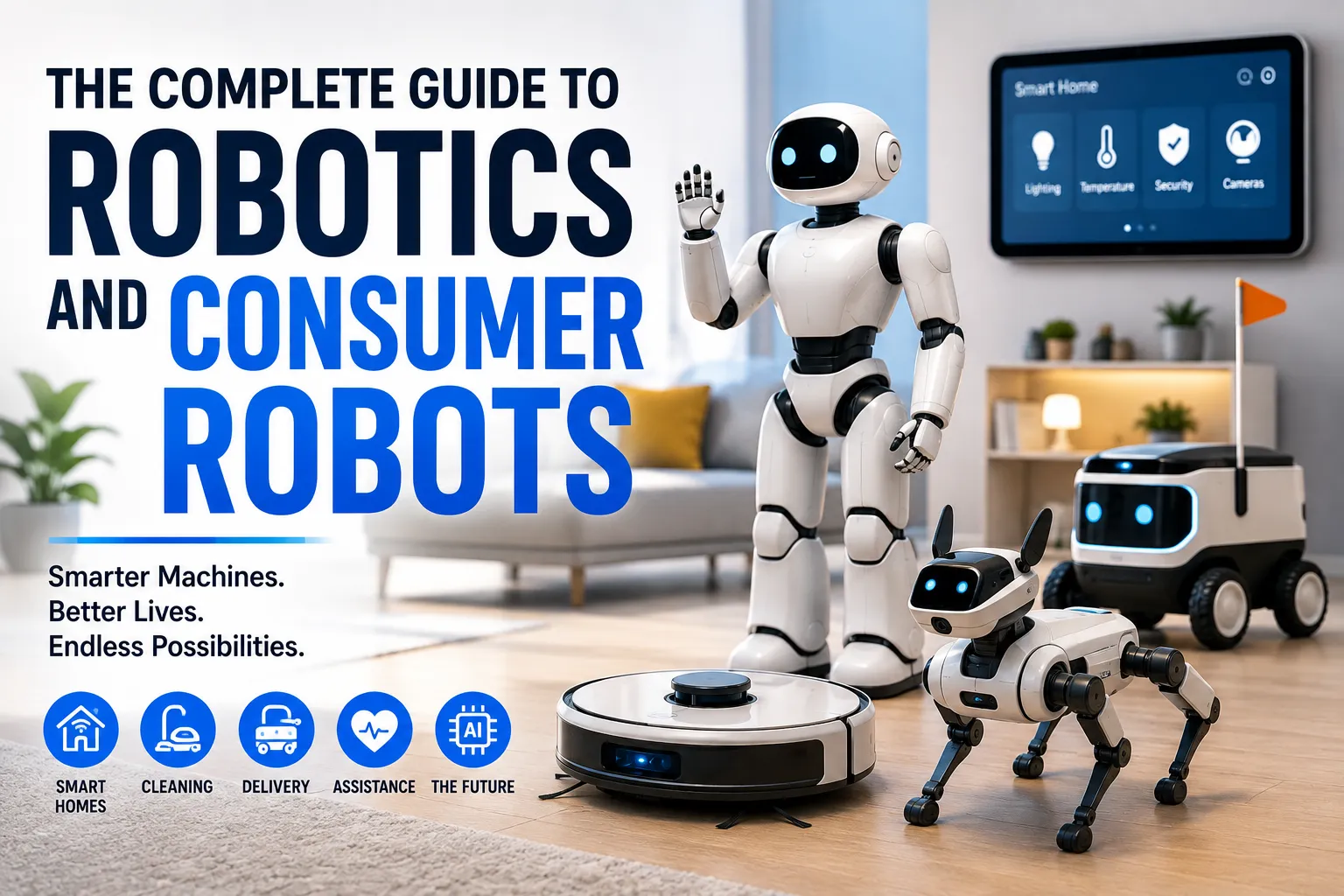
The Complete Guide to Robotics and Consumer Robots
Robots are moving steadily from factories and research laboratories into everyday life.
For decades, the word “robot” was associated primarily with industrial machines assembling cars, moving heavy materials, or performing repetitive tasks in controlled environments. Today, robotics is becoming much more visible in homes, offices, hospitals, warehouses, farms, schools, and public spaces.
Consumer robots can vacuum floors, mow lawns, deliver items, assist with entertainment, monitor homes, and perform other specialized tasks. Meanwhile, advances in artificial intelligence, computer vision, sensors, batteries, and machine learning are making robots increasingly capable of operating in environments designed for humans.
But what exactly is a robot? How does it work? What makes a machine autonomous, and how are consumer robots different from the industrial robots that have been used for decades?
This guide explains the fundamentals of robotics, the technologies that make robots possible, the different types of consumer robots, their benefits and limitations, and what the future of robotics could look like.
What Is a Robot?
A robot is a programmable machine capable of sensing its environment, processing information, and carrying out physical or digital actions.
Unlike a conventional appliance that generally performs a fixed function, a robot can often respond to changing conditions.
A robot may use sensors to determine what is happening around it, software to decide what to do, and motors or other mechanisms to perform an action.
A simplified robotic system can be represented as:
Environment
↓Sensors
↓Processing / Software
↓Decision Making
↓Actuators / Motors
↓Action
↓
EnvironmentThe robot then observes the result and can repeat the process.
This ability to sense, decide, and act is one of the characteristics that separates robotics from many conventional machines.
What Is Robotics?
Robotics is the field concerned with designing, building, programming, controlling, and using robots.
It combines several areas of technology and engineering, including:
- Mechanical engineering
- Electrical engineering
- Computer science
- Software development
- Artificial intelligence
- Electronics
- Control systems
- Sensors
- Materials science
A modern robot is therefore rarely the product of one technology alone.
Its physical structure, electronics, software, sensors, motors, batteries, and control systems all need to work together.
For a broader look at the machines, technologies, and applications that make up this field, see the complete guide to robotics and consumer robots.
How Do Robots Work?
Although robots can be extremely complicated, their basic operation can be understood through a few key components.
Sensors
Sensors allow a robot to collect information about its surroundings.
Depending on the robot, sensors may detect:
- Distance
- Light
- Sound
- Temperature
- Pressure
- Movement
- Touch
- Orientation
- Acceleration
- Objects
- People
- Obstacles
A robot vacuum, for example, may use sensors to determine where walls, furniture, stairs, and other obstacles are located.
Processing
The robot’s processor or computing system analyzes information collected by its sensors.
This is where software and algorithms become important.
The system may determine:
- Where the robot is
- What objects are nearby
- Whether an obstacle is present
- Which direction to move
- Whether a task has been completed
- What action should happen next
More advanced robots can perform significantly more complex calculations.
Actuators
Actuators are components that allow a robot to physically interact with the world.
They can include:
- Electric motors
- Hydraulic systems
- Pneumatic systems
- Robotic joints
- Linear actuators
A motor might rotate a wheel, move a robotic arm, adjust a camera, or turn a joint.
Power System
Robots require energy to operate.
Many consumer robots use rechargeable batteries, while larger systems may connect directly to electrical power.
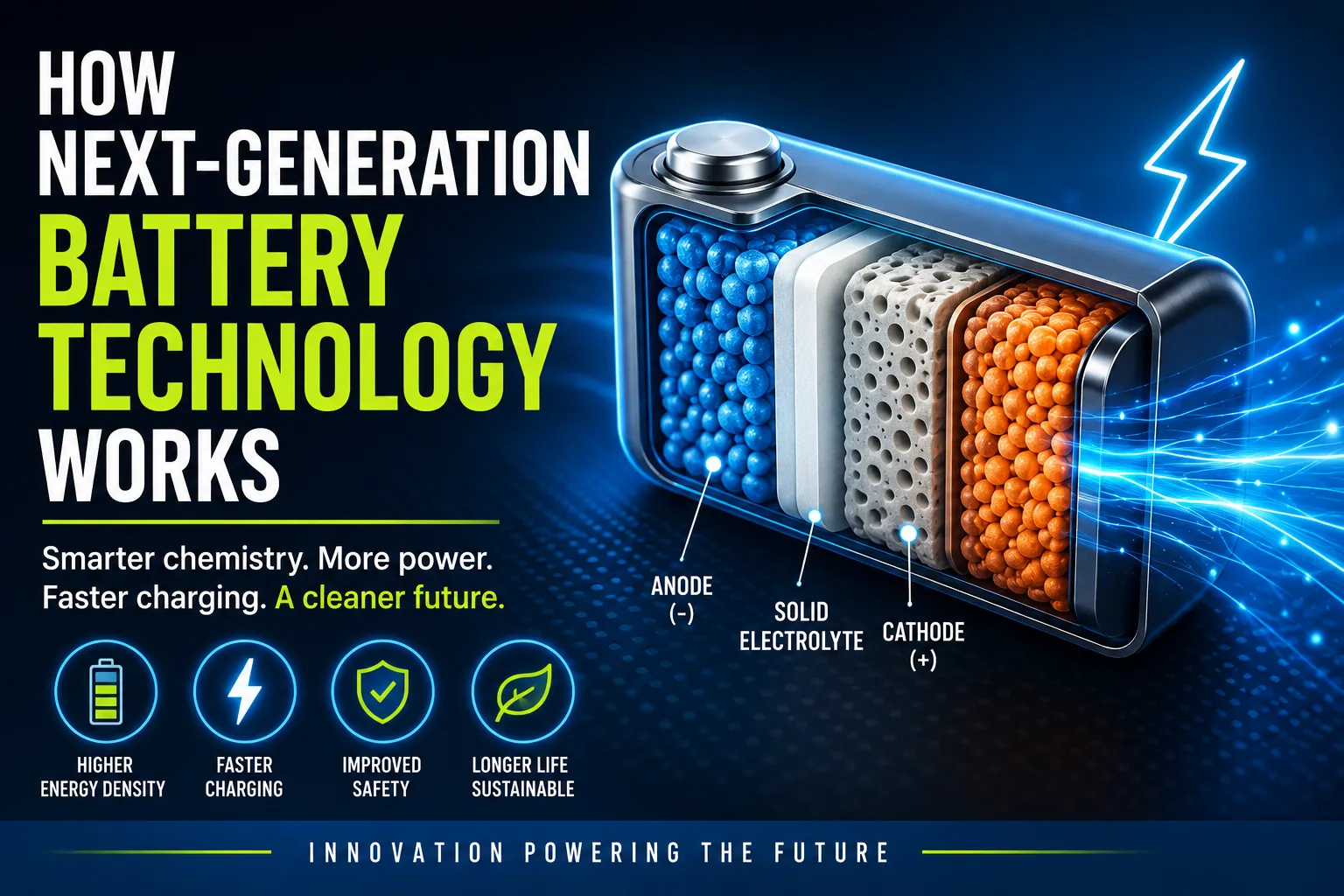
Battery technology is particularly important for mobile robots because operating time, charging speed, weight, and battery lifespan can directly affect usability.
Software
Software controls how the robot behaves.
It determines how sensor information is interpreted, how decisions are made, and how physical components are controlled.
The software may range from simple programmed rules to sophisticated artificial intelligence systems.
What Makes a Robot Autonomous?
Autonomy refers to a robot’s ability to perform tasks without continuous human control.
A remotely controlled machine is not necessarily autonomous because a person may be making most of its decisions.
An autonomous robot can independently perform some or all of the steps required to complete a task.
For example, a robot lawn mower might:
- Determine where it is.
- Identify the area it is supposed to maintain.
- Detect obstacles.
- Navigate around the yard.
- Continue working until its task is complete.
- Return to its charging station when its battery is low.
The degree of autonomy varies considerably between robots.
Some consumer robots are highly autonomous for narrow tasks, while others still require significant human supervision.
Robots and Artificial Intelligence
Artificial intelligence is increasingly influencing robotics.
Traditional robots often relied heavily on predefined instructions.
A robot might be programmed to move along a specific path or perform a repetitive sequence of actions.
AI can allow robots to handle more complex and variable environments.
Machine learning and computer vision can help robots:
- Recognize objects
- Identify people
- Understand environments
- Predict movement
- Navigate unfamiliar spaces
- Interpret spoken commands
- Adapt to changing conditions
This does not mean that every modern robot is powered entirely by AI.
Many robots still rely on traditional control systems, algorithms, and carefully programmed rules.
In practice, robotics often combines conventional engineering with AI-based capabilities.
What Is Computer Vision?
Computer vision allows machines to interpret information from cameras and other visual sensors.
For a robot, vision can be used to identify:
- Objects
- Walls
- Doors
- People
- Furniture
- Floor surfaces
- Signs
- Obstacles
A robot vacuum could use visual information to distinguish between different objects on the floor.
A robotic arm in a warehouse might use cameras to locate products.
A household robot could potentially use computer vision to understand where objects are located within a room.
Computer vision is one of the technologies helping robots move beyond highly controlled environments.
Navigation and Mapping
Mobile robots need to understand where they are.
Navigation systems can combine information from several sensors to estimate a robot’s position and determine where it should move.
Some robots create maps of their surroundings.
A technique commonly associated with robotic navigation is SLAM, or Simultaneous Localization and Mapping.
The basic challenge is straightforward but technically difficult:
The robot needs to build a map while simultaneously figuring out where it is within that map.
Navigation technology is particularly important for:
- Robot vacuums
- Robot lawn mowers
- Delivery robots
- Warehouse robots
- Autonomous vehicles
- Security robots
Autonomous vehicles are another major application of robotic perception and navigation. For a closer look at the technology behind them, see how self-driving cars work.
What Are Consumer Robots?
Consumer robots are robotic products designed primarily for individuals or households rather than industrial facilities.
They are generally created to perform practical tasks, provide entertainment, assist users, or offer specialized services.
Examples include:
- Robot vacuum cleaners
- Robot mowers
- Pool-cleaning robots
- Window-cleaning robots
- Educational robots
- Toy robots
- Companion robots
- Home security robots
- Robotic kitchen appliances
- Personal assistant robots
The consumer robotics market is broad because robots can serve very different purposes.
Robot Vacuum Cleaners
Robot vacuums are among the most recognizable consumer robots.
These machines are designed to navigate floors while collecting dust, dirt, hair, and other debris.
Modern models can include features such as:
- Automated navigation
- Room mapping
- Obstacle detection
- Scheduled cleaning
- Automatic charging
- App control
- Multiple cleaning modes
- Self-emptying systems
- Mopping capabilities
Their usefulness comes largely from automation.
Instead of manually operating a vacuum cleaner, a user can schedule the robot to clean at specific times.
However, robot vacuums still have limitations.
They may struggle with:
- Stairs
- Very cluttered rooms
- Cables
- Small objects
- Certain floor transitions
- Tight spaces
They also require maintenance, including cleaning brushes, filters, sensors, and collection systems.
Robot Lawn Mowers
Robot lawn mowers apply similar concepts to outdoor environments.
They can automatically cut grass according to a schedule while navigating a defined area.
Depending on the model and system, navigation can involve boundary wires, positioning technologies, sensors, cameras, or other methods.
Potential benefits include:
- Automated mowing
- Consistent lawn maintenance
- Reduced manual labor
- Scheduled operation
- Quiet operation compared with some conventional mowers
Outdoor robots face different challenges from indoor machines, including uneven surfaces, weather, vegetation, slopes, and changing environmental conditions.
Pool-Cleaning Robots
Robotic pool cleaners are another established consumer robotics category.
These machines can move through swimming pools while removing debris from surfaces and water.
Some models can clean:
- Pool floors
- Walls
- Waterlines
Their controlled environment makes pool cleaning a suitable application for specialized robotics.
Window-Cleaning Robots
Window-cleaning robots are designed to move across glass surfaces while cleaning them.
Depending on the design, they may use suction, magnetic systems, or other mechanisms to remain attached to the surface.
Safety is especially important for these devices because a robot operating on an elevated window must remain securely attached.
Educational Robots
Educational robots are designed to help children, students, and learners understand technology.
They can teach concepts such as:
- Programming
- Electronics
- Robotics
- Logic
- Mathematics
- Engineering
- Problem-solving
Some educational robots are designed to be assembled by users, allowing students to learn how mechanical and electronic systems work together.
This makes robotics particularly useful as a hands-on educational tool.
Companion Robots
Companion robots are designed to interact socially with users.
Depending on the product, they may:
- Respond to voice commands
- Recognize users
- Provide reminders
- Display expressions
- Play games
- Offer entertainment
- Provide basic interaction
The idea of a social robot raises interesting questions about how humans interact with machines.
A robot may be able to simulate certain social behaviors without actually experiencing emotions in the human sense.
Consumers should therefore understand what a companion robot can genuinely do rather than assuming that sophisticated conversation necessarily means human-like understanding.
Home Security Robots
Some robots are designed to provide mobile monitoring around homes or other spaces.
Instead of relying entirely on fixed cameras, a mobile security robot can potentially move between locations.
Depending on its capabilities, it may provide:
- Video monitoring
- Motion detection
- Remote viewing
- Automated patrols
- Alerts
- Two-way communication
These systems can potentially provide additional visibility, but they also raise privacy considerations because a mobile camera can collect information from many parts of a home.
Telepresence Robots
Telepresence robots allow a person to interact with another location remotely.
A typical system may include:
- A camera
- Microphones
- Speakers
- A display
- Wheels or another movement system
- Remote communication software
For example, a remote worker could use a telepresence robot to move through an office and communicate with colleagues.
Similar systems can have applications in education, healthcare, and other environments.
Humanoid Robots
Humanoid robots are designed with some characteristics associated with the human body.
They may have:
- Two arms
- Two legs
- A torso
- A head
- Hands
- Human-like movement
The appeal of humanoid robots is partly practical.
Many environments have already been designed for humans, including stairs, doors, tools, vehicles, shelves, and workstations.
A robot with a human-like physical structure could potentially operate in these environments without requiring everything to be redesigned.
However, creating machines capable of safely and reliably reproducing human movement remains a major engineering challenge.
Robotic Arms
Robotic arms are among the most established forms of robotics.
They are widely used in manufacturing and can perform tasks such as:
- Welding
- Painting
- Assembly
- Packaging
- Picking
- Inspection
- Material handling
Robotic arms are particularly effective at repetitive tasks that require consistent movement.
Some modern robotic arms, including collaborative robots, are designed to work closer to human workers under appropriate safety controls.
Industrial Robots vs. Consumer Robots
Industrial and consumer robots can use many of the same underlying technologies, but their environments and objectives are different.
Industrial robots are often designed for:
- High speed
- Precision
- Repetition
- Reliability
- Controlled environments
Consumer robots generally prioritize:
- Ease of use
- Safety
- Affordability
- Convenience
- Compact design
- Quiet operation
A factory robot may perform one task thousands of times under carefully controlled conditions.
A household robot, by contrast, must deal with unpredictable environments.
A living room may contain furniture, children, pets, cables, clothing, toys, and constantly changing obstacles.
That makes consumer robotics surprisingly challenging.
The Importance of Sensors
Sensors are essential because robots cannot rely on human-style perception.
A person can walk into a room and immediately recognize a chair, a wall, a pet, and a staircase.
A robot needs sensors and software to gather information and interpret it.
Different sensors provide different types of information.
Cameras
Cameras provide visual information.
LiDAR
LiDAR uses laser-based measurements to determine distances and can help create detailed environmental maps.
Ultrasonic Sensors
Ultrasonic systems can detect nearby objects using sound waves.
Infrared Sensors
Infrared technology can be used for proximity detection and other sensing applications.
Inertial Sensors
Accelerometers and gyroscopes can help robots determine movement and orientation.
Touch Sensors
Touch sensors can detect physical contact.
Modern robots often combine several types of sensors because no single sensor can provide a complete understanding of the environment.
How Robots Learn
Not all robots learn in the same way.
Some operate entirely according to predetermined rules.
Others use machine learning systems trained on large datasets.
A robot might learn to recognize objects by being exposed to many examples during training.
Machine learning can also be used to improve navigation, manipulation, perception, and decision-making.
However, learning does not necessarily mean that a robot understands the world like a human.
A machine-learning model may recognize patterns extremely well while still making unexpected mistakes in situations that differ from its training data.
Robots and Human Interaction
As robots enter homes and public spaces, interaction becomes increasingly important.
Users need to understand how to communicate with machines.
Voice interfaces can make robots easier to operate because people can use ordinary language instead of complicated controls.
Physical interfaces remain important as well.
A robot vacuum might have buttons on the device and controls in a smartphone application.
The best consumer robots generally try to make complex technology feel simple to use.
Smartphone Apps and Connected Robots
Many consumer robots connect to smartphones through applications.
A companion app may allow users to:
- Start or stop a robot
- Create schedules
- View maps
- Change settings
- Receive notifications
- Monitor activity
- Configure cleaning areas
- Check maintenance information
Internet connectivity can make robots more convenient, but it also creates cybersecurity and privacy considerations.
A connected robot is effectively another networked computing device inside a home.
This makes robotics closely connected to the broader Internet of Things, where physical devices can collect, exchange, and respond to information across connected networks.
Privacy and Consumer Robots
Robots can collect significant amounts of information.
A robot with cameras, microphones, mapping systems, or internet connectivity may gather information about its environment.
Depending on the device, collected information could include:
- Images
- Audio
- Room layouts
- Location information
- Device identifiers
- Usage patterns
- Account information
Consumers should therefore examine privacy policies and device settings before purchasing connected robots.
Questions worth asking include:
- What information does the robot collect?
- Is data stored locally or in the cloud?
- How long is information retained?
- Can data collection be limited?
- Who can access the information?
- Is the device regularly updated?
Convenience should not come at the expense of understanding how personal information is handled.
Cybersecurity Risks
Connected robots can also become targets for cyberattacks.
Security risks may include:
- Weak passwords
- Outdated software
- Vulnerable mobile applications
- Insecure network connections
- Compromised accounts
- Poorly protected cloud services
A compromised home robot could potentially expose information about the household or provide attackers with access to other connected systems.
Consumers should use strong account credentials, enable multi-factor authentication when available, keep robot software updated, and secure their home network.
The Importance of Software Updates
Like smartphones and computers, modern robots rely heavily on software.
Manufacturers may release updates to:
- Fix bugs
- Improve navigation
- Add features
- Address security vulnerabilities
- Improve performance
- Support new devices
Consumers should avoid assuming that a robot is finished once it leaves the store.
Regular software maintenance can be important for both functionality and security.
Batteries and Energy Efficiency
Battery technology is one of the limiting factors for mobile robots.
A robot needs enough energy to power its:
- Motors
- Sensors
- Processors
- Cameras
- Wireless connections
- Other components
Larger batteries provide more energy but also increase weight.
Heavy robots require more energy to move, creating a difficult engineering trade-off.
This is one reason many consumer robots use charging stations that allow them to return automatically when their batteries become low.
Why Consumer Robots Can Be Expensive
Robots combine many components that can be relatively costly.
A consumer robot may contain:
- Motors
- Sensors
- Cameras
- Processors
- Batteries
- Wireless hardware
- Mechanical components
- Software
- Cloud services
Development costs also contribute to pricing.
Manufacturers need to design, test, certify, manufacture, distribute, support, and update the product.
As technologies mature and production scales increase, some robotic systems can become more affordable.
Are Consumer Robots Actually Useful?
The answer depends on the task.
A robot can be extremely useful when it performs a repetitive task that people would rather not do.
Cleaning is a good example.
A robot vacuum does not necessarily clean every part of a home better than a person. Its main advantage is that it can perform routine cleaning automatically.
The same principle applies to robotic lawn mowers, pool cleaners, and other specialized machines.
The value of a consumer robot is therefore not always about replacing humans.
Sometimes it is about reducing repetitive work and giving people more time for other activities.
Common Limitations of Consumer Robots
Despite rapid advances, consumer robots remain far from perfect.
Common limitations include:
Difficulty With Unpredictable Environments
Robots generally perform best when their operating environment is predictable.
Limited Dexterity
Manipulating arbitrary objects remains difficult for many robots.
Battery Constraints
Mobile robots require regular charging.
Maintenance
Brushes, filters, wheels, sensors, and other components can require cleaning or replacement.
Connectivity Dependence
Some connected robots may rely on cloud services or internet connections for certain features.
Navigation Errors
Robots can occasionally become stuck or misunderstand their surroundings.
High Costs
Advanced systems can still be expensive compared with conventional alternatives.
Understanding these limitations can help consumers make more realistic purchasing decisions.
How to Choose a Consumer Robot
Before buying a robot, start with the problem you want it to solve.
Ask:
- What task should the robot perform?
- How often will it perform that task?
- Does it work in my environment?
- How much maintenance does it require?
- Does it need an internet connection?
- What data does it collect?
- How long does the battery last?
- How much does replacement equipment cost?
- How long is the manufacturer likely to support the product?
- What happens if the robot breaks?
It is also worth reading reviews that discuss long-term use rather than relying solely on promotional material.
What Should You Look for in a Robot Vacuum?
For example, someone considering a robot vacuum might compare:
- Navigation technology
- Obstacle detection
- Suction performance
- Battery life
- Mapping features
- Mopping capability
- Self-emptying functionality
- Replacement parts
- App quality
- Privacy controls
- Software support
The most expensive model is not necessarily the best choice.
A simpler robot may be more appropriate for a small home with relatively uncluttered floors.
Robots and Children
Robots can be fascinating educational tools for children, but safety needs to be considered.
Parents should examine:
- Moving parts
- Small components
- Battery safety
- Charging systems
- Internet connectivity
- Camera and microphone access
- Age recommendations
Educational robots can help children develop programming and problem-solving skills, but they should be selected according to the child’s age and level of supervision required.
Robots in Healthcare
Robotics has applications far beyond consumer products.
Healthcare systems use robots and robotic technologies for areas such as:
- Surgery
- Rehabilitation
- Logistics
- Medication delivery
- Patient assistance
- Disinfection
Robotic surgical systems, for example, can provide surgeons with specialized instruments and precise control.
Robots can also assist with repetitive logistics tasks in hospitals, allowing human staff to focus on other responsibilities.
Robots in Agriculture
Agriculture is another area where robotics can make a significant difference.
Robotic systems can potentially assist with:
- Crop monitoring
- Weed detection
- Harvesting
- Spraying
- Planting
- Autonomous equipment
- Soil analysis
Agricultural robots must operate in difficult environments where weather, terrain, plants, animals, and other variables are constantly changing.
Robots in Warehouses
Modern warehouses increasingly use robotic systems to move goods.
Robots can transport items between storage locations and workers, move shelves, sort packages, and automate repetitive logistics operations.
Warehouse robotics can improve efficiency and reduce the amount of physical movement required from human workers.
However, these systems also change the nature of warehouse jobs, creating new roles in robot maintenance, supervision, software, engineering, and operations.
Robots in Hospitality and Retail
Businesses are experimenting with robots for customer-facing tasks.
Depending on the environment, robots may assist with:
- Deliveries
- Cleaning
- Food service
- Information
- Inventory
- Customer interaction
The challenge is balancing automation with the human interaction customers expect.
A robot can perform a repetitive delivery efficiently, but some customers may still prefer speaking with a person when dealing with complex questions or problems.
The Rise of General-Purpose Robots
One of the most ambitious directions in robotics is the development of more general-purpose machines.
Instead of designing one robot for one specific task, researchers and companies are working toward systems capable of handling a broader range of activities.
A general-purpose household robot could potentially:
- Carry objects
- Organize rooms
- Fetch items
- Assist with household chores
- Interact with appliances
- Respond to spoken instructions
Achieving reliable general-purpose physical intelligence is extremely difficult.
The real world contains enormous variation, and robots need to understand not just what objects look like but how those objects can safely be manipulated.
Why Humanoid Robots Are Receiving So Much Attention
Humanoid robots have attracted significant attention because they could potentially operate in spaces already designed for humans.
A humanoid machine could theoretically use:
- Stairs
- Door handles
- Shelves
- Tools
- Workstations
without requiring an entirely new environment.
Advances in AI, sensors, motors, batteries, and mechanical design are helping researchers explore these possibilities.
However, demonstrations and prototypes should not be confused with mature consumer products.
A robot successfully performing a controlled demonstration does not necessarily mean it can reliably perform the same task in thousands of ordinary homes.
The Role of AI in Future Consumer Robots
Artificial intelligence may become one of the most important technologies in future consumer robotics.
Instead of controlling a robot using a collection of rigid commands, users may increasingly interact with robots through natural language.
For example, a person might eventually say:
“Please tidy the living room and put the books back on the shelf.”
For a robot to perform that instruction reliably, it would need to understand the request, identify objects, plan a sequence of actions, navigate the room, manipulate objects, and recover from unexpected situations.
That is a far more difficult problem than simply responding to a voice command.
AI can help, but physical robotics still requires substantial advances in perception, manipulation, safety, and reliability.
The Future of Robots in Everyday Life
The future of robotics is unlikely to involve one machine suddenly replacing every household appliance.
Instead, robotics may develop through specialized products that gradually become more capable.
Consumers may see improvements in:
- Navigation
- Object recognition
- Voice interaction
- Battery life
- Manipulation
- Home integration
- Safety
- Personalization
- Autonomous operation
Over time, several robotic systems may also work together.
A home could eventually contain multiple automated devices that communicate with one another, sharing information about schedules, energy use, security, cleaning, and other household tasks.
This broader connected-device environment is closely related to how Internet of Things devices collect, exchange, and process data.
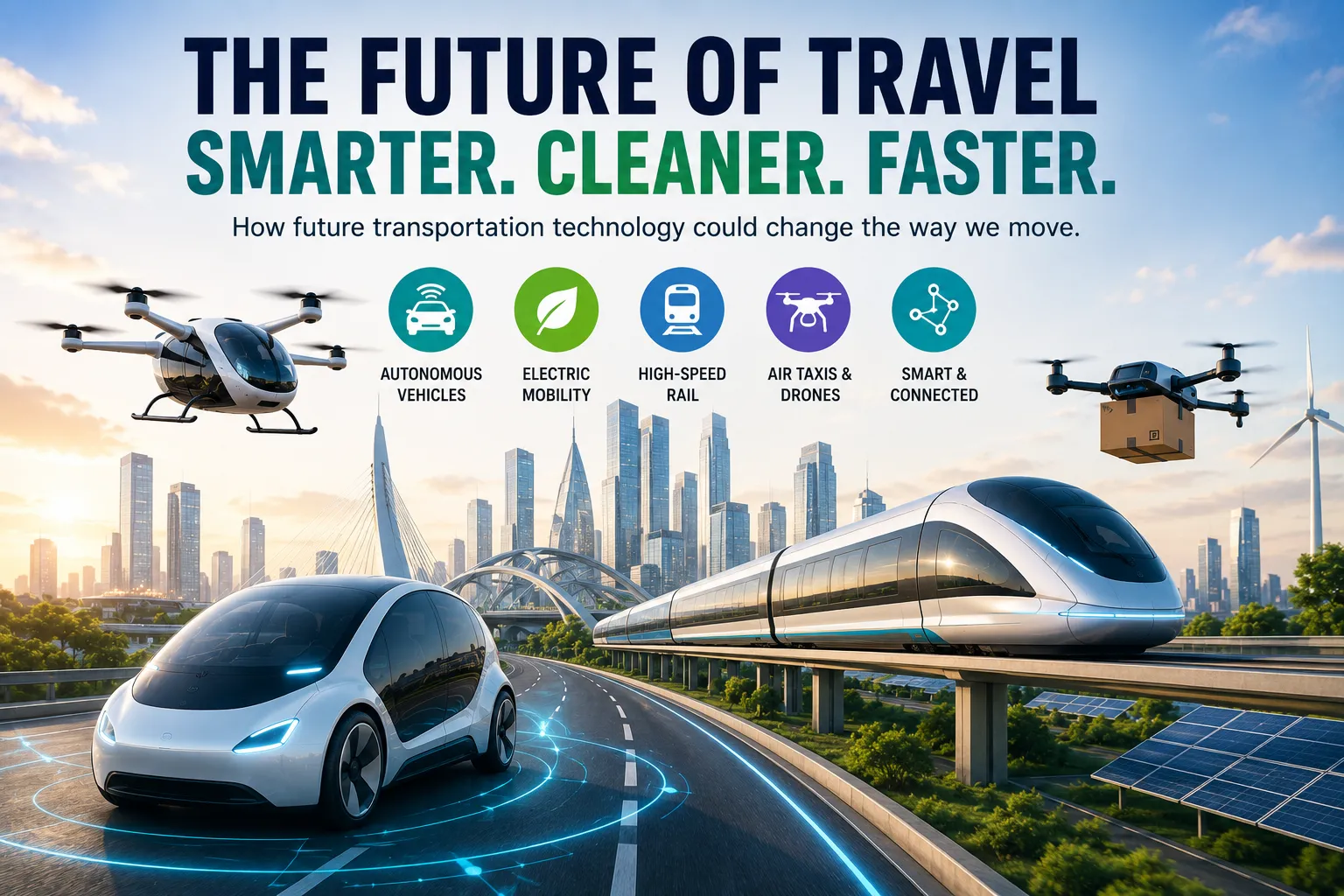
Robotics may also intersect increasingly with transportation. From autonomous vehicles to delivery systems and other emerging mobility technologies, future transportation technology could change how people travel.
Drones represent another important branch of robotics and autonomous machines, particularly for aerial monitoring, delivery, photography, inspection, and other specialized applications. The complete guide to drones explores this area in greater detail.
Will Robots Replace Humans?
The question of whether robots will replace human workers is more complicated than a simple yes-or-no answer.
Robots are particularly effective at repetitive, predictable, physically demanding, or dangerous tasks.
Humans remain strong in areas involving:
- Complex social interaction
- Creativity
- Judgment
- Adaptability
- Empathy
- Ambiguous problem-solving
- Leadership
In many industries, the likely outcome is not complete replacement but changing job responsibilities.
Workers may increasingly supervise automated systems, maintain robotic equipment, analyze information produced by machines, and focus on tasks that require human judgment.
The impact will vary significantly by industry and occupation.
A More Automated Home
Consumer robotics is ultimately part of a broader trend toward automation.
Smartphones, smart appliances, connected security systems, voice assistants, and robotic devices are increasingly able to perform tasks without direct human intervention.
The goal is not necessarily to automate everything.
The most useful automation removes repetitive work while allowing people to remain in control of important decisions.
That balance will be particularly important as robots become more capable.
The Questions Consumers Should Ask Before Buying a Robot
Robotics is advancing quickly, but consumers should remain practical.
Before purchasing a robotic device, ask:
- Does it solve a real problem?
- Is the task difficult or time-consuming without it?
- How reliably does it work?
- What happens when it makes a mistake?
- Does it require a subscription?
- What happens if the manufacturer’s cloud service shuts down?
- How is personal data handled?
- How frequently does it receive software updates?
- Are replacement parts available?
- Can the device be repaired?
- Is the manufacturer likely to support it for several years?
These questions can reveal important differences between products that may appear similar in advertisements.
From Smart Appliances to Physical Intelligence
Robotics is entering an interesting stage.
Earlier generations of consumer robots were often designed around narrow, predictable tasks. They could perform those jobs automatically but had limited ability to understand changing environments.
Newer systems are combining better sensors, improved processors, computer vision, machine learning, natural-language interfaces, and increasingly capable mechanical systems.
The long-term goal is not simply to create machines that move.
It is to create machines that can perceive, reason, act, learn, and safely interact with the physical world.
That transition could have significant implications for homes, businesses, healthcare, transportation, education, and entertainment.
Understanding What Comes Next
Robotics has already moved beyond the factory floor, but consumer robotics is still in an early stage compared with the broader vision of intelligent machines operating alongside people.
For consumers, the most useful robots today are generally those designed around clear and specific problems: cleaning floors, maintaining lawns, monitoring spaces, assisting with education, or automating repetitive tasks.
The next generation could be considerably more capable as artificial intelligence and robotics converge.
Yet progress will not be measured simply by how human-like a robot looks or how impressive a demonstration appears. The real test will be whether a machine can perform useful tasks reliably, safely, affordably, privately, and with minimal supervision in the messy environments where people actually live and work.
That is where robotics becomes more than futuristic technology. It becomes a practical part of everyday life.