How Electronics Warranties Actually Work
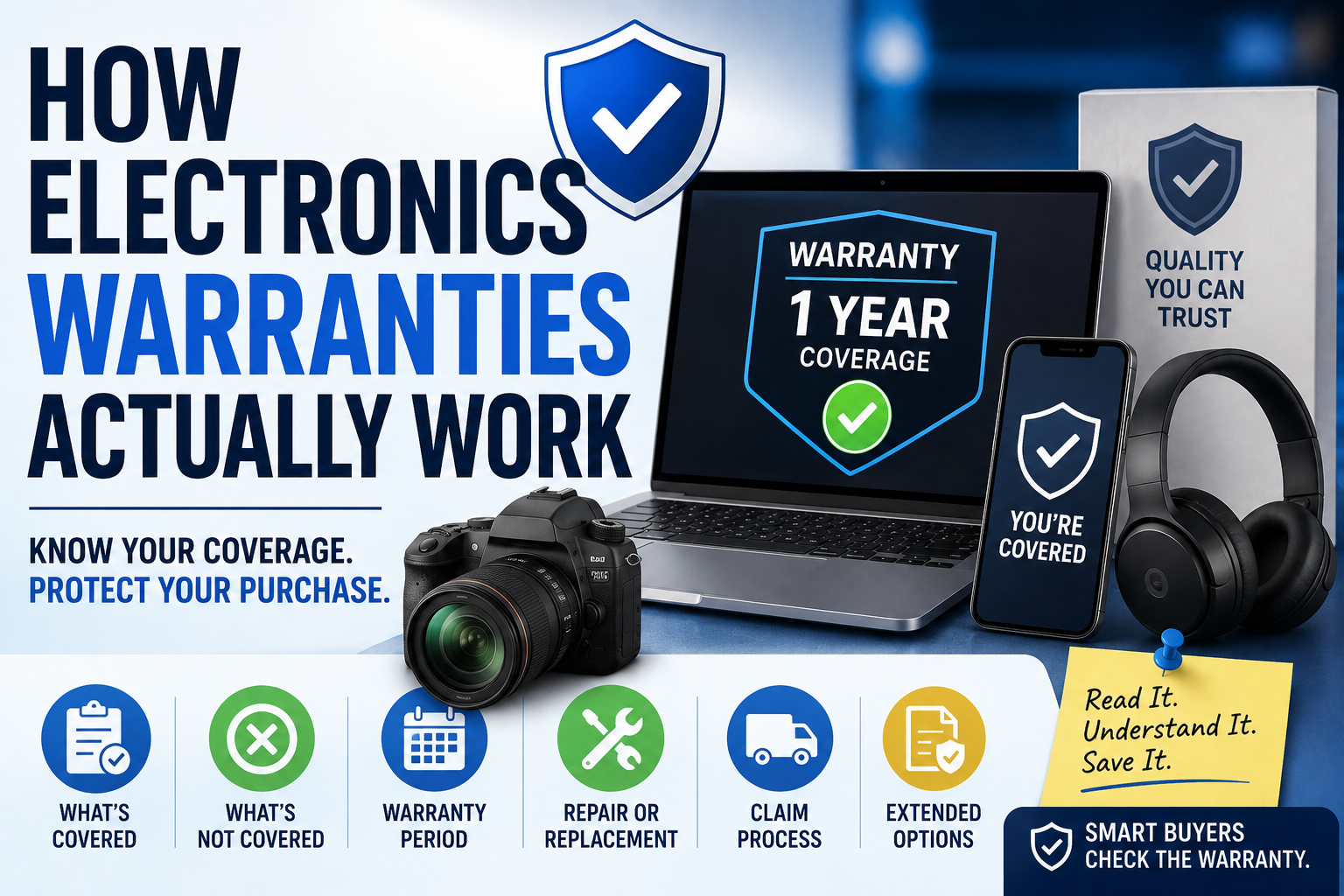
Buying a new phone, laptop, television, camera or other electronic device often comes with a promise that the product is covered by a warranty. Yet many buyers do not fully understand what that warranty actually covers, how long it lasts, what can invalidate it or what happens when something goes wrong.
A warranty is not simply a guarantee that an electronic device will never fail. It is a set of terms that defines what the manufacturer or seller will do when a covered problem occurs.
Understanding those terms before making a purchase can save money, reduce frustration and help you make better decisions when comparing electronics and choosing the right technology devices.
What Is an Electronics Warranty?
An electronics warranty is a commitment from a manufacturer, seller or another provider concerning the condition, performance or repair of a product for a specified period.
Depending on the warranty, the provider may agree to:
- Repair the product
- Replace defective components
- Replace the entire product
- Refund some or all of the purchase price
- Provide replacement parts
- Offer technical support
The exact remedy depends on the warranty’s terms and the applicable consumer-protection laws.
A warranty normally applies only to specific problems and under specific conditions.
Why Do Electronics Come With Warranties?
Electronics contain many components that can fail because of manufacturing defects or other problems.
A warranty gives buyers some protection against certain failures during the covered period.
For manufacturers, warranties can also demonstrate confidence in product quality and provide a formal process for handling defective products.
However, warranties are not designed to cover every type of damage.
Manufacturer Warranty vs. Seller Warranty
One of the first things to understand is who is providing the warranty.
Manufacturer Warranty
A manufacturer warranty is provided by the company that made the product.
For example, an electronics manufacturer may promise to repair or replace a defective device within a specified period.
The customer may need to contact an authorized service center or the manufacturer’s support team.
Seller or Retailer Warranty
A retailer may provide its own warranty or service guarantee.
The retailer’s terms may differ from those offered directly by the manufacturer.
Before buying, determine whether you would need to return the product to the store or contact the manufacturer if something goes wrong.
What Does a Typical Electronics Warranty Cover?
Most standard warranties primarily address defects in materials or workmanship.
For example, a warranty might cover a television that develops an internal hardware failure despite normal use.
It may also cover a laptop component that stops functioning because of a manufacturing defect. Understanding the hardware inside a laptop can also help buyers distinguish between normal component wear and a potential hardware failure, as explained in How Laptop Hardware Affects Performance and Everyday Use.
Typical covered problems can include:
- Defective internal components
- Manufacturing faults
- Certain display failures
- Faulty buttons or ports
- Electrical defects
- Premature component failure
The exact coverage depends on the specific warranty.
What Does a Warranty Usually Not Cover?
Standard warranties commonly exclude damage caused by circumstances outside normal manufacturing defects.
Depending on the terms, exclusions may include:
- Accidental drops
- Cracked screens
- Water damage
- Physical abuse
- Improper installation
- Unauthorized repairs
- Cosmetic damage
- Normal wear and tear
- Misuse
- Damage caused by incompatible accessories
- Lost or stolen products
Never assume that a warranty covers accidental damage simply because the product is still within its warranty period.
Warranty Periods
A warranty normally lasts for a defined period.
Examples might include:
- One year
- Two years
- Three years
- Longer periods for particular components
The clock may begin from the purchase date, delivery date or another date specified by the warranty terms.
Keep your proof of purchase because it can be important when establishing when the warranty period began.
Are All Components Covered for the Same Length of Time?
Not necessarily.
Some electronics have different warranty periods for different components.
For example, a product might have one warranty period for the main device and a different policy for:
- Batteries
- Accessories
- Chargers
- Cables
- Removable components
This is particularly important for products containing batteries because batteries naturally lose capacity over time.
Batteries and Warranty Coverage
Battery coverage can be confusing.
A battery may be considered a consumable component, meaning its capacity naturally decreases with use.
That does not necessarily mean every battery-related problem is excluded.
A warranty may cover a battery that fails because of a manufacturing defect while excluding ordinary capacity loss caused by normal use.
Check the specific warranty language rather than assuming either outcome. Battery behavior and charging practices can also affect how electronic devices perform over time, making it useful to understand the principles covered in the Complete Guide to Charging Technology.
What Is a Limited Warranty?
Many electronics are sold with a limited warranty.
“Limited” means the warranty applies only to specified circumstances.
Restrictions may involve:
- The type of defect covered
- Warranty duration
- Geographic coverage
- Authorized repair locations
- Excluded damage
- Required documentation
- Available remedies
The word “limited” does not necessarily mean the warranty is worthless. It means buyers should understand its boundaries.
What Is an Extended Warranty?
An extended warranty is additional coverage purchased beyond the original warranty period or sometimes for additional types of damage.
It may be offered by:
- The manufacturer
- Retailer
- Insurance company
- Third-party warranty provider
Extended warranties vary substantially.
Some simply extend coverage for manufacturing defects, while others may include accidental damage or additional services.
Extended Warranty vs. Insurance
These products are not necessarily the same.
A warranty generally covers problems specified in its contractual terms, often involving defects or particular failures.
Insurance may provide broader protection against specified risks, potentially including events such as accidental damage, theft or other losses depending on the policy.
When comparing the two, look at:
- Covered events
- Exclusions
- Deductibles
- Claim limits
- Repair options
- Replacement rules
- Duration
The cheapest option is not automatically the best value.
Do You Really Need an Extended Warranty?
The answer depends on the product, its price, reliability, repair cost and the terms of the additional coverage.
An extended warranty may be more attractive when:
- The product is expensive
- Repairs are costly
- Replacement parts are expensive
- The device is difficult to repair
- Coverage includes risks you are genuinely concerned about
- The extended coverage offers meaningful additional protection
It may be less attractive when:
- The product is inexpensive
- The standard warranty is already lengthy
- The extended plan duplicates existing coverage
- The exclusions are extensive
- Repairs would cost relatively little
Calculate the likely cost of repair or replacement before paying for additional protection.
Read the Warranty Before Buying
One of the biggest mistakes buyers make is waiting until a product fails before reading the warranty.
Important details include:
Duration
How long does coverage last?
Covered Problems
Which defects or failures qualify?
Exclusions
What types of damage are specifically excluded?
Claim Process
Who should you contact?
Proof of Purchase
Is a receipt or other purchase documentation required?
Repair Location
Must repairs be performed by an authorized service provider?
Replacement Policy
When will the manufacturer replace rather than repair the product?
Shipping
Who pays for shipping when sending the product for service?
Geographic Restrictions
Does the warranty apply in the country where you purchased or currently use the product?
What Is Proof of Purchase?
Proof of purchase establishes that you bought the product and can help determine when warranty coverage began.
It might include:
- A sales receipt
- Digital invoice
- Order confirmation
- Retailer transaction record
Store this information somewhere accessible.
For expensive electronics, keeping the receipt until the warranty expires can be particularly useful.
Does Registration Activate a Warranty?
Some manufacturers encourage or require customers to register products.
Registration may help with:
- Product identification
- Support
- Warranty administration
- Software updates
- Recall notifications
However, registration requirements vary.
Do not assume that failing to register automatically eliminates all warranty rights. The answer can depend on the manufacturer’s terms and applicable consumer law.
What Happens When You Make a Warranty Claim?
The process varies between manufacturers and retailers, but it commonly follows several steps.
1. Contact the Provider
Contact the manufacturer, retailer or authorized service center specified by the warranty.
2. Provide Product Information
You may need:
- Model number
- Serial number
- Purchase date
- Proof of purchase
- Description of the problem
3. Troubleshooting
Technical support may ask you to perform basic troubleshooting.
4. Inspection
If the issue cannot be resolved remotely, the product may need to be inspected.
5. Decision
The provider determines whether the problem qualifies for warranty coverage.
6. Repair, Replacement or Other Remedy
If the claim is approved, the provider follows the applicable warranty terms.
Why Warranty Claims Get Rejected
A warranty claim can be denied for several reasons.
Common examples include:
Accidental Damage
A device that was dropped may have damage unrelated to a manufacturing defect.
Liquid Damage
Water or other liquid exposure may be excluded.
Unauthorized Repairs
Opening or modifying a device may affect warranty coverage depending on the warranty terms and applicable law.
Misuse
Using the product outside its intended purpose can lead to exclusions.
Expired Coverage
The warranty period may have ended.
Missing Documentation
Some warranty processes require proof of purchase.
Excluded Component
The problem may involve a component specifically excluded from the warranty.
A rejected claim should not automatically be interpreted as evidence that the warranty is unfair. The relevant question is whether the rejection is consistent with the warranty terms and applicable consumer-protection rules.
Does Opening a Device Void Its Warranty?
This is a common question, and the answer depends on the circumstances and jurisdiction.
A manufacturer may restrict coverage for damage caused by unauthorized modification or repair.
However, a statement such as “opening this device automatically voids all warranty rights” should not be accepted without checking the applicable law and the actual warranty terms.
Consumer-protection rules can limit how warranty restrictions operate in some jurisdictions.
If the device needs repair, using an authorized service provider is generally the safest approach when preserving manufacturer warranty coverage is important.
Do Software Updates Affect Warranty Coverage?
Software problems and hardware defects are different issues, but they can overlap.
Manufacturers may provide software updates to fix:
- Security vulnerabilities
- Bugs
- Compatibility problems
- Performance issues
A warranty may have separate provisions concerning software.
Before making significant modifications to device software, check the manufacturer’s support documentation and warranty conditions. Understanding the role of software in modern electronics is also useful when evaluating a device as a whole, since the Complete Guide to Operating Systems explains how operating systems manage hardware and software interactions.
Warranty vs. Return Policy
A return policy and a warranty serve different purposes.
A return policy generally governs whether a buyer can return a product within a specified period.
A warranty generally applies to covered defects or failures during the warranty period.
For example:
A store may allow returns within 14 or 30 days, while the manufacturer provides a one-year warranty for covered defects.
The exact policies depend on the seller and applicable consumer law.
Warranty vs. Guarantee
The words warranty and guarantee are sometimes used interchangeably in everyday language, but their legal meaning can vary by country and context.
A warranty generally establishes specific obligations regarding a product or service.
A guarantee can be broader or can refer to a specific promise made by a seller or manufacturer.
Because terminology varies, it is more useful to read the actual terms than rely solely on the label.
What Is an Implied Warranty?
In some jurisdictions, consumer law can provide protections that exist independently of a manufacturer’s written warranty.
These may concern concepts such as:
- Product quality
- Fitness for a particular purpose
- Conformity with the sales contract
The exact protections vary significantly by country and transaction.
This means a written warranty may not necessarily represent the full extent of a consumer’s legal rights.
International Warranty Coverage
Buying electronics while traveling or importing products can create additional warranty questions.
A manufacturer may offer:
- Worldwide warranty service
- Regional warranty coverage
- Country-specific service
- No international warranty support
Before buying an imported device, determine:
- Where warranty repairs are available
- Who performs repairs
- Whether replacement parts are locally available
- Whether shipping is required
- Whether the warranty applies in your country
A cheaper imported product may become less attractive if obtaining warranty service is difficult.
Refurbished Electronics and Warranties
Refurbished products can have different warranty arrangements from new products.
Coverage may come from:
- The original manufacturer
- The retailer
- A refurbishment company
- A third-party provider
Check whether the warranty covers the entire product and how long it lasts.
A lower purchase price does not necessarily mean poor value, but buyers should understand the trade-off between price and warranty protection.
Used Electronics and Warranty Coverage
Used electronics require additional caution.
The original manufacturer’s warranty may:
- Transfer to a new owner
- Remain tied to the original purchaser
- Have restrictions
- Already be expired
Before buying a used device, ask for:
- Original purchase information
- Warranty documentation
- Serial number where appropriate
- Service records
- Information about previous repairs
Also determine whether the seller provides their own warranty.
What Does “As Is” Mean?
Products sold “as is” may come with limited or no seller warranty, depending on local law and the transaction.
Buyers should be especially careful with used electronics sold under such terms.
Inspect the device thoroughly and understand what legal protections remain available before purchasing.
Electronics Warranty and Accidental Damage
Accidental damage protection is often different from a standard defect warranty.
Accidental damage may include events such as:
- Dropping a phone
- Cracking a laptop screen
- Spilling liquid on a device
- Breaking a camera
- Damaging a tablet
If this type of protection is important to you, look specifically for coverage that addresses accidental damage rather than assuming a standard warranty provides it.
What About Theft and Loss?
A standard electronics warranty generally should not be assumed to cover theft or loss.
Those risks may instead be addressed through:
- Insurance
- Specialized protection plans
- Home or renters insurance
- Device-specific coverage
Check the relevant policy before relying on it for protection.
How to Compare Warranty Coverage
When comparing two similar electronics, do not compare only the headline warranty duration.
Consider:
| Factor | What to Check |
|---|---|
| Length | How many months or years? |
| Coverage | Which failures qualify? |
| Accidental damage | Included or excluded? |
| Battery | What protection applies? |
| Repairs | Authorized service available? |
| Replacement | When is the device replaced? |
| Shipping | Who pays? |
| Location | Where can you claim service? |
| Documentation | What proof is required? |
| Support | Phone, online or in-person? |
| Exclusions | What is specifically excluded? |
A two-year warranty with extensive exclusions may provide less practical value than a shorter warranty with broader coverage.
How to Protect Your Warranty
Simple habits can make warranty claims easier.
Keep the Receipt
Store a digital copy somewhere secure.
Keep Product Information
Record the model and serial number.
Follow Usage Instructions
Use the device according to manufacturer guidance.
Avoid Unnecessary Modifications
Unauthorized modifications can create warranty complications.
Use Appropriate Accessories
Incompatible accessories can cause damage.
Keep Service Records
If the product is repaired, retain documentation.
Back Up Your Data
Before sending a device for repair, back up important information where possible.
A warranty repair may involve resetting or replacing the device.
Back Up Your Data Before a Warranty Repair
A warranty provider generally focuses on repairing or replacing the hardware.
It may not be responsible for preserving your personal data.
Before sending a device away, back up:
- Photos
- Documents
- Contacts
- Messages
- Application data
- Important settings
If the device cannot be accessed, recovery may be difficult or impossible.
Also remove sensitive personal information when the manufacturer’s instructions allow you to do so.
What If a Warranty Repair Fails?
If a repaired device develops the same problem again, contact the warranty provider and explain that the issue has returned.
Keep records of:
- Previous repair dates
- Service reports
- Replacement parts
- Communication with support
- Serial numbers
- Original purchase documentation
Depending on the warranty terms and applicable law, repeated failures may lead to additional remedies.
What If the Manufacturer Refuses a Valid Claim?
If you believe a legitimate warranty claim was improperly denied:
- Review the warranty terms.
- Ask the provider to explain the reason for rejection.
- Request the decision in writing when appropriate.
- Keep all documentation.
- Escalate through the company’s customer-service process.
- Contact the relevant consumer-protection authority or dispute-resolution service if necessary.
The specific process depends on the country and type of transaction.
Common Electronics Warranty Mistakes
Assuming Everything Is Covered
A warranty normally has exclusions.
Throwing Away the Receipt
Proof of purchase can simplify a claim.
Buying an Imported Device Without Checking Coverage
International service may be limited.
Paying for Duplicate Protection
You may already have protection through another policy or service.
Ignoring Warranty Duration
A claim submitted after coverage expires may be rejected.
Sending a Device to an Unauthorized Repair Shop
This can create complications depending on the warranty terms.
Forgetting About Your Data
Always consider data backup before repair.
How to Decide Whether a Warranty Is Worth It
Use a simple cost-benefit approach.
Consider:
Expected repair cost + likelihood of failure + cost of replacement protection + coverage quality
For inexpensive electronics, an expensive protection plan may not make financial sense.
For high-value devices, broader protection may be more attractive.
Also consider how disruptive a failure would be.
A $300 device that is inconvenient to replace may justify a different decision from a $3,000 professional computer that is essential to your work.
Questions to Ask Before Buying
Before purchasing an expensive electronic device, ask:
- How long is the standard warranty?
- Who provides it?
- What exactly is covered?
- What is excluded?
- Is accidental damage covered?
- How are battery failures handled?
- Where are repairs performed?
- How long do repairs usually take?
- Who pays shipping?
- Does coverage transfer if I sell the device?
- Is international service available?
- Is an extended warranty available?
- What does the extended plan add?
- Are there deductibles or service fees?
These questions can reveal important differences between apparently similar products.
The Best Warranty Is Not Always the Longest
Warranty length is an easy number to compare, but it should not be the only consideration.
A useful warranty combines:
- Appropriate duration
- Meaningful coverage
- Reasonable exclusions
- Accessible service
- Clear claim procedures
- Practical remedies
A long warranty with difficult service and extensive exclusions may provide less real-world value than a shorter, straightforward warranty.
What Buyers Should Remember Before the Warranty Card Goes in the Drawer
Electronics warranties are essentially agreements about risk.
The manufacturer or seller is taking responsibility for certain problems under defined circumstances, while the buyer remains responsible for other types of damage, misuse and ordinary wear.
The most important step is therefore to understand the terms before something goes wrong.
When comparing electronics, look beyond the product’s specifications and purchase price. Examine the warranty period, exclusions, repair process, accidental-damage protection, battery coverage, geographic restrictions and the reputation of the service network. These considerations form part of the broader process of understanding what consumer gadgets are and how modern gadgets work.
And remember that a written warranty is only one part of the protection available to consumers. Depending on where you live, consumer-protection laws may provide additional rights that exist independently of the manufacturer’s warranty.
A few minutes spent reading the warranty before buying can make a significant difference later—especially when the expensive device you rely on suddenly stops working.