What Are Consumer Gadgets and How Do Modern Gadgets Work?
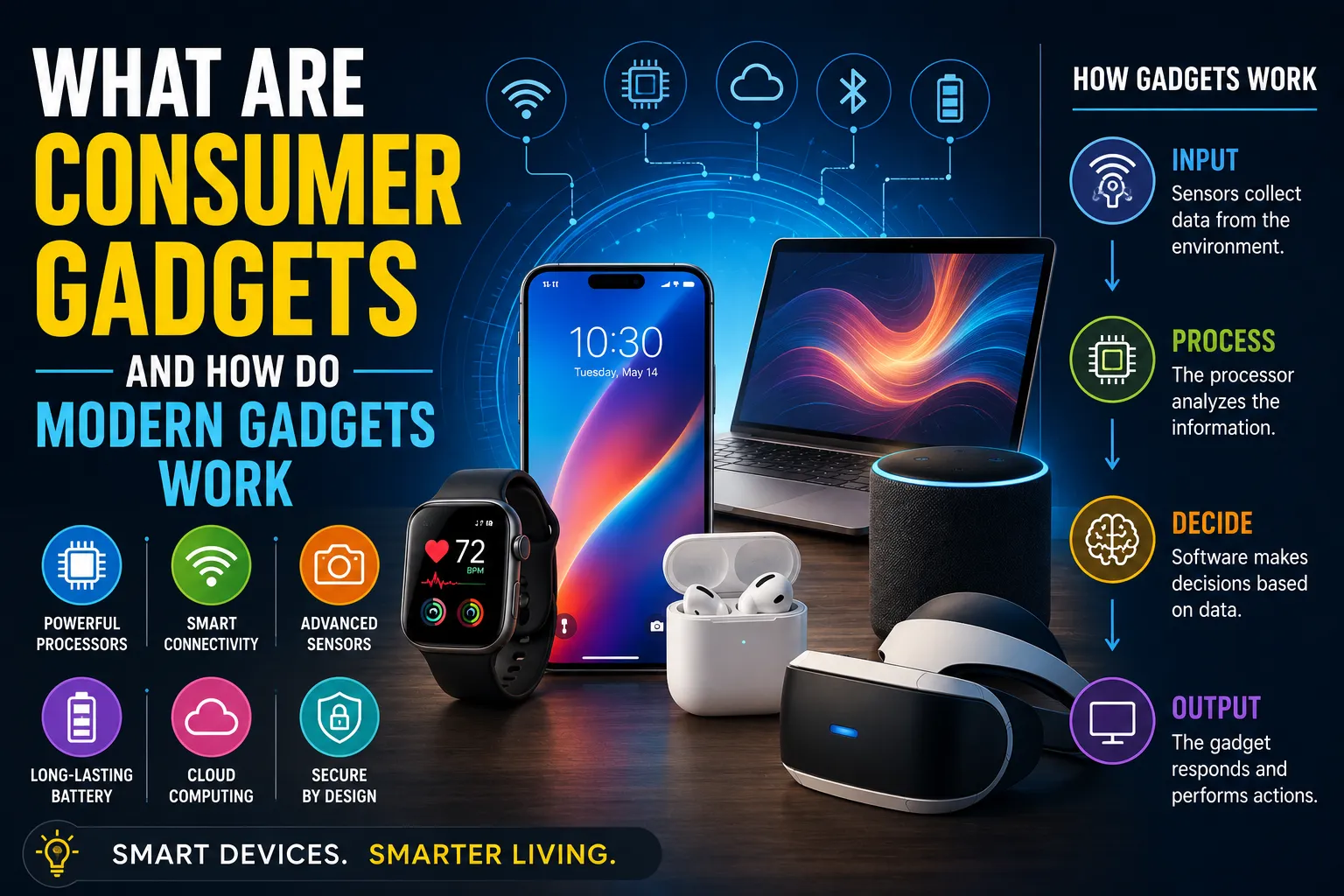
Consumer gadgets have become an ordinary part of everyday life. Smartphones help people communicate, laptops support work and education, smartwatches track activity, wireless earbuds deliver audio, and smart home devices can control everything from lighting to thermostats.
Despite their familiarity, many modern gadgets are remarkably sophisticated. A small device may contain processors, sensors, wireless radios, batteries, memory, software, and artificial intelligence working together within a package that fits in the palm of a hand.
Understanding how these devices work makes it easier to understand the technology behind the products people use every day.
What Are Consumer Gadgets?
Consumer gadgets are electronic devices designed primarily for personal, household, entertainment, communication, productivity, or convenience purposes.
The term can cover a wide range of products, including:
-
Smartphones and tablets
-
Laptops and desktop computers
-
Smartwatches and fitness trackers
-
Wireless earbuds and headphones
-
Digital cameras
-
Gaming consoles and handheld systems
-
Smart speakers
-
Streaming devices
-
E-readers
-
Smart home equipment
-
Portable chargers and accessories
-
Virtual and augmented reality devices
Some gadgets are relatively simple, while others combine multiple technologies into a single product.
A modern smartphone, for example, can function as a camera, navigation system, gaming device, music player, communication tool, payment terminal, and miniature computer.
Virtual and augmented reality devices represent another category of consumer electronics that combines displays, sensors, processors, and spatial tracking. For a deeper explanation of the technology behind these systems, see How Augmented and Virtual Reality Technology Works Using Displays, Sensors, Tracking and Spatial Computing.
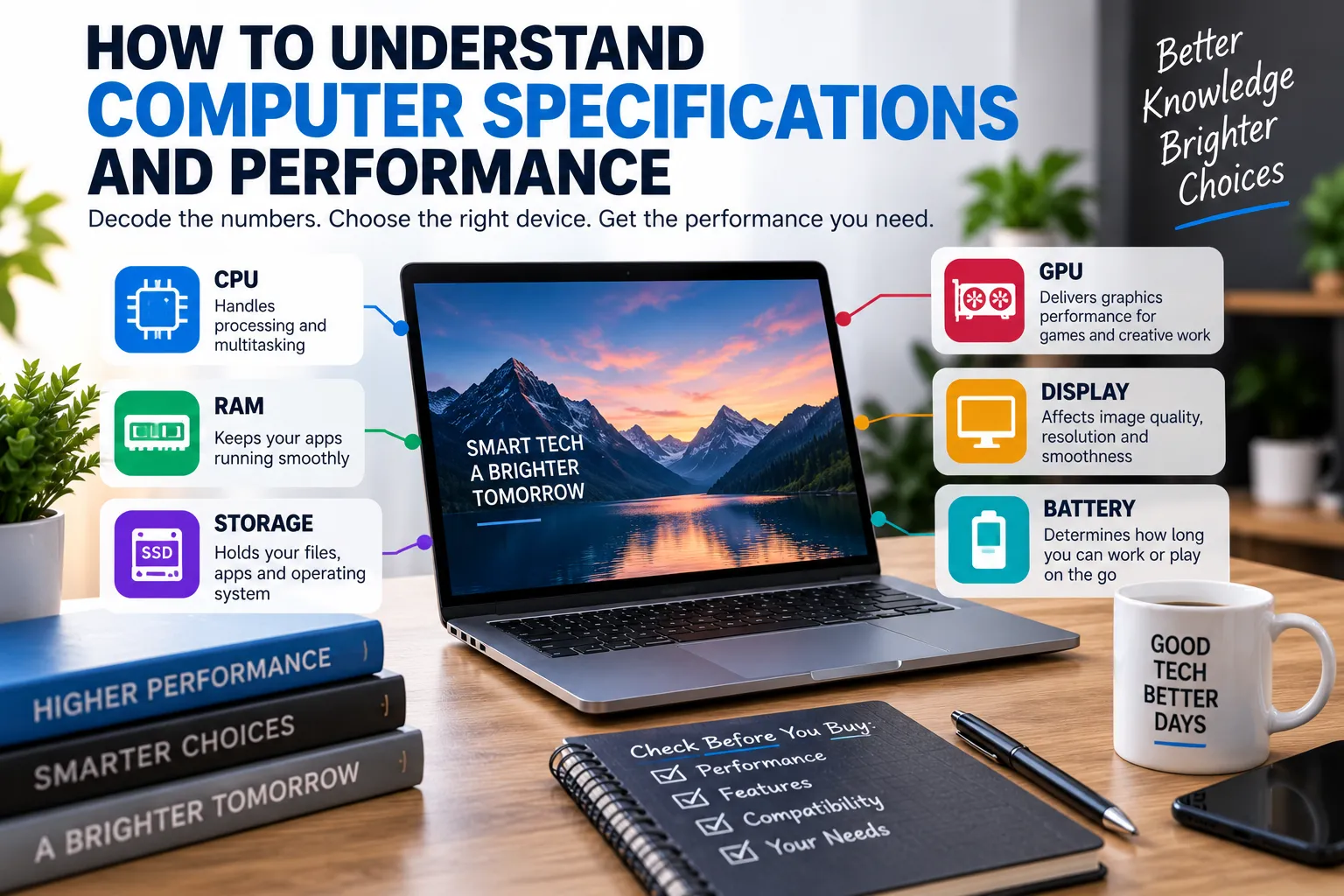
For consumers comparing different types of products, understanding how to choose the right technology devices can make it easier to evaluate specifications against actual needs.
Portable devices are also an important part of this broader category. What Is Portable Computing and How Do Modern Mobile Computers Work? explains how compact computers combine processors, batteries, storage, wireless connectivity, and software to deliver computing capabilities away from traditional desktop environments.
What Makes a Gadget “Smart”?
The word smart generally refers to a device that can process information and respond to its environment or user instructions.
A smart device typically combines several components:
-
Sensors collect information.
-
Processors analyze information and execute instructions.
-
Software determines how the device behaves.
-
Connectivity allows the device to communicate with other systems.
-
Memory and storage hold information and applications.
-
A power system provides the energy needed to operate everything.
A smart thermostat, for example, might use temperature sensors to measure a room, a processor to analyze the reading, software to determine what should happen, and Wi-Fi to communicate with a mobile application.
The same basic combination of sensing, processing, software, and connectivity is important in more advanced devices such as autonomous robots and immersive computing systems.
How Do Modern Gadgets Work?
Although devices differ significantly, many follow a similar basic process:
Input → Processing → Decision → Output
Consider a smartwatch measuring heart rate.
The sensors collect information from the user’s wrist. The device processes that information using algorithms. Software interprets the measurements and may store them. The result can then appear on the watch’s screen or synchronize with a smartphone.
This basic sequence happens continuously in many modern electronic products.
The Processor Is the Gadget’s Computing Engine
At the center of many sophisticated gadgets is a processor.
A processor executes instructions provided by software. It performs calculations, moves data, controls hardware components, and coordinates different operations.
Modern mobile devices often use systems-on-a-chip, commonly called SoCs. Rather than placing every computing component on separate chips, an SoC can integrate multiple functions into a single piece of silicon.
Depending on the design, an SoC may contain:
-
CPU cores
-
Graphics processing units
-
Memory controllers
-
Image-processing hardware
-
AI or machine-learning accelerators
-
Security components
-
Wireless-related components
This integration helps manufacturers create powerful devices that consume relatively little energy.
What Does Software Do Inside Gadgets?
Hardware provides the physical machinery, but software tells that machinery what to do.
A gadget may contain several layers of software.
Firmware
Firmware is software closely associated with the device’s hardware.
It can control low-level operations and allow electronic components to function correctly.
Operating Systems
More sophisticated gadgets may use operating systems.
Smartphones, computers, tablets, and many smart devices rely on operating systems to manage hardware and provide an environment for applications.
Examples include Android, iOS, Windows, macOS, Linux-based systems, and specialized operating systems used in embedded devices.
The operating system is therefore a fundamental part of many devices, and The Complete Guide to Operating Systems provides a broader look at how these software platforms manage computing hardware.
Applications
Applications provide specific functionality.
A smartphone can have separate applications for photography, messaging, navigation, banking, entertainment, and productivity.
These applications interact with the operating system, which in turn communicates with the underlying hardware.
How Do Gadgets Sense the World?
Sensors are among the most important technologies in modern gadgets.
A sensor converts some physical characteristic of the environment into information that electronics can process.
Common sensors include:
-
Cameras
-
Microphones
-
Accelerometers
-
Gyroscopes
-
Temperature sensors
-
Light sensors
-
Proximity sensors
-
Pressure sensors
-
GPS receivers
-
Biometric sensors
A smartphone’s accelerometer can detect changes in movement. A camera can capture light and convert it into digital information. A microphone converts sound waves into electrical signals that can be processed digitally.
Sensors effectively give electronic devices ways to perceive their surroundings.
This ability to sense and interpret the physical environment becomes especially important in immersive technologies. In Virtual Reality Explained, sensors such as accelerometers and gyroscopes help track movement so digital environments can respond to the user’s position and orientation.
How Do Touchscreens Work?
Touchscreens allow users to interact directly with digital interfaces.
Many modern smartphones and tablets use capacitive touchscreens.
The screen contains a conductive layer that detects changes in an electrical field when a finger approaches or touches its surface.
The device’s controller determines where the interaction occurred and sends that information to the operating system.
The software can then interpret the interaction as an action such as:
-
Tapping an icon
-
Scrolling
-
Typing
-
Zooming
-
Dragging an object
-
Selecting an option
Multi-touch technology allows devices to recognize multiple points of contact simultaneously.
How Do Cameras Turn Light Into Photos?
Digital cameras use image sensors to capture light.
When light enters a camera, it reaches an image sensor containing millions of tiny light-sensitive elements. These elements measure incoming light and convert it into electrical information.
The camera’s image-processing system then processes the captured data.
Modern cameras can perform operations such as:
-
Noise reduction
-
Exposure adjustment
-
Color processing
-
Sharpening
-
HDR processing
-
Image stabilization
-
Portrait effects
-
Object detection
This explains why smartphone photography increasingly depends on software as much as physical camera hardware.
Two devices with similar camera sensors can produce noticeably different photographs because their image-processing systems use different algorithms.
For a deeper look at this area, How Smartphone Computational Photography Works explains how computational techniques have become an important part of modern mobile photography.
How Does Wireless Connectivity Work?
Modern gadgets rarely operate in isolation.
They communicate through technologies such as:
-
Wi-Fi
-
Bluetooth
-
Cellular networks
-
NFC
-
GPS
-
Zigbee
-
Thread
-
Other specialized wireless protocols
Each technology is designed for different types of communication.
A broader look at these technologies can be found in the Complete Guide to Wireless Connectivity.
Wi-Fi
Wi-Fi is commonly used to connect devices to local networks and the internet.
A smartphone might use Wi-Fi to stream video, download applications, synchronize files, or communicate with smart home equipment.
Bluetooth
Bluetooth is designed for relatively short-range wireless communication.
Wireless headphones, keyboards, mice, smartwatches, and other accessories frequently use Bluetooth.
NFC
Near-field communication, or NFC, enables very short-range wireless interactions.
It can be used for contactless payments, device pairing, access systems, and other applications.
Cellular Connectivity
Smartphones use cellular networks to communicate over much greater distances.
Depending on the network and device, cellular connectivity can support voice calls, messaging, internet access, and other services.
How Do Gadgets Connect to the Internet?
When a gadget connects to the internet, it usually communicates through several layers of networking technology.
For example, a smartphone might connect through Wi-Fi to a router. The router communicates with an internet service provider, which provides access to wider networks.
When an application requests information from an online service, the device sends network requests to a remote server.
The server processes the request and sends data back.
This enables applications to provide services such as:
-
Cloud storage
-
Online gaming
-
Video streaming
-
Social networking
-
Online banking
-
Remote device control
-
Software synchronization
The gadget may therefore be only one part of a much larger technological system.
What Is Cloud Computing in Consumer Gadgets?
Cloud computing allows devices to use remote computing and storage resources instead of keeping everything locally.
For example, a smartphone may store some photographs locally while also synchronizing copies to cloud storage.
Similarly, a smart home camera may send video to remote servers where it can be stored, analyzed, or accessed from another device.
Cloud services can make gadgets more useful because they provide access to information and computing resources beyond the physical limits of the device.
However, they also create dependencies on internet connectivity, service providers, account systems, and data infrastructure.
How Do Smart Home Gadgets Work?
Smart home devices extend connected computing into household environments.
Examples include:
-
Smart lights
-
Smart thermostats
-
Smart locks
-
Security cameras
-
Smart speakers
-
Robot vacuum cleaners
-
Smart appliances
-
Motion sensors
A smart home system typically consists of devices, a communication network, software, and sometimes a cloud service. For a broader explanation of how these connected technologies fit together in a household environment, see The Complete Guide to Building an Intelligent Home.
For example, a smart light may receive a command from a smartphone. The command travels through the network to the appropriate device, which activates its electronics and changes the light’s state.
More advanced systems can automate these decisions.
A light might turn on automatically when a motion sensor detects movement.
What Role Does Artificial Intelligence Play?
Artificial intelligence is increasingly integrated into consumer electronics.
AI-related features can be used for:
-
Voice recognition
-
Image classification
-
Translation
-
Predictive text
-
Photo enhancement
-
Personalized recommendations
-
Noise cancellation
-
Object detection
-
Health and fitness analysis
-
Generative features
Some processing occurs directly on the gadget, while other tasks are performed on remote servers.
The same combination of AI, sensors, and physical hardware is also driving advances in robotics. Modern robots increasingly use perception systems and machine learning to interpret their surroundings and make decisions, as discussed in The Future of Robotics.
On-Device AI
On-device processing allows a gadget to perform certain AI tasks locally.
This can reduce latency and may improve privacy because some information does not need to leave the device.
Cloud-Based AI
Cloud-based systems can provide access to much larger computing resources.
A device can send information to a remote service, where powerful processors perform the requested computation and return a result.
Many modern products use a combination of local and cloud-based processing.
How Do Batteries Power Modern Gadgets?
Portable gadgets depend heavily on rechargeable batteries.
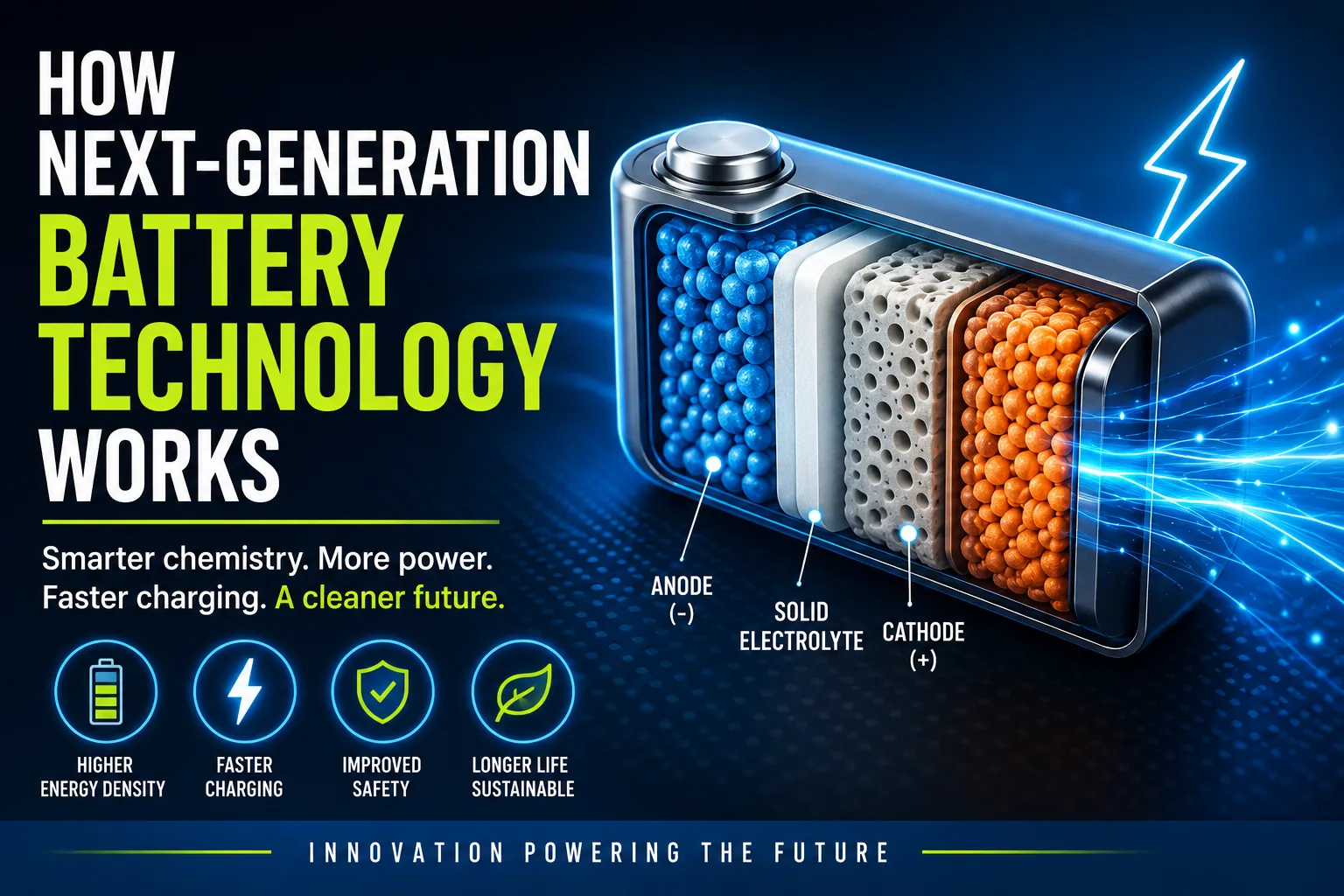
Lithium-ion and lithium-polymer battery technologies are widely used in consumer electronics because they offer a useful combination of energy density, weight, and rechargeable performance.
A battery stores chemical energy and converts it into electrical energy when the device operates.
Modern gadgets also include power-management systems that regulate how electricity is distributed.
These systems can:
-
Monitor battery conditions
-
Control charging
-
Reduce energy consumption
-
Adjust processor performance
-
Manage screen brightness
-
Put components into low-power states
Battery life therefore depends on much more than battery capacity.
A device with efficient hardware and software can sometimes operate longer than a device with a physically larger battery.
For a deeper understanding of the technology behind charging devices, see the Complete Guide to Charging Technology.
Why Do Gadgets Generate Heat?
Electronic components consume energy, and some of that energy ultimately becomes heat.
Processors can become particularly warm when performing demanding tasks such as gaming, video editing, artificial intelligence processing, or high-resolution recording.
Manufacturers use different techniques to manage heat, including:
-
Heat spreaders
-
Thermal compounds
-
Metal frames
-
Cooling fans
-
Vapor chambers
-
Software-based performance controls
Some mobile devices can automatically reduce processor performance when temperatures become too high. This process is often called thermal throttling.
Managing heat is important because excessive temperatures can affect performance, battery life, reliability, and component longevity.
How Do Gadgets Store Information?
Consumer electronics use several forms of digital storage and memory.
RAM
Random-access memory, or RAM, provides temporary working space for active applications and processes.
More RAM can allow a device to keep more information readily available for simultaneous tasks, although the benefits depend on the operating system and workload.
Internal Storage
Internal storage retains information even when a device is turned off.
It can hold:
-
Applications
-
Photos
-
Videos
-
Documents
-
Operating system files
-
Games
-
Other user data
Modern gadgets commonly use flash-based storage because it is compact, fast, and does not require moving mechanical parts.
How Do Gadgets Protect User Data?
Security has become an essential part of consumer electronics.
Modern devices may use:
-
Passwords and PINs
-
Biometric authentication
-
Encryption
-
Secure boot mechanisms
-
Hardware security modules
-
Application permissions
-
Security updates
-
Sandboxing
Biometric systems can allow users to unlock devices using fingerprints or facial characteristics.
Encryption can help prevent unauthorized parties from reading protected information if storage or communications are intercepted.
Security also depends on software updates. Even sophisticated hardware can become vulnerable if security weaknesses remain unpatched.
Why Software Updates Matter?
A gadget’s capabilities do not necessarily remain fixed after purchase.
Manufacturers can distribute software updates that:
-
Fix bugs
-
Patch security vulnerabilities
-
Improve performance
-
Add features
-
Improve compatibility
-
Change user interfaces
-
Extend device functionality
This means the effective lifespan of a gadget can depend partly on how long its manufacturer continues to support it.
Software support has therefore become an important consideration when evaluating technology products.
How Do Wearable Gadgets Track Health and Activity?
Wearable devices such as smartwatches and fitness trackers combine sensors, processors, algorithms, and software to estimate various measurements.
Depending on the device, sensors may collect information related to:
-
Movement
-
Heart activity
-
Skin characteristics
-
Temperature
-
Location
-
Exercise patterns
Algorithms can then interpret these signals and produce estimates such as step counts, workout information, or heart-rate measurements.
It is important to distinguish between direct measurements and estimates. A wearable’s reported metric may be calculated from sensor signals rather than directly measuring the biological quantity in question.
For health-related decisions, consumer wearable measurements should not automatically be treated as equivalent to professional medical testing.
For a broader look at these products, the Wearable Technology Guide explores how wearable devices combine sensors, computing, connectivity, and software.
Why Are Modern Gadgets Becoming Smaller and More Powerful?
Several technological developments have allowed manufacturers to place increasingly powerful computing systems into smaller devices.
These include:
-
Smaller semiconductor manufacturing processes
-
More efficient processor architectures
-
Better battery technologies
-
Improved wireless components
-
More compact storage
-
Advanced packaging
-
Specialized processors
As components become more integrated, manufacturers can add capabilities without proportionally increasing the size of the device.
This trend has helped turn phones, watches, earbuds, and other small products into surprisingly capable computers.
For a closer look at how compact computing has developed and how laptops, tablets, smartphones, and other mobile systems balance performance with portability, see What Is Portable Computing and How Do Modern Mobile Computers Work?.
The Difference Between Hardware and Software
One of the simplest ways to understand a gadget is to separate it into two broad categories.
Hardware refers to the physical components.
Examples include:
-
Processor
-
Display
-
Battery
-
Camera
-
Sensors
-
Speakers
-
Storage
-
Circuit boards
Software refers to the instructions and digital systems controlling the hardware.
Examples include:
-
Operating systems
-
Applications
-
Firmware
-
Drivers
-
Algorithms
Neither side operates independently in a modern gadget. Software tells hardware what to do, while hardware provides the physical capabilities required to execute the software.
What Makes a Gadget Useful?
Technical specifications alone do not determine whether a gadget is useful.
The overall experience depends on how well its components work together.
Important factors include:
-
Reliability
-
Ease of use
-
Battery life
-
Performance
-
Software quality
-
Connectivity
-
Security
-
Durability
-
Compatibility
-
Repairability
-
Long-term software support
A device with impressive specifications can still be frustrating if its software is poorly designed or its battery drains quickly.
Conversely, a well-optimized device can deliver an excellent experience without having the highest specifications in every category.
Where Consumer Gadgets Are Heading
The future of consumer electronics is likely to involve even greater integration between hardware, software, connectivity, and artificial intelligence.
Devices are becoming increasingly capable of understanding their surroundings, predicting user needs, communicating with other devices, and processing information locally.
At the same time, questions around privacy, security, repairability, energy consumption, electronic waste, and long-term software support are becoming increasingly important.
The most significant development may not be any individual gadget. Instead, it may be the growing ecosystem of connected devices in which phones, computers, wearables, vehicles, appliances, and smart home systems work together.
From Simple Electronics to Connected Computing Ecosystems
Modern consumer gadgets are far more than individual pieces of electronic hardware. They are combinations of processors, sensors, software, batteries, connectivity systems, data storage, and increasingly sophisticated algorithms.
Understanding these building blocks explains why a smartphone can recognize a face, why wireless earbuds can cancel surrounding noise, why a smartwatch can interpret movement, and why a smart home can respond automatically to changing conditions.
As technology advances, the distinction between different types of gadgets may become less important. More products are becoming connected computers capable of sensing, processing, communicating, and adapting. For consumers, understanding how those systems work can make it easier to choose technology wisely and use it with greater awareness of its capabilities and limitations.