Business Technology Explained: How Digital Innovation Is Transforming Modern Companies
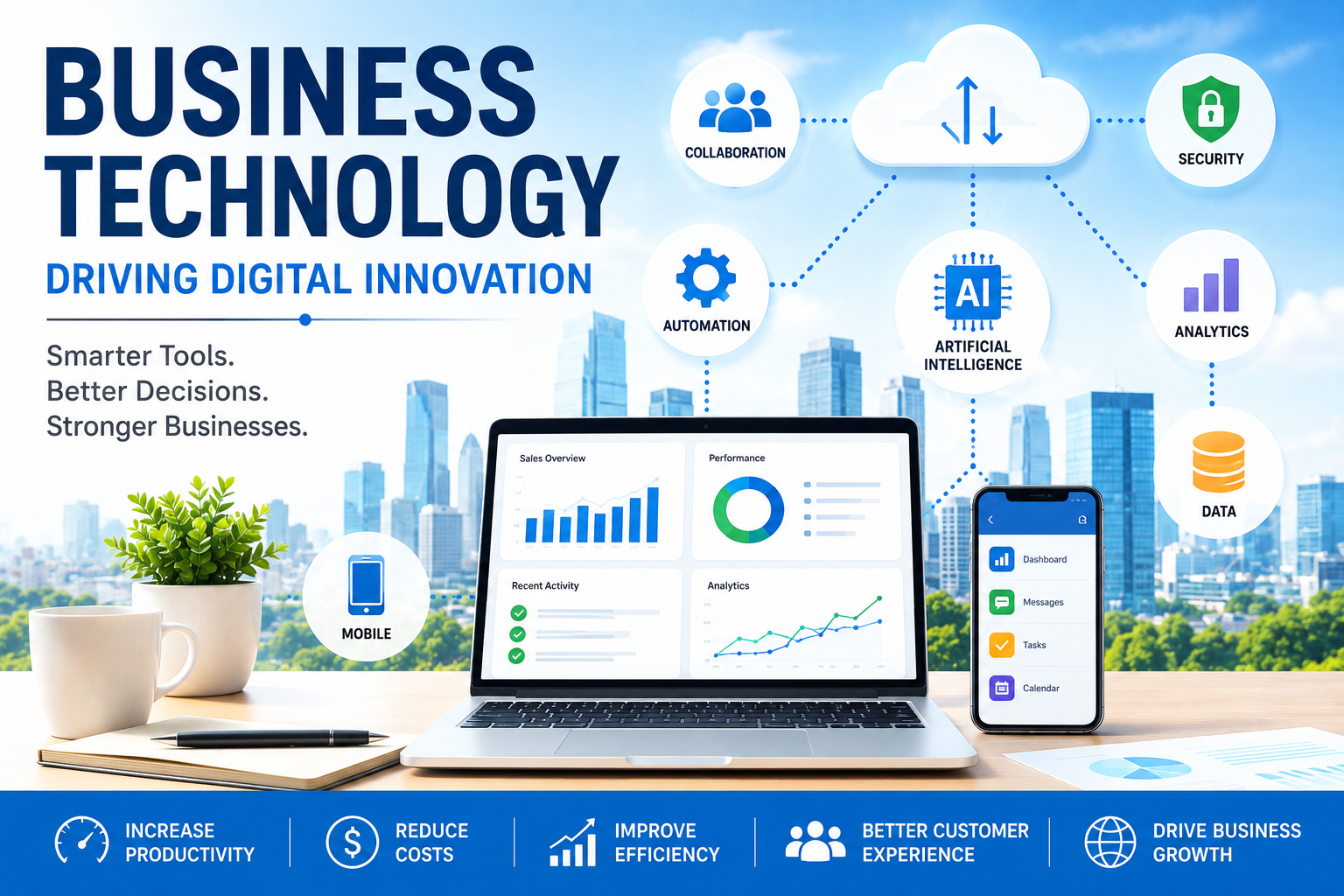
Technology has become the driving force behind modern business. From cloud computing and artificial intelligence to automation, data analytics, and cybersecurity, organizations across every industry are embracing digital innovation to improve efficiency, reduce costs, and deliver better customer experiences. What was once considered a competitive advantage has now become a necessity for businesses seeking long-term success.
Business technology is no longer limited to large multinational corporations. Small businesses, startups, and nonprofits are increasingly adopting digital tools to streamline operations, reach new markets, and make smarter decisions. As technology continues to evolve, companies that successfully adapt are often better positioned to compete in an increasingly digital economy.
This guide explores what business technology is, why it matters, the key technologies shaping today’s workplace, and how digital transformation is changing the future of business.
What Is Business Technology?
Business technology refers to the hardware, software, digital systems, and technological processes organizations use to improve operations, productivity, communication, decision-making, and customer service.
It includes everything from:
- Cloud computing
- Business software
- Artificial intelligence
- Data analytics
- Cybersecurity
- Customer Relationship Management (CRM) systems
- Enterprise Resource Planning (ERP) software
- Collaboration tools
- Mobile technology
- Internet of Things (IoT)
The goal is to help businesses operate more efficiently while creating value for customers and stakeholders.
For businesses looking to understand the broader role of software across finance, operations, sales, communication, and other functions, our complete guide to business software provides a useful foundation.
Why Business Technology Matters
Technology has transformed how companies operate.
Modern businesses use digital tools to:
- Increase productivity
- Reduce operational costs
- Improve customer experiences
- Enhance collaboration
- Make data-driven decisions
- Automate repetitive tasks
- Expand into global markets
- Strengthen cybersecurity
- Improve supply chain management
Organizations that invest wisely in technology often gain a significant competitive advantage.
However, successful technology adoption is about more than purchasing software. Businesses need to understand their processes, identify genuine problems, select appropriate systems, and ensure employees can use those systems effectively.
The Evolution of Business Technology
Business technology has changed dramatically over the past few decades.
| Era | Key Innovation |
|---|---|
| 1980s | Personal computers |
| 1990s | Internet and email |
| 2000s | E-commerce and enterprise software |
| 2010s | Cloud computing and mobile technology |
| 2020s | Artificial intelligence, automation, and data analytics |
Each wave of innovation has fundamentally changed how businesses communicate, sell products, manage operations, and interact with customers.
The pace of change has also accelerated. Technologies that once required significant infrastructure investment can now be accessed through cloud-based services, allowing smaller organizations to adopt capabilities that were previously available mainly to large enterprises.
Cloud Computing
Cloud computing allows businesses to access computing resources over the internet instead of relying solely on local servers.
Businesses can use cloud technology for:
- File storage
- Software applications
- Databases
- Computing power
- Backup systems
- Business analytics
- Artificial intelligence
- Collaboration
Potential benefits include:
- Lower infrastructure costs
- Remote access
- Automatic updates
- Improved scalability
- Centralized data access
- Faster deployment
Cloud technology has also changed how businesses approach IT infrastructure because organizations can increasingly consume computing resources as services rather than purchasing and maintaining every component themselves.
Artificial Intelligence (AI)
Artificial intelligence is rapidly becoming one of the most influential business technologies.
Companies use AI for:
- Customer support chatbots
- Predictive analytics
- Fraud detection
- Demand forecasting
- Personalized marketing
- Document processing
- Workflow automation
- Virtual assistants
- Content generation
- Data analysis
AI helps organizations analyze massive amounts of information faster than traditional methods.
It can also support employees by handling certain repetitive knowledge tasks, generating initial drafts, identifying patterns, or helping people locate relevant information.
However, organizations need appropriate controls around accuracy, privacy, security, and human oversight. AI can assist business decisions, but it should not automatically be treated as an unquestionable source of truth.
Automation
Automation reduces manual work by allowing software to perform repetitive tasks according to predefined rules or conditions.
Common applications include:
- Invoice processing
- Inventory management
- Payroll
- Email marketing
- Customer onboarding
- Appointment scheduling
- Report generation
- Data entry
- Workflow management
Automation improves efficiency while allowing employees to focus on higher-value work.
The best automation strategies usually begin with process improvement. Automating a poorly designed process can simply make an inefficient workflow happen faster.
Businesses should therefore determine which activities are repetitive, predictable, and suitable for automation while keeping appropriate human oversight over decisions that require judgment.
Data Analytics
Businesses generate enormous amounts of data every day.
Analytics tools help organizations understand:
- Customer behavior
- Sales performance
- Marketing effectiveness
- Financial trends
- Employee workflows
- Supply chain performance
- Product performance
- Operating costs
Better insights can lead to more informed business decisions.
Organizations can use historical information to identify trends, monitor current performance, and develop forecasts. The value of analytics depends heavily on the quality of the underlying data, making accurate data collection and management essential.
For a deeper look at how organizations turn operational information into useful insights, see our complete guide to data analytics for business.
Customer Relationship Management (CRM)
Customer relationship management software helps companies manage interactions with customers throughout the customer lifecycle.
Typical CRM features include:
- Contact management
- Sales tracking
- Customer support
- Marketing automation
- Lead management
- Customer communication
- Reporting
- Sales forecasting
A CRM system can give employees a centralized view of customer interactions, helping sales and service teams understand customer histories without searching through disconnected systems.
Businesses can also use CRM technology to organize sales pipelines, track leads, identify opportunities, and improve customer retention.
To understand the technology behind these systems in more detail, see what CRM technology is and how businesses use it.
Enterprise Resource Planning (ERP)
Enterprise Resource Planning systems integrate multiple business functions into a connected software environment.
They commonly manage:
- Finance
- Human resources
- Inventory
- Manufacturing
- Procurement
- Sales
- Supply chain operations
- Business reporting
ERP solutions can improve coordination and reduce duplication across departments by allowing different functions to work with shared business information.
For example, a sales transaction can affect inventory information, fulfillment activity, and financial records. Instead of requiring employees to manually transfer information between unrelated systems, an integrated ERP environment can connect these processes.
Businesses interested in how these systems connect finance, operations, inventory, human resources, and other functions can explore ERP technology and how businesses integrate operations.
Cybersecurity
As businesses become more digital, protecting information becomes increasingly important.
Effective cybersecurity can include:
- Firewalls
- Encryption
- Multi-factor authentication
- Endpoint protection
- Security monitoring
- Employee awareness training
- Data backups
- Access controls
- Incident response planning
Cybersecurity protects organizations from threats such as data breaches, ransomware, credential theft, and unauthorized access.
Security is also closely connected to business continuity. If employees cannot access essential systems because of an attack or outage, productivity and customer service can be affected immediately.
Remote and Hybrid Work
Business technology has transformed workplace flexibility.
Employees now use digital tools for:
- Video conferencing
- Team messaging
- File sharing
- Project management
- Virtual meetings
- Cloud collaboration
- Digital document management
These technologies enable organizations to support distributed teams while maintaining productivity.
The digital workplace has consequently become an important part of modern business operations. Companies need to consider not only which tools employees use, but also how those tools fit together and how information moves between them.
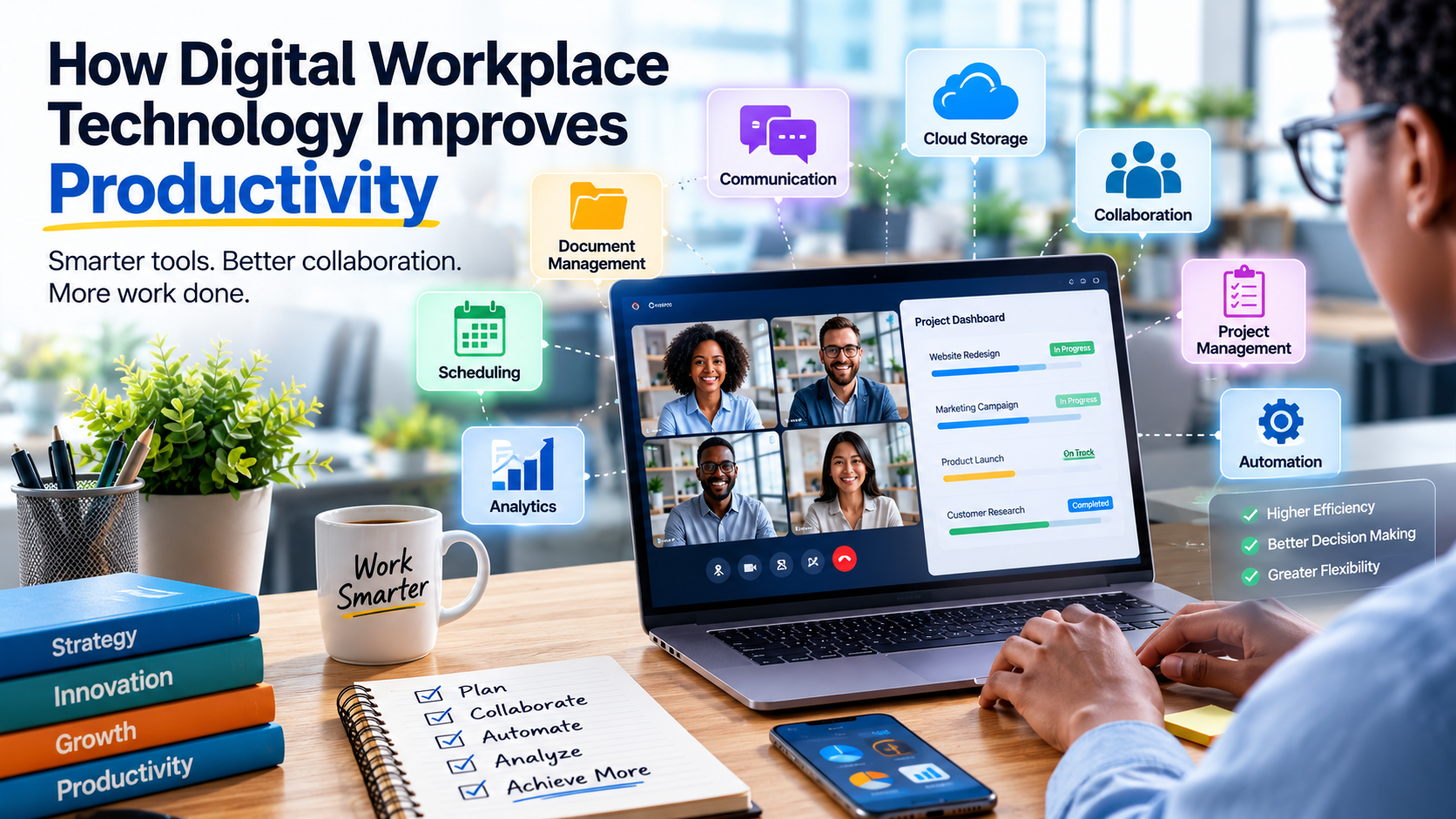
Our guide to how digital workplace technology improves productivity examines this relationship in greater detail.
Collaboration and Communication Technology
Communication technology allows employees to exchange information regardless of where they work.
Businesses may use:
- Instant messaging
- Video conferencing
- Shared documents
- Team workspaces
- Digital meeting platforms
- Internal communication systems
These tools can reduce geographical barriers and make distributed work more practical.
However, communication technology is most effective when employees understand which channels should be used for different types of information. A quick question may belong in instant messaging, while an important project decision may need to be recorded in a shared project or documentation system.
Businesses can explore the broader technology landscape in our complete guide to business communication technology.
Project and Workflow Management
Technology has also changed how businesses organize work.
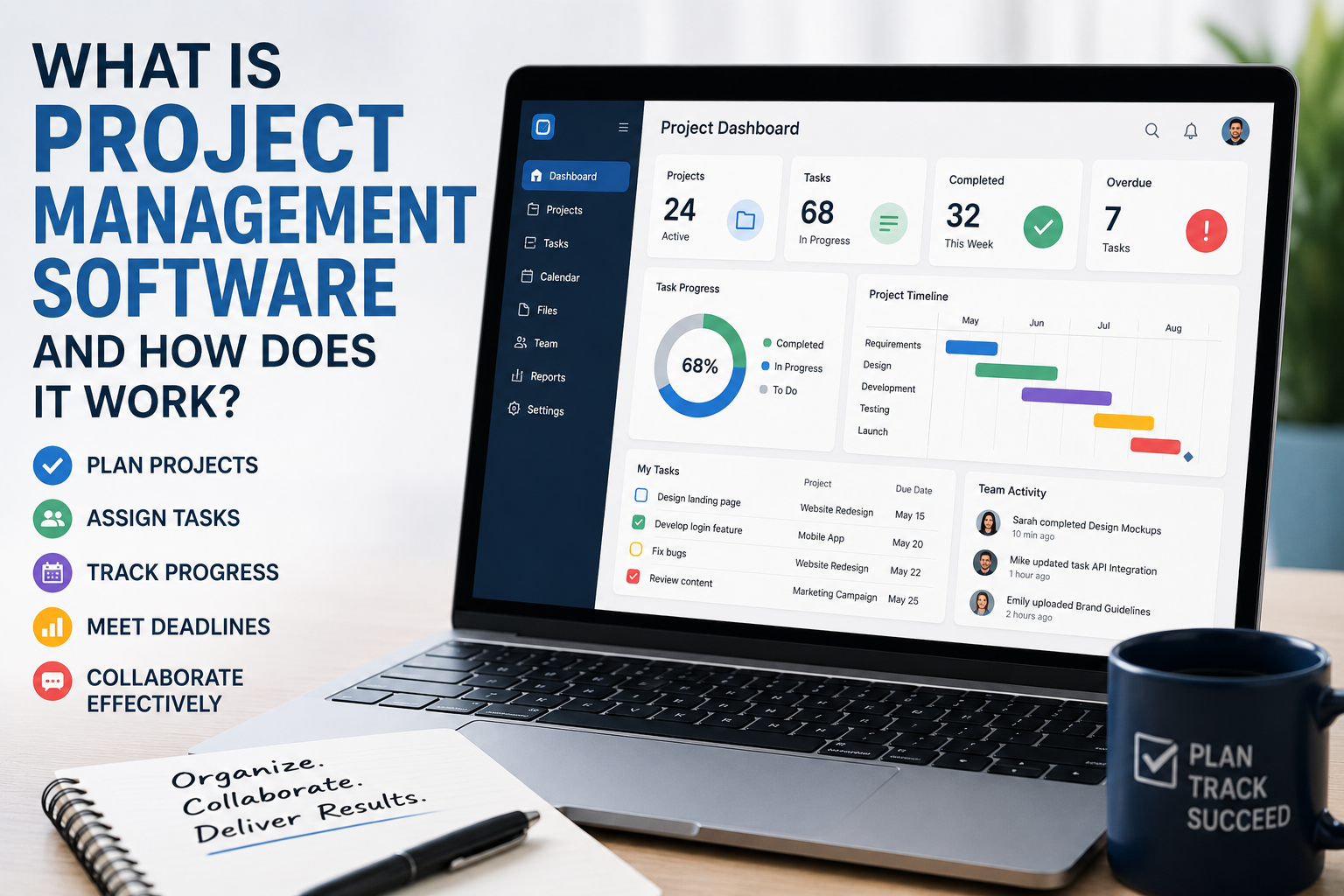
Project-management platforms can help teams manage:
- Tasks
- Deadlines
- Responsibilities
- Priorities
- Milestones
- Dependencies
- Documents
- Project communication
These systems give employees greater visibility into what needs to happen and help managers identify delays or bottlenecks.
Collaboration software can complement project-management systems by giving teams shared spaces for communication, document editing, and day-to-day teamwork. Businesses can learn more about these platforms in our complete guide to collaboration software.
Human Resources Technology
Technology has also transformed how organizations manage their workforce.
HR systems can support:
- Employee records
- Recruitment
- Payroll
- Benefits administration
- Time tracking
- Workforce planning
- Training
- Performance management
Centralized HR technology can reduce administrative work and make employee information easier to manage.
Because employee information can be highly sensitive, organizations need to pay particular attention to privacy, access controls, data protection, and appropriate permissions.
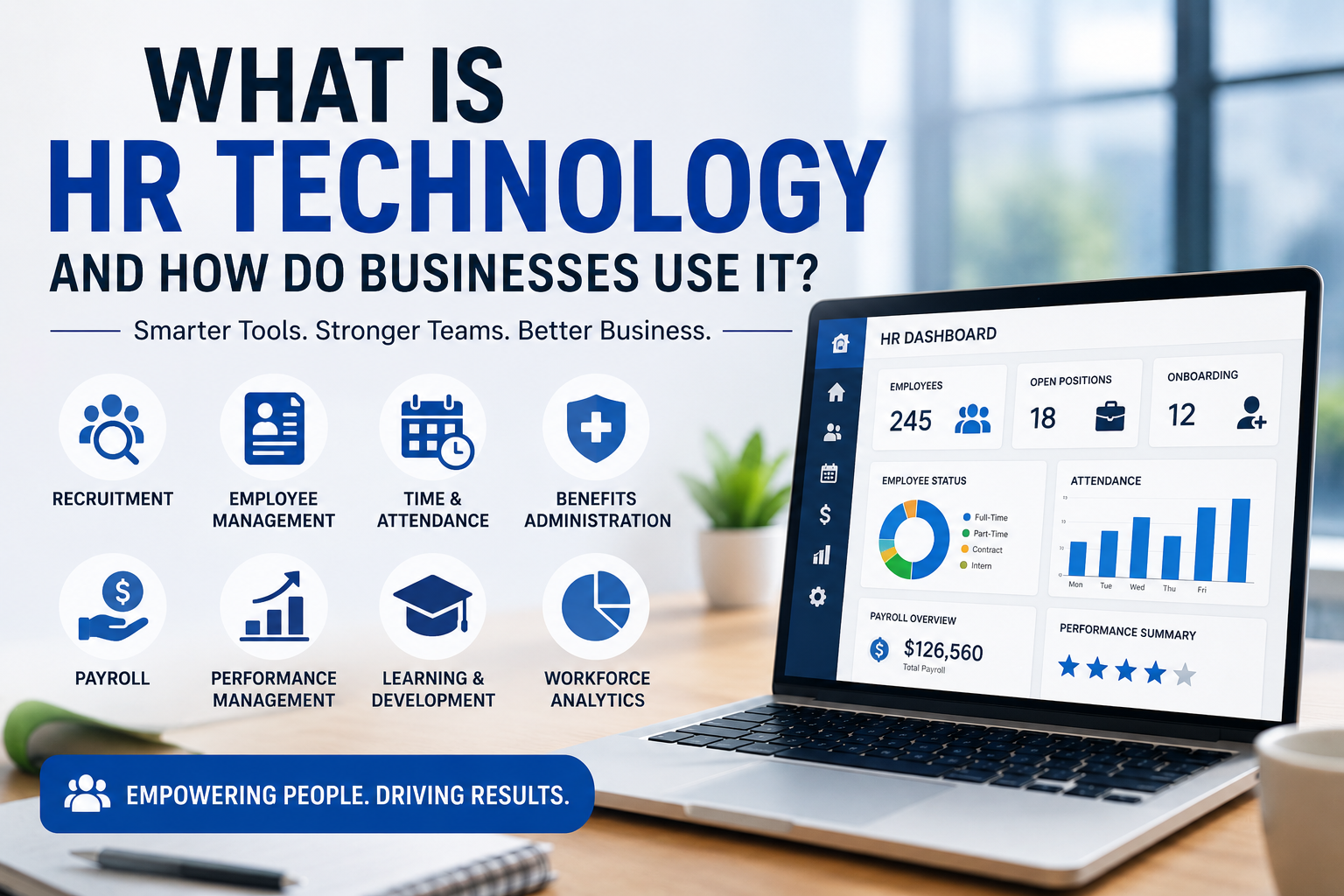
For a more detailed examination of this area, see what HR technology is and how businesses use it.
Internet of Things (IoT)
The Internet of Things connects physical devices to digital networks, allowing businesses to collect and exchange information.
Examples include:
- Smart manufacturing equipment
- Connected vehicles
- Warehouse sensors
- Energy management systems
- Asset tracking devices
- Industrial monitoring systems
IoT can provide organizations with real-time information about physical operations.
A manufacturer, for example, might use connected equipment to monitor machine performance and identify maintenance issues. A logistics company could use connected tracking devices to monitor the movement of assets.
The result can be greater visibility into physical processes that were previously difficult to monitor continuously.
Digital Marketing Technology
Modern businesses rely heavily on technology to reach and understand customers online.
Key tools include:
- Search engine optimization
- Email marketing platforms
- Social media management
- Marketing automation
- Customer analytics
- Online advertising platforms
- Content management systems
These technologies can help organizations attract prospects, nurture relationships, measure campaigns, and understand customer behavior.
Digital marketing also generates valuable data that can feed into analytics and CRM systems, creating connections between marketing, sales, and customer service.
Business Data Management
Technology has made it easier for organizations to collect enormous quantities of information, but storing data is only one part of the challenge.
Businesses also need to determine:
- Where data is stored
- Who owns it
- Who can access it
- How it should be structured
- How long it should be retained
- How accuracy should be maintained
- How systems should exchange it
Poor data management can lead to duplicate records, inconsistent information, reporting errors, and inefficient workflows.
Strong data-management practices provide a foundation for analytics, artificial intelligence, business intelligence, and other technologies that depend on reliable information.
Business Intelligence and Decision-Making
Business intelligence tools help organizations transform business information into reports, dashboards, and insights.
Managers can use these systems to examine:
- Revenue
- Costs
- Sales performance
- Customer behavior
- Inventory
- Operational efficiency
- Profitability
- Key performance indicators
The objective is not simply to collect more information. It is to make information useful for decision-making.
For organizations looking specifically at how business intelligence supports better decisions, see how business intelligence helps businesses make better data-driven decisions.
Benefits of Business Technology
Businesses adopting digital innovation can experience significant advantages.
Improved Productivity
Technology can reduce repetitive work, simplify access to information, and help employees complete processes more efficiently.
Better Decision-Making
Analytics and business intelligence provide managers with greater visibility into organizational performance.
Enhanced Customer Experience
Digital platforms can enable faster communication, personalized services, and convenient self-service options.
Lower Costs
Automation and cloud services can reduce some infrastructure and administrative costs when implemented effectively.
Greater Scalability
Technology can help organizations support increasing numbers of customers, employees, transactions, and business processes without relying entirely on proportional increases in manual work.
Improved Collaboration
Digital communication and collaboration tools allow employees to work together across departments, locations, and time zones.
Challenges of Digital Transformation
Implementing new technology is not without challenges.
Organizations may face:
- High implementation costs
- Employee resistance
- Cybersecurity risks
- Data privacy concerns
- Integration difficulties
- Skills shortages
- Legacy systems
- Regulatory requirements
- Poor data quality
- Technology overload
Digital transformation should therefore be treated as an organizational change rather than simply an IT project.
Businesses need leadership support, employee participation, realistic objectives, appropriate training, and a clear understanding of how technology will improve existing processes.
Our complete guide to digital transformation for businesses explores how organizations can approach this broader transition.
Technology Evaluation and Purchasing
Choosing business technology requires more than comparing feature lists.
Organizations should consider:
- Business objectives
- Existing workflows
- Number of users
- Integration requirements
- Security
- Data requirements
- Scalability
- Total cost of ownership
- Training requirements
- Vendor support
- Ease of use
A technology solution that looks impressive on paper may not be appropriate for the organization using it.
Businesses should begin by identifying the problem they are trying to solve and then evaluate technologies against that requirement.
The purchasing process itself can also involve multiple stakeholders. IT teams may focus on security and integration, finance may evaluate costs, managers may assess functionality, and employees may judge usability.
A structured approach is covered in how businesses evaluate and purchase technology solutions for organizational needs.
IT Infrastructure
Behind every business application is an underlying technology infrastructure.
This can include:
- Servers
- Networks
- Computers
- Cloud services
- Databases
- Storage
- Security systems
- Internet connectivity
- Backup systems
Infrastructure provides the foundation that allows business software and digital services to operate.
As organizations become more dependent on cloud applications and connected systems, infrastructure planning becomes increasingly important for reliability, security, scalability, and performance.
Businesses can learn more about this foundation through the complete guide to IT infrastructure for businesses.
IT Governance and Technology Decisions
Technology decisions can affect security, finances, compliance, employees, customers, and long-term business strategy.
IT governance helps organizations establish structures for making technology decisions and assigning accountability.
It can address questions such as:
- Who approves technology investments?
- Who is responsible for security?
- How are technology risks assessed?
- Which policies govern technology use?
- How are compliance requirements addressed?
- How are technology projects prioritized?
Without clear governance, organizations can accumulate disconnected applications, inconsistent policies, unnecessary risks, and overlapping technology investments.
Effective governance helps ensure technology decisions remain aligned with broader organizational objectives.
How Digital Innovation Changes Modern Companies
Digital innovation can affect nearly every part of an organization.
A company may use automation to change administrative workflows, cloud services to support distributed teams, analytics to improve decision-making, AI to assist employees, and integrated business systems to connect departments.
This means technology is increasingly influencing not only how companies work but also what products and services they can offer.
Digital innovation can create entirely new business models.
Companies can provide software through subscriptions, deliver services digitally, personalize customer experiences using data, and use connected devices to create ongoing relationships with customers.
The impact therefore extends beyond individual software applications.
Emerging Business Technologies
Several innovations are expected to continue influencing business.
These include:
- Generative AI
- Machine learning
- Blockchain
- Edge computing
- Quantum computing
- Augmented reality
- Virtual reality
- Autonomous systems
- Digital twins
- Sustainable technology
Not every emerging technology will become equally important to every organization.
Businesses should distinguish between technologies with genuine strategic value and technologies that are simply receiving temporary attention.
The most useful question is usually not “What is the newest technology?” but “Could this technology solve an important problem or create meaningful value for our organization?”
How Small Businesses Benefit
Digital tools are no longer limited to large enterprises.
Small businesses can use affordable technology to:
- Build websites
- Accept online payments
- Automate accounting
- Manage inventory
- Manage customer relationships
- Market products
- Provide customer support
- Analyze performance
- Collaborate with remote workers
Cloud-based services have made advanced business technology more accessible than ever.
A small company does not necessarily need the same technology stack as a multinational corporation. In many cases, a smaller collection of well-integrated tools can provide greater value than a complicated collection of enterprise systems.
Common Myths About Business Technology
| Myth | Reality |
|---|---|
| Business technology is only for large companies. | Small businesses can benefit significantly from digital tools. |
| AI replaces all employees. | AI can automate specific tasks while supporting human decision-making. |
| Digital transformation happens overnight. | It is an ongoing process requiring planning and continuous improvement. |
| More technology always means better results. | Success depends on selecting the right tools and implementing them effectively. |
| Cybersecurity is only an IT issue. | Employees across an organization play an important role in protecting business information. |
Frequently Asked Questions
What is business technology?
Business technology refers to the digital tools, software, hardware, systems, and processes organizations use to improve operations, productivity, communication, decision-making, and customer service.
Why is digital transformation important?
Digital transformation can help businesses improve efficiency, adapt to changing customer expectations, modernize outdated processes, and develop new ways of delivering products and services.
What are the most important business technologies today?
Cloud computing, artificial intelligence, automation, cybersecurity, data analytics, CRM systems, ERP software, collaboration platforms, and digital workplace technologies are among the most important areas of modern business technology.
How does AI help businesses?
AI can assist businesses with data analysis, automation, customer service, document processing, forecasting, content generation, and other tasks that involve processing large amounts of information.
What is cloud computing?
Cloud computing provides internet-based access to computing resources such as storage, applications, databases, and processing power.
Can small businesses benefit from digital technology?
Yes. Cloud software, automation platforms, analytics tools, communication systems, and other digital services allow small businesses to improve efficiency and access capabilities that previously required significant infrastructure investment.
Building a Smarter Technology Strategy
Business technology has become the foundation of modern organizations, but successful digital adoption is not about collecting as many tools as possible.
The most effective businesses start with their objectives and processes. They identify where employees lose time, where customers experience friction, where information becomes difficult to access, and where manual work creates unnecessary costs or errors.
Technology can then be introduced to address those specific problems.
Cloud computing can provide flexible infrastructure. Automation can reduce repetitive work. AI can assist knowledge workers. CRM systems can organize customer relationships. ERP platforms can connect core operations. Analytics can improve decision-making. Collaboration technology can bring distributed teams together.
The result is a technology environment that supports the organization rather than forcing employees to work around disconnected systems.
As digital innovation continues, the companies most likely to benefit will not necessarily be those that adopt every emerging technology first. They will be the organizations that understand their business needs, make deliberate technology decisions, manage risk, and continuously improve the relationship between people, processes, and technology.
Business technology is therefore best understood not as a collection of individual applications, but as an interconnected foundation for how modern organizations operate, compete, communicate, and create value.